QUESTION IMAGE
Question
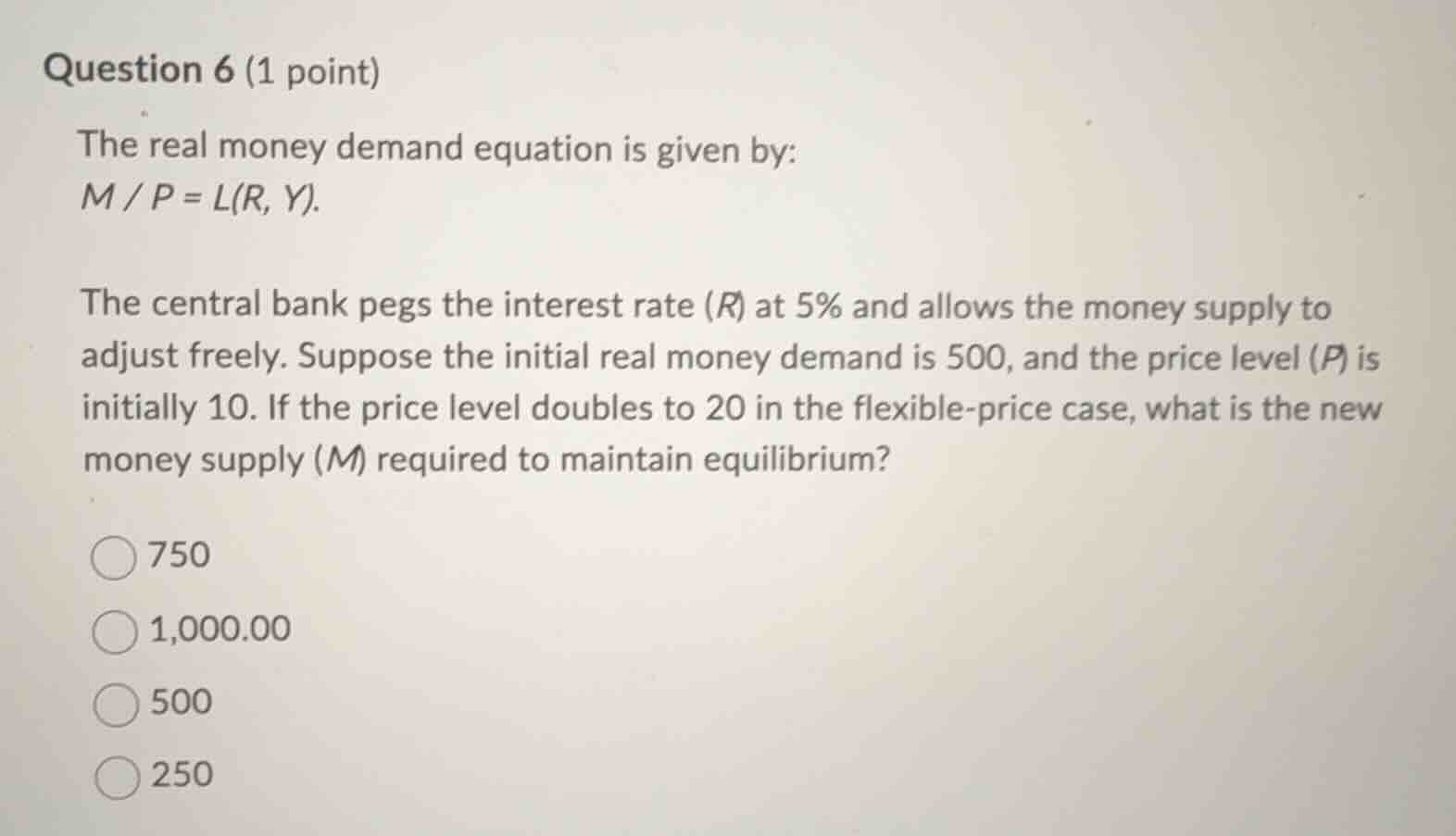
question 6 (1 point)
the real money demand equation is given by:
$m / p = l(r, y)$.
the central bank pegs the interest rate ($r$) at 5% and allows the money supply to adjust freely. suppose the initial real money demand is 500, and the price level ($p$) is initially 10. if the price level doubles to 20 in the flexible - price case, what is the new money supply ($m$) required to maintain equilibrium?
750
1,000.00
500
250
Step1: Recall the real money demand equation
The real money demand equation is \( \frac{M}{P}=L(R, Y) \). In equilibrium, money supply equals money demand, so \( \frac{M}{P}= \text{Real Money Demand} \).
Step2: Analyze the effect of interest rate pegging
Since the central bank pegs the interest rate \( R \) and we assume \( Y \) (output) doesn't change (or the real money demand function \( L(R, Y) \) remains the same in terms of real demand), the real money demand \( L(R, Y) \) remains 500 (because \( R \) is pegged and if \( Y \) is constant, real money demand doesn't change).
Step3: Calculate the new money supply
We know that \( \frac{M}{P}=\text{Real Money Demand} \). Now, the new price level \( P = 20 \) and real money demand is still 500. Rearranging the formula for \( M \), we get \( M=\text{Real Money Demand} \times P \).
Substitute the values: \( \text{Real Money Demand} = 500 \), \( P = 20 \). So \( M = 500\times20=1000 \).

Snap & solve any problem in the app
Get step-by-step solutions on Sovi AI
Photo-based solutions with guided steps
Explore more problems and detailed explanations
1,000.00