QUESTION IMAGE
Question
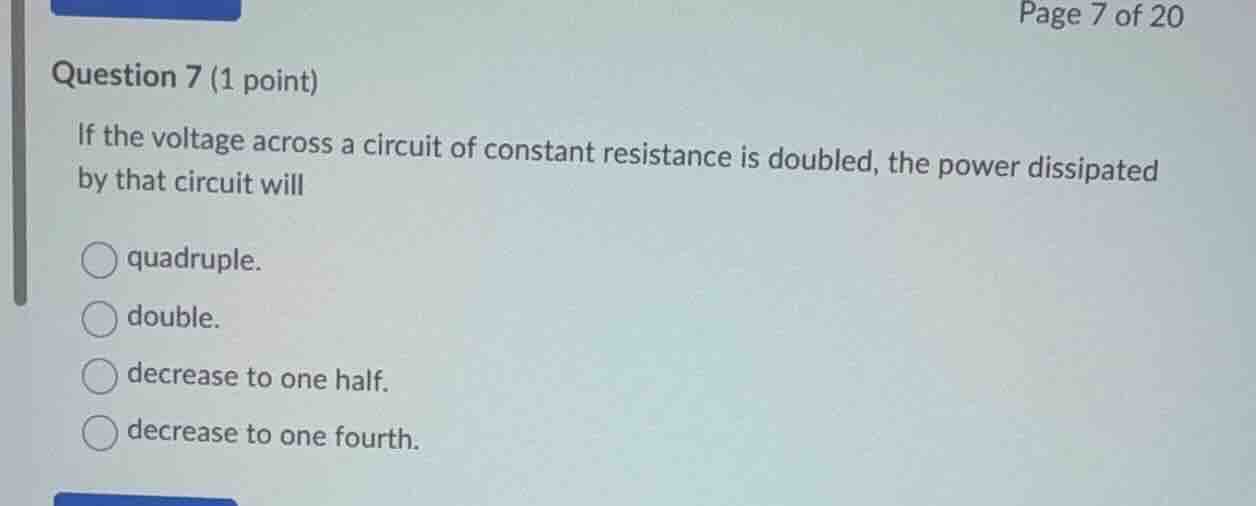
question 7 (1 point) if the voltage across a circuit of constant resistance is doubled, the power dissipated by that circuit will quadruple. double. decrease to one half. decrease to one fourth.
Step1: Recall the power formula for a circuit
The power \( P \) dissipated in a circuit with resistance \( R \) and voltage \( V \) is given by \( P=\frac{V^{2}}{R} \) (since \( P = VI \) and \( I=\frac{V}{R} \), substituting \( I \) into \( P = VI \) gives \( P=\frac{V^{2}}{R} \)).
Step2: Analyze the change in voltage
Let the initial voltage be \( V_1 = V \) and the new voltage be \( V_2=2V \) (since the voltage is doubled). The resistance \( R \) is constant.
Step3: Calculate the initial and new power
The initial power \( P_1=\frac{V_1^{2}}{R}=\frac{V^{2}}{R} \).
The new power \( P_2=\frac{V_2^{2}}{R}=\frac{(2V)^{2}}{R}=\frac{4V^{2}}{R} \).
Step4: Find the ratio of new power to initial power
To find how many times the power has changed, we take the ratio \( \frac{P_2}{P_1}=\frac{\frac{4V^{2}}{R}}{\frac{V^{2}}{R}} = 4 \). So the power quadruples.

Snap & solve any problem in the app
Get step-by-step solutions on Sovi AI
Photo-based solutions with guided steps
Explore more problems and detailed explanations
quadruple.