QUESTION IMAGE
Question
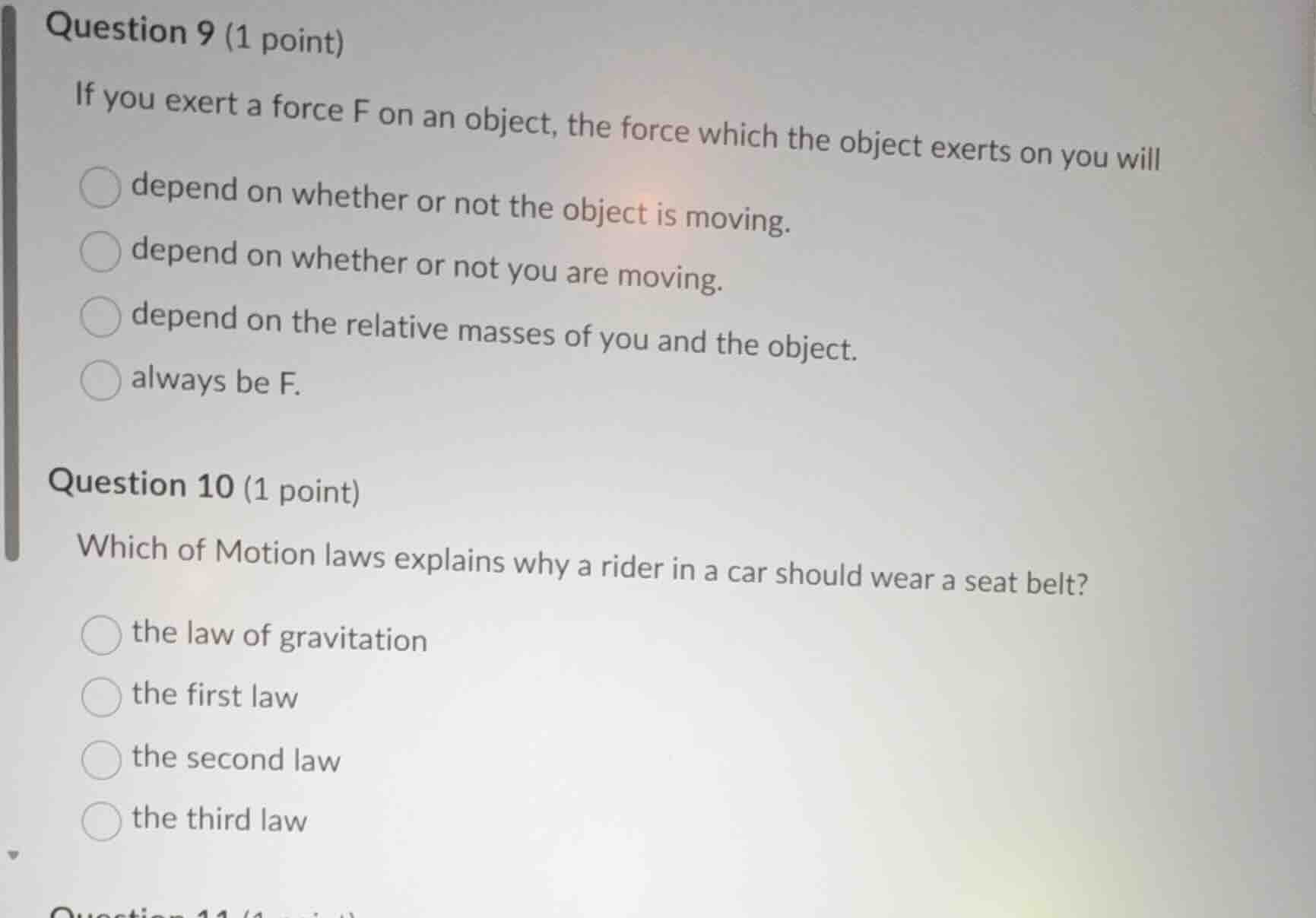
question 9 (1 point)
if you exert a force f on an object, the force which the object exerts on you will
depend on whether or not the object is moving.
depend on whether or not you are moving.
depend on the relative masses of you and the object.
always be f.
question 10 (1 point)
which of motion laws explains why a rider in a car should wear a seat belt?
the law of gravitation
the first law
the second law
the third law
Question 9
According to Newton's third law of motion, when one object exerts a force on a second object, the second object exerts an equal and opposite force on the first object. This reaction force (the force the object exerts on you) is equal in magnitude to the force \( F \) you exert on it, regardless of the motion of the object, your motion, or the relative masses (as long as the interaction is a force - pair in the context of Newton's third law). So the force the object exerts on you will always be \( F \).
Newton's first law of motion (the law of inertia) states that an object at rest will remain at rest, and an object in motion will continue in motion with a constant velocity (in a straight line) unless acted upon by a net external force. A rider in a car is moving with the car. If the car suddenly stops (due to a collision or braking), the rider's body tends to continue moving forward with the original velocity of the car (because of inertia). A seat belt exerts a force on the rider to stop this forward motion and prevent injury. The law of gravitation is about the attractive force between masses, the second law is about \( F = ma \) (force, mass, and acceleration relationship), and the third law is about action - reaction pairs, so the first law explains the need for a seat belt.

Snap & solve any problem in the app
Get step-by-step solutions on Sovi AI
Photo-based solutions with guided steps
Explore more problems and detailed explanations
always be F. (The option: always be F.)