QUESTION IMAGE
Question
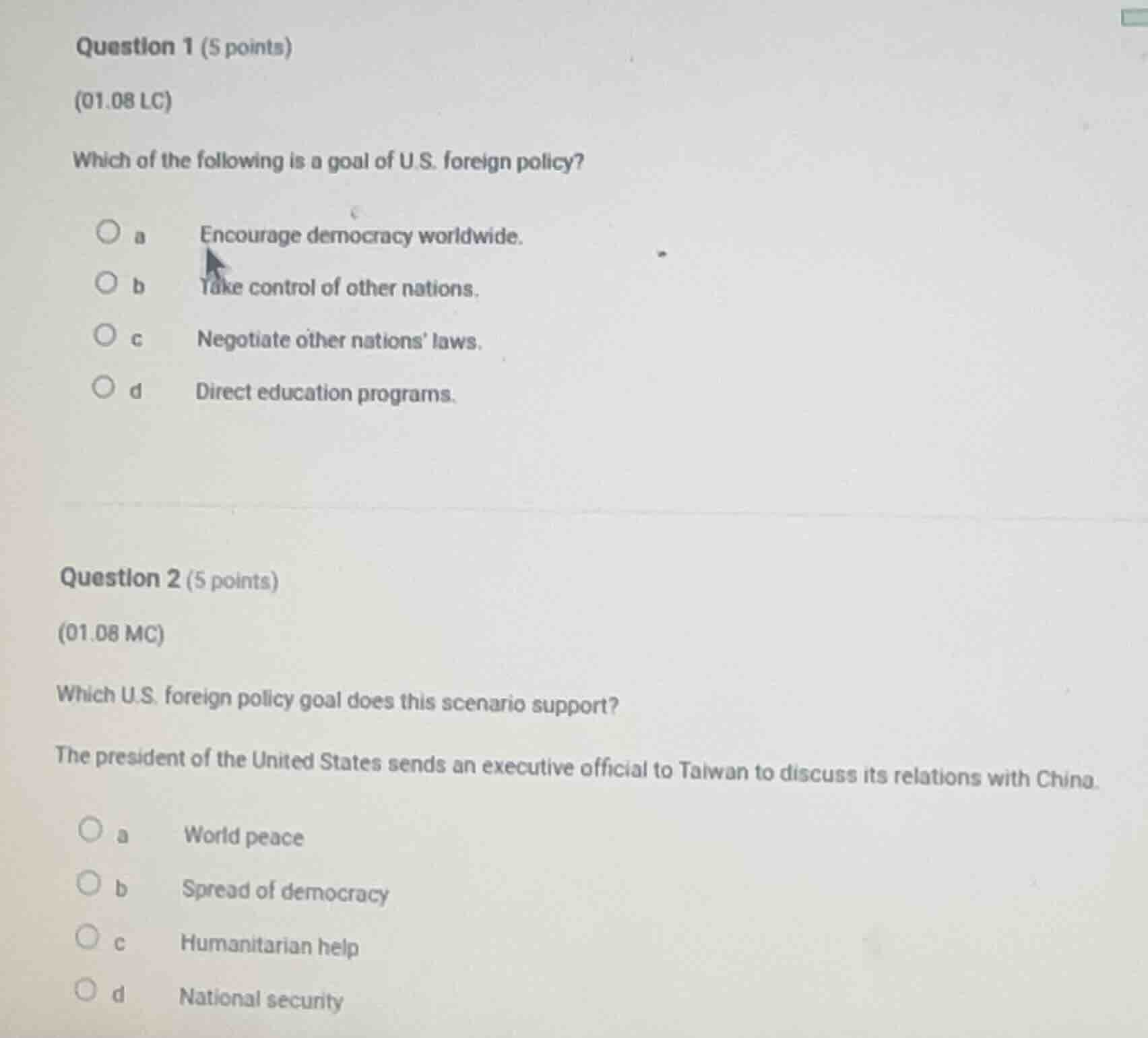
question 1 (5 points)
(01.08 lc)
which of the following is a goal of u.s. foreign policy?
a encourage democracy worldwide.
b take control of other nations.
c negotiate other nations’ laws.
d direct education programs.
question 2 (5 points)
(01.08 mc)
which u.s. foreign policy goal does this scenario support?
the president of the united states sends an executive official to taiwan to discuss its relations with china.
a world peace
b spread of democracy
c humanitarian help
d national security
Response
Question 1
Brief Explanations
- Option a: Encouraging democracy worldwide is a known goal of U.S. foreign policy, aiming to promote democratic governance globally.
- Option b: The U.S. does not seek to take control of other nations, as it respects national sovereignty (in principle for foreign policy rhetoric).
- Option c: The U.S. does not negotiate other nations’ laws, as each nation has sovereign authority over its legal system.
- Option d: Directing education programs in other nations is not a primary foreign policy goal; education is more of a domestic or soft - power - related initiative, not a core foreign policy goal.
Brief Explanations
- Option a: Sending an official to discuss Taiwan - China relations can be seen as an effort to maintain stability and peace in the region, as tensions between Taiwan and China could impact global peace.
- Option b: The scenario does not involve promoting democracy; it is about diplomatic discussions on regional relations.
- Option c: There is no humanitarian aid involved in this diplomatic meeting scenario.
- Option d: While national security can be related, the act of discussing Taiwan - China relations to prevent conflict is more directly related to world peace. The U.S. often frames such diplomatic efforts as contributing to regional and world peace.

Snap & solve any problem in the app
Get step-by-step solutions on Sovi AI
Photo-based solutions with guided steps
Explore more problems and detailed explanations
a. Encourage democracy worldwide.