QUESTION IMAGE
Question
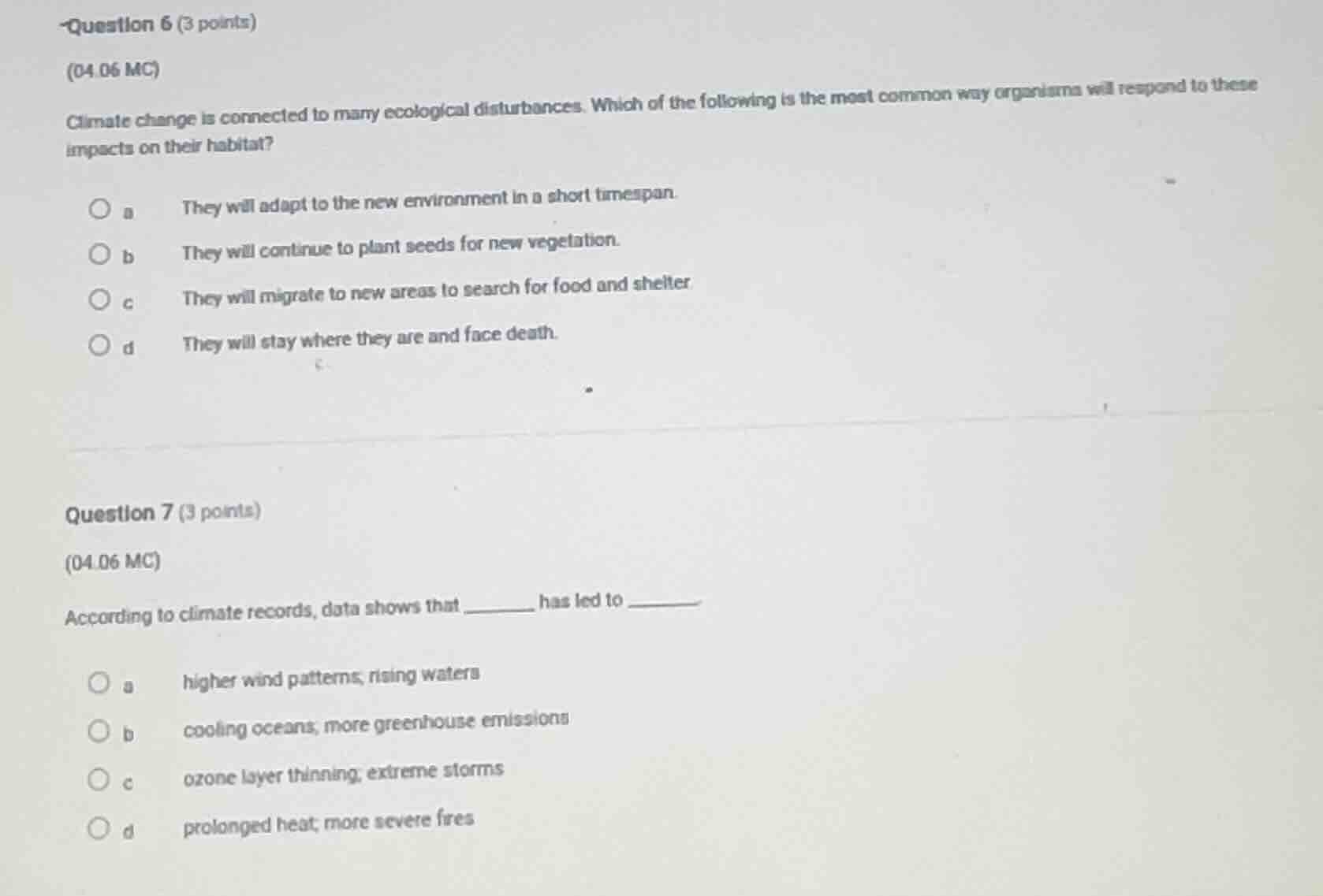
question 6 (3 points)
(04.06 mc)
climate change is connected to many ecological disturbances. which of the following is the most common way organisms will respond to these impacts on their habitat?
a they will adapt to the new environment in a short timespan.
b they will continue to plant seeds for new vegetation.
c they will migrate to new areas to search for food and shelter.
d they will stay where they are and face death.
question 7 (3 points)
(04.06 mc)
according to climate records, data shows that ____ has led to ____
a higher wind patterns; rising waters
b cooling oceans; more greenhouse emissions
c ozone layer thinning; extreme storms
d prolonged heat; more severe fires
Question 6
- Option a: Evolutionary adaptation takes time, not short-term, so a is incorrect.
- Option b: Most organisms don't "plant seeds" (this is more plant - specific and not a general organism response), so b is incorrect.
- Option c: When habitats are disturbed by climate change, organisms often migrate to find suitable food and shelter, which is a common response.
- Option d: While some may die, it's not the most common response as most will try to move to suitable areas.
- Option a: Higher wind patterns don't directly cause rising waters as a primary climate - related causal link in the typical sense, so a is incorrect.
- Option b: Greenhouse emissions cause ocean warming, not cooling, so the causal relationship in b is reversed, incorrect.
- Option c: Ozone layer thinning is mainly due to CFCs and is not the main cause of extreme storms. Extreme storms are more related to climate change from greenhouse gases, so c is incorrect.
- Option d: Prolonged heat (due to climate change) dries out vegetation, leading to more severe fires, which is a correct causal relationship.

Snap & solve any problem in the app
Get step-by-step solutions on Sovi AI
Photo-based solutions with guided steps
Explore more problems and detailed explanations
c. They will migrate to new areas to search for food and shelter.