QUESTION IMAGE
Question
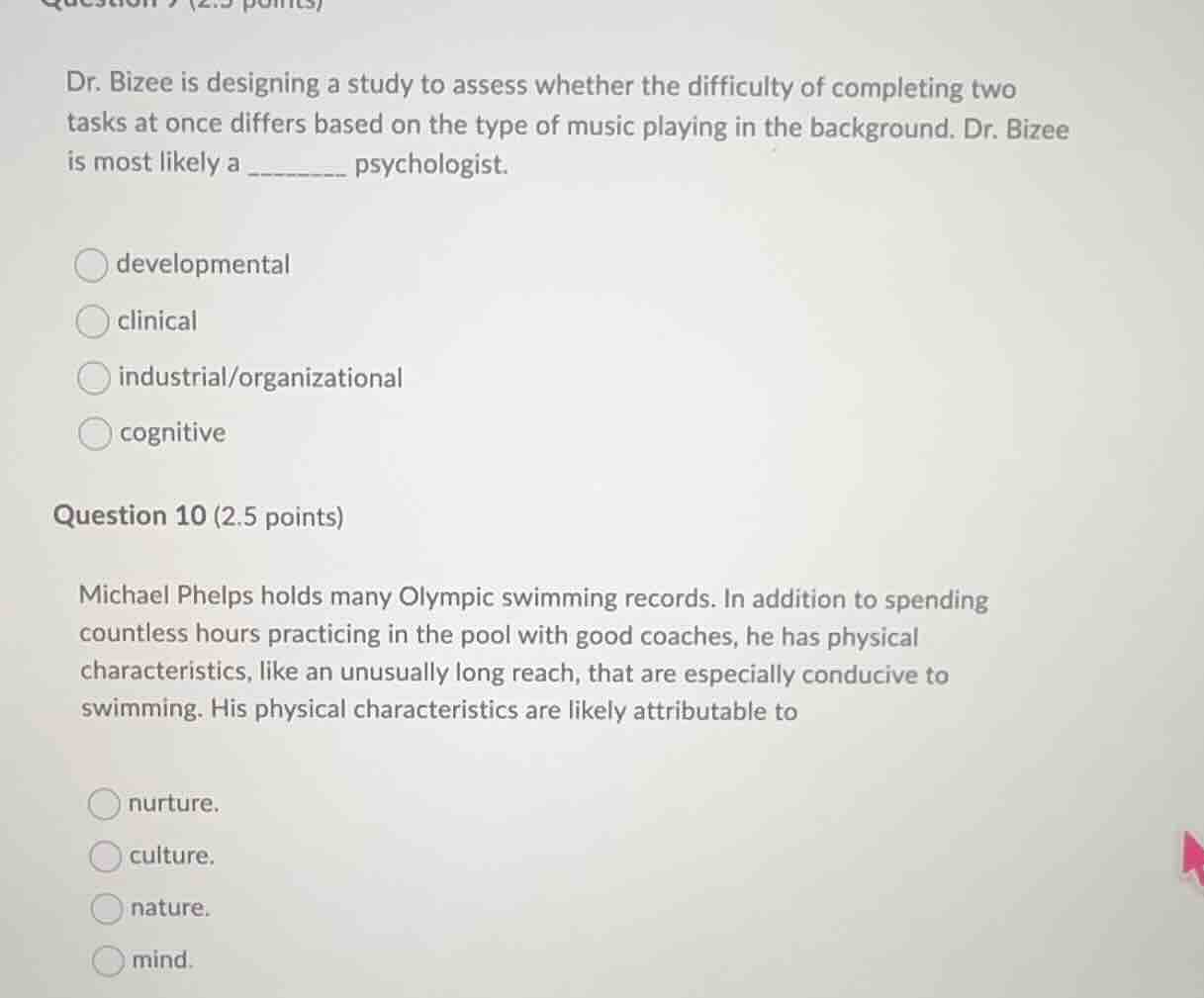
question 9 (2.5 points)
dr. bizee is designing a study to assess whether the difficulty of completing two tasks at once differs based on the type of music playing in the background. dr. bizee is most likely a ______ psychologist.
developmental
clinical
industrial/organizational
cognitive
question 10 (2.5 points)
michael phelps holds many olympic swimming records. in addition to spending countless hours practicing in the pool with good coaches, he has physical characteristics, like an unusually long reach, that are especially conducive to swimming. his physical characteristics are likely attributable to
nurture.
culture.
nature.
mind.
Question 9
To determine the type of psychologist, we analyze each option:
- Developmental psychologists study human development across the lifespan, which is not related to task difficulty and music.
- Clinical psychologists focus on mental health disorders and therapy, not this type of cognitive task study.
- Industrial/organizational psychologists study workplace behavior, not task difficulty with music.
- Cognitive psychologists study mental processes like attention, perception, and multitasking (task difficulty here relates to cognitive processes, and the study involves how music affects task completion, which is a cognitive domain).
We analyze the "nature vs. nurture" concept:
- Nurture refers to environmental factors (like practice, coaching), but the question is about physical characteristics (unusually long reach) which are innate.
- Culture relates to social norms and values, not physical traits.
- Nature refers to genetic/biological factors, and physical characteristics like long reach are likely due to genetic inheritance (innate, biological), so nature.
- "Mind" is not a term used in the nature - nurture debate for physical traits.

Snap & solve any problem in the app
Get step-by-step solutions on Sovi AI
Photo-based solutions with guided steps
Explore more problems and detailed explanations
D. cognitive