QUESTION IMAGE
Question
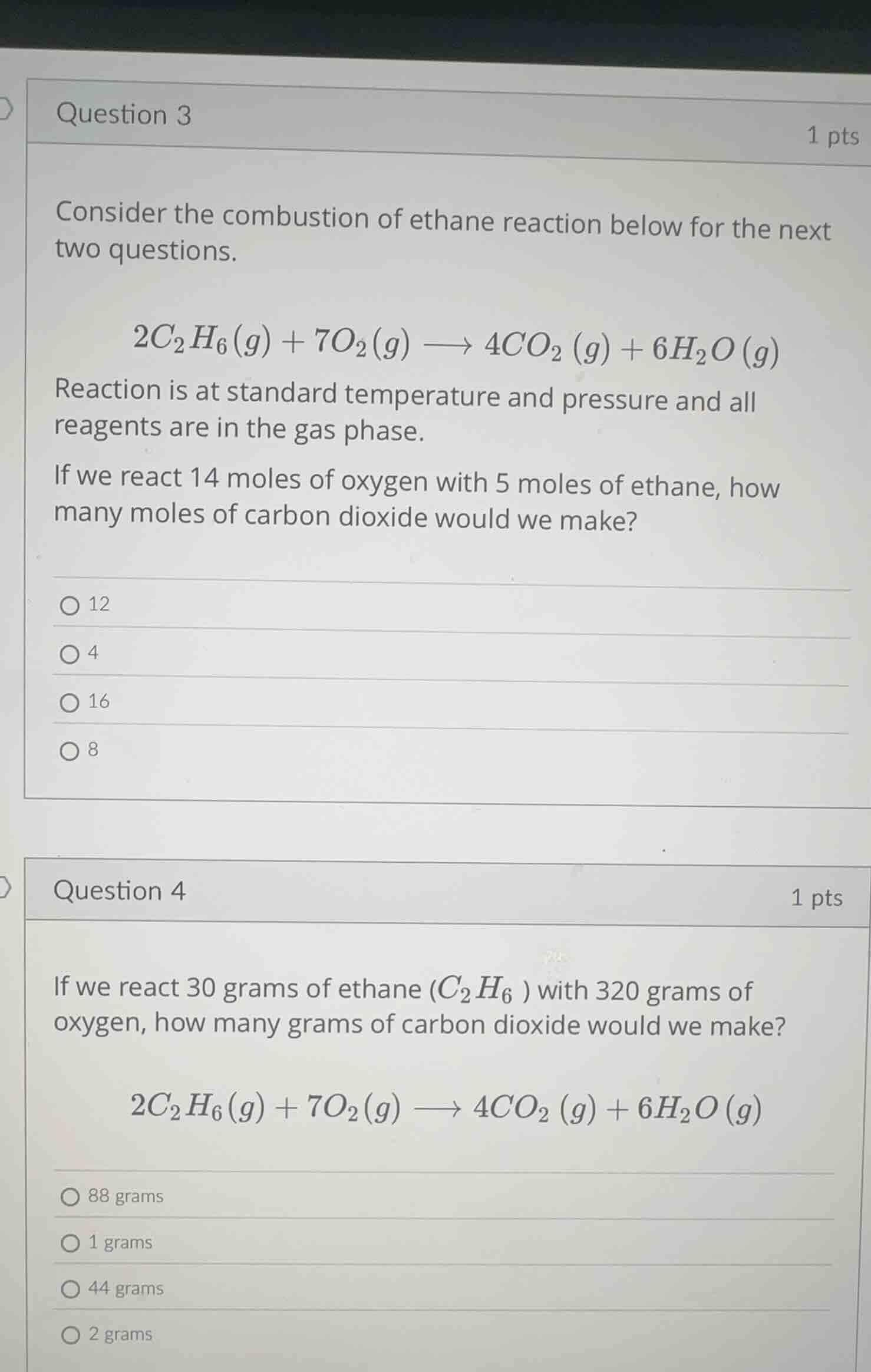
question 3
1 pts
consider the combustion of ethane reaction below for the next two questions.
$2c_2h_6(g) + 7o_2(g) \longrightarrow 4co_2 (g) + 6h_2o (g)$
reaction is at standard temperature and pressure and all reagents are in the gas phase.
if we react 14 moles of oxygen with 5 moles of ethane, how many moles of carbon dioxide would we make?
12
4
16
8
question 4
1 pts
if we react 30 grams of ethane ($c_2h_6$) with 320 grams of oxygen, how many grams of carbon dioxide would we make?
$2c_2h_6(g) + 7o_2(g) \longrightarrow 4co_2 (g) + 6h_2o (g)$
88 grams
1 grams
44 grams
2 grams
Question 3
Step1: Determine limiting reactant
From the reaction \(2C_2H_6 + 7O_2
ightarrow 4CO_2 + 6H_2O\), the mole ratio of \(C_2H_6\) to \(O_2\) is \(2:7\).
For 5 moles of \(C_2H_6\), moles of \(O_2\) required: \(\frac{7}{2} \times 5 = 17.5\) mol. But we have 14 mol \(O_2\) (less than 17.5), so \(O_2\) is limiting.
Step2: Calculate \(CO_2\) from \(O_2\)
Mole ratio of \(O_2\) to \(CO_2\) is \(7:4\).
Moles of \(CO_2\) = \(\frac{4}{7} \times 14 = 8\) mol? Wait, no—wait, 14 mol \(O_2\): \(\frac{4}{7} \times 14 = 8\)? Wait, no, wait the options have 8? Wait, no, let's recheck. Wait, 2 moles \(C_2H_6\) react with 7 moles \(O_2\) to make 4 moles \(CO_2\). So for 14 moles \(O_2\): \(\frac{4}{7} \times 14 = 8\)? Wait, but the options have 8? Wait, no, maybe I messed up. Wait, 7 moles \(O_2\) produce 4 moles \(CO_2\), so 14 moles \(O_2\) (which is 2 times 7) would produce \(4 \times 2 = 8\)? Wait, but the options include 8. Wait, but let's check the \(C_2H_6\) side. 5 moles \(C_2H_6\) would need \(7/2 \times 5 = 17.5\) moles \(O_2\), but we have 14, so \(O_2\) is limiting. So \(CO_2\) from \(O_2\): \(14 \times (4/7) = 8\). Wait, but the options have 8? Wait, the options are 12,4,16,8. So 8? Wait, maybe I made a mistake. Wait, no, 7 moles \(O_2\) give 4 moles \(CO_2\), so 14 moles \(O_2\) (72) give 42=8 moles \(CO_2\). Yes.
Step1: Calculate moles of reactants
Molar mass of \(C_2H_6\): \(2(12) + 6(1) = 30\) g/mol. Moles of \(C_2H_6\): \(\frac{30}{30} = 1\) mol.
Molar mass of \(O_2\): 32 g/mol. Moles of \(O_2\): \(\frac{320}{32} = 10\) mol.
Step2: Determine limiting reactant
Mole ratio \(C_2H_6:O_2 = 2:7\). For 1 mol \(C_2H_6\), moles \(O_2\) needed: \(\frac{7}{2} \times 1 = 3.5\) mol. We have 10 mol \(O_2\) (excess), so \(C_2H_6\) is limiting.
Step3: Calculate \(CO_2\) from \(C_2H_6\)
Mole ratio \(C_2H_6:CO_2 = 2:4 = 1:2\). So 1 mol \(C_2H_6\) produces \(2\) mol \(CO_2\).
Molar mass of \(CO_2\): \(12 + 32 = 44\) g/mol. Mass of \(CO_2\): \(2 \times 44 = 88\) g.

Snap & solve any problem in the app
Get step-by-step solutions on Sovi AI
Photo-based solutions with guided steps
Explore more problems and detailed explanations
8 (the option with 8)