QUESTION IMAGE
Question
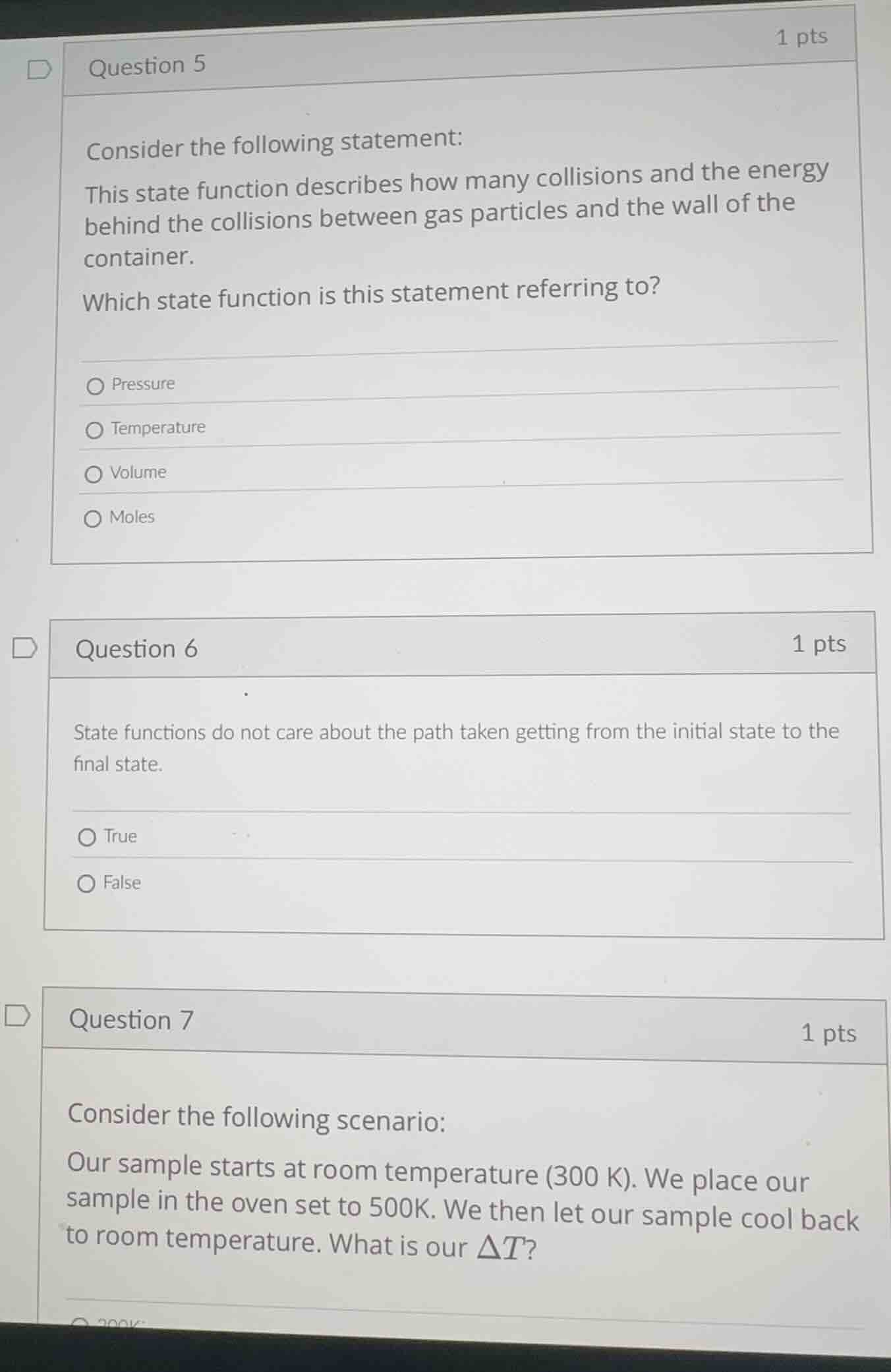
question 5
1 pts
consider the following statement:
this state function describes how many collisions and the energy behind the collisions between gas particles and the wall of the container.
which state function is this statement referring to?
pressure
temperature
volume
moles
question 6
1 pts
state functions do not care about the path taken getting from the initial state to the final state.
true
false
question 7
1 pts
consider the following scenario:
our sample starts at room temperature (300 k). we place our sample in the oven set to 500k. we then let our sample cool back to room temperature. what is our δt?
Question 5
Pressure in gases is defined by the collisions of gas particles with the container walls, including the frequency (number) of collisions and the energy of those collisions. Temperature relates to average kinetic energy of particles, volume is the space occupied, and moles are the amount of substance—none match the description as pressure does.
By definition, state functions depend only on the initial and final states, not the path taken to reach the final state (e.g., internal energy, enthalpy, pressure, temperature, volume are state functions; work and heat are not as they depend on path). So the statement is true.
Step1: Recall the formula for temperature change
The formula for temperature change is $\Delta T = T_{final} - T_{initial}$.
Step2: Identify initial and final temperatures
The initial temperature $T_{initial}$ is 300 K. After heating and cooling, the final temperature $T_{final}$ is also 300 K (back to room temperature).
Step3: Calculate $\Delta T$
Substitute into the formula: $\Delta T = 300\ \text{K} - 300\ \text{K} = 0\ \text{K}$.

Snap & solve any problem in the app
Get step-by-step solutions on Sovi AI
Photo-based solutions with guided steps
Explore more problems and detailed explanations
A. Pressure