QUESTION IMAGE
Question
question 4
1 pts
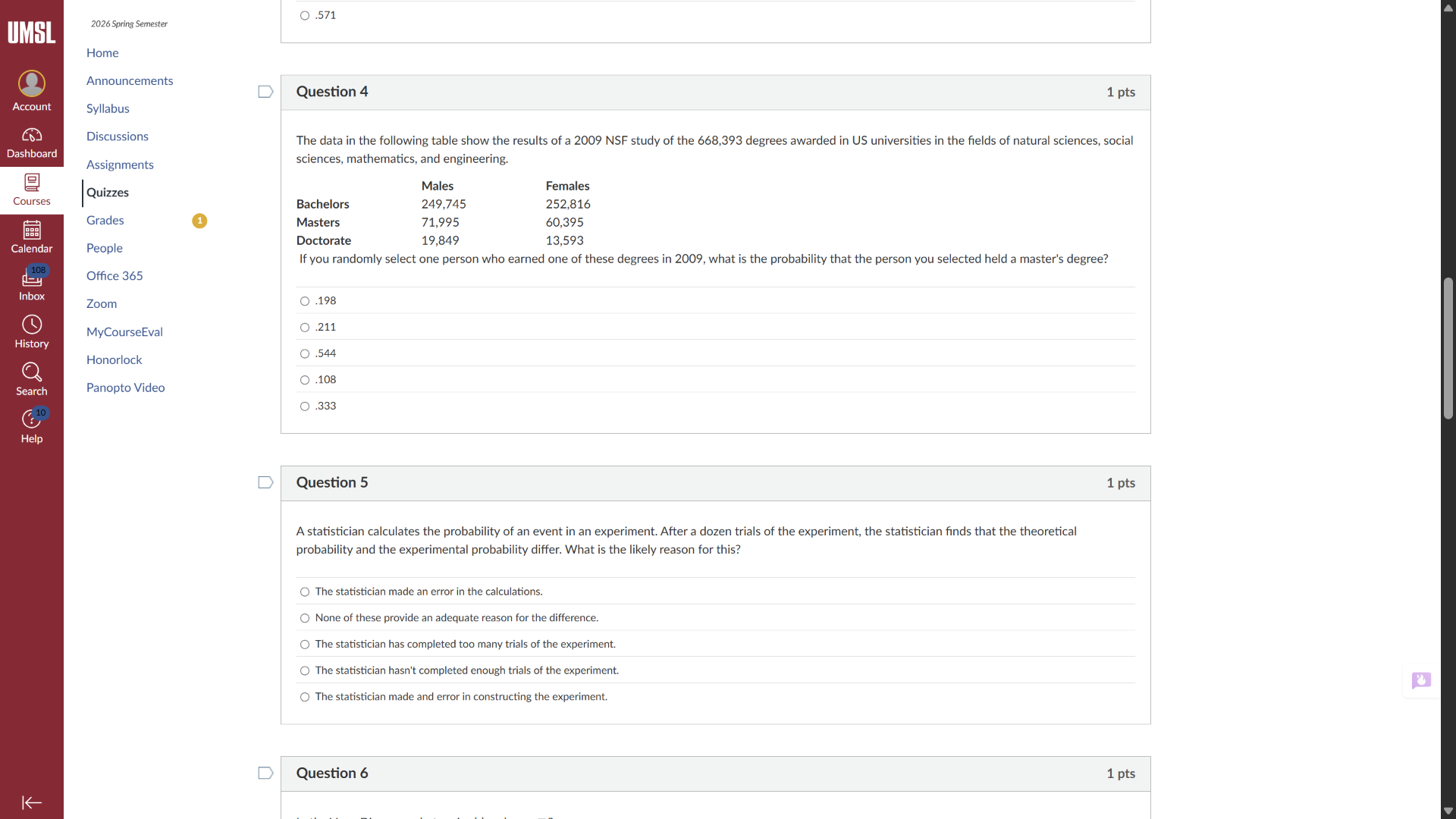
the data in the following table show the results of a 2009 nsf study of the 668,393 degrees awarded in us universities in the fields of natural sciences, social sciences, mathematics, and engineering.
males\tfemales
bachelors\t249,745\t252,816
masters\t71,995\t60,395
doctorate\t19,849\t13,593
if you randomly select one person who earned one of these degrees in 2009, what is the probability that the person you selected held a masters degree?
.198
.211
.544
.108
.333
question 5
1 pts
a statistician calculates the probability of an event in an experiment. after a dozen trials of the experiment, the statistician finds that the theoretical probability and the experimental probability differ. what is the likely reason for this?
the statistician made an error in the calculations.
none of these provide an adequate reason for the difference.
the statistician has completed too many trials of the experiment.
the statistician hasnt completed enough trials of the experiment.
the statistician made and error in constructing the experiment.
question 6
1 pts
Question 4
Step1: Calculate total number of master's degrees
First, we find the total number of master's degrees by adding the number of male and female master's degree holders. The number of male master's degree holders is 71,995 and female is 60,395. So total master's degrees = 71995 + 60395 = 132390.
Step2: Calculate total number of degrees
The total number of degrees awarded is 668,393 (given in the problem).
Step3: Calculate the probability
Probability is the number of favorable outcomes (master's degrees) divided by the total number of outcomes (total degrees). So probability = $\frac{132390}{668393} \approx 0.198$.
Theoretical probability is based on the expected likelihood, while experimental probability is based on actual trials. For experimental probability to approach theoretical probability, a large number of trials (Law of Large Numbers) is needed. A dozen (12) trials is a small number, so the experimental probability may differ because not enough trials were done. The other options are incorrect: a dozen trials is not too many, and the difference isn't due to calculation or experiment construction errors as the main reason here is insufficient trials.

Snap & solve any problem in the app
Get step-by-step solutions on Sovi AI
Photo-based solutions with guided steps
Explore more problems and detailed explanations
\(0.198\) (corresponding to the option with.198)