QUESTION IMAGE
Question
question 3
1 pts
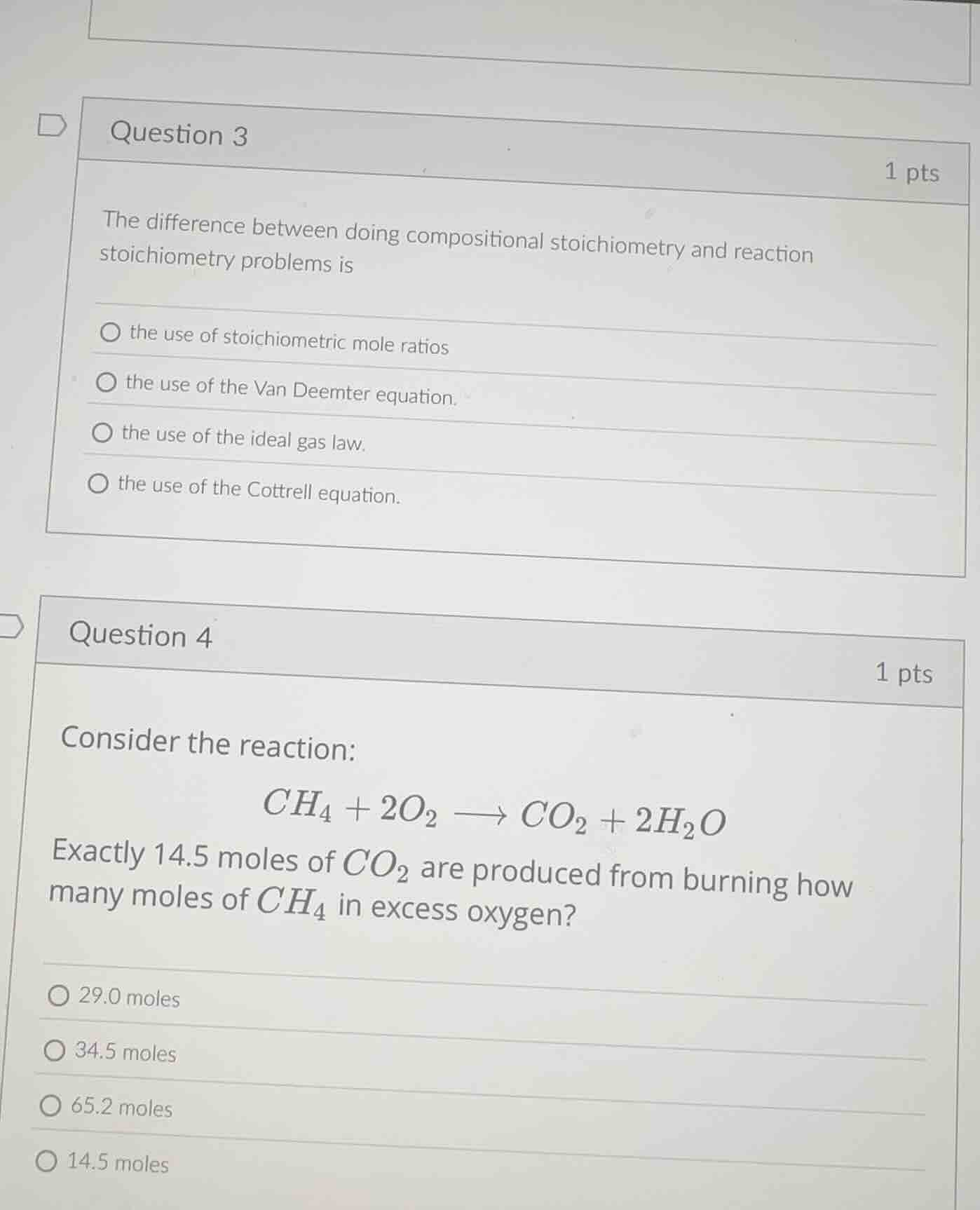
the difference between doing compositional stoichiometry and reaction stoichiometry problems is
the use of stoichiometric mole ratios
the use of the van deemter equation.
the use of the ideal gas law.
the use of the cottrell equation.
question 4
1 pts
consider the reaction:
$ch_4 + 2o_2 \
ightarrow co_2 + 2h_2o$
exactly 14.5 moles of $co_2$ are produced from burning how many moles of $ch_4$ in excess oxygen?
29.0 moles
34.5 moles
65.2 moles
14.5 moles
Question 3
- Compositional stoichiometry deals with the composition of substances (e.g., mass percent, empirical formulas), while reaction stoichiometry involves relationships between reactants and products in a chemical reaction, which uses stoichiometric mole ratios from the balanced equation.
- The Van Deemter equation is related to chromatography, the ideal gas law to gas behavior, and the Cottrell equation to electrochemistry—none relate to the difference between these two stoichiometry types. So the correct option is about stoichiometric mole ratios.
Step1: Identify mole ratio
From the balanced reaction $\ce{CH4 + 2O2 -> CO2 + 2H2O}$, the mole ratio of $\ce{CH4}$ to $\ce{CO2}$ is $1:1$.
Step2: Calculate moles of $\ce{CH4}$
Let $n_{\ce{CH4}}$ be moles of $\ce{CH4}$ and $n_{\ce{CO2}} = 14.5$ mol.
Using the ratio $\frac{n_{\ce{CH4}}}{n_{\ce{CO2}}} = \frac{1}{1}$, so $n_{\ce{CH4}} = n_{\ce{CO2}} = 14.5$ mol.

Snap & solve any problem in the app
Get step-by-step solutions on Sovi AI
Photo-based solutions with guided steps
Explore more problems and detailed explanations
A. the use of stoichiometric mole ratios (Note: Assuming the first option is A, as per the order. If options had labels, use the correct label. Here, the first option is the correct one.)