QUESTION IMAGE
Question
question 9
1 pts
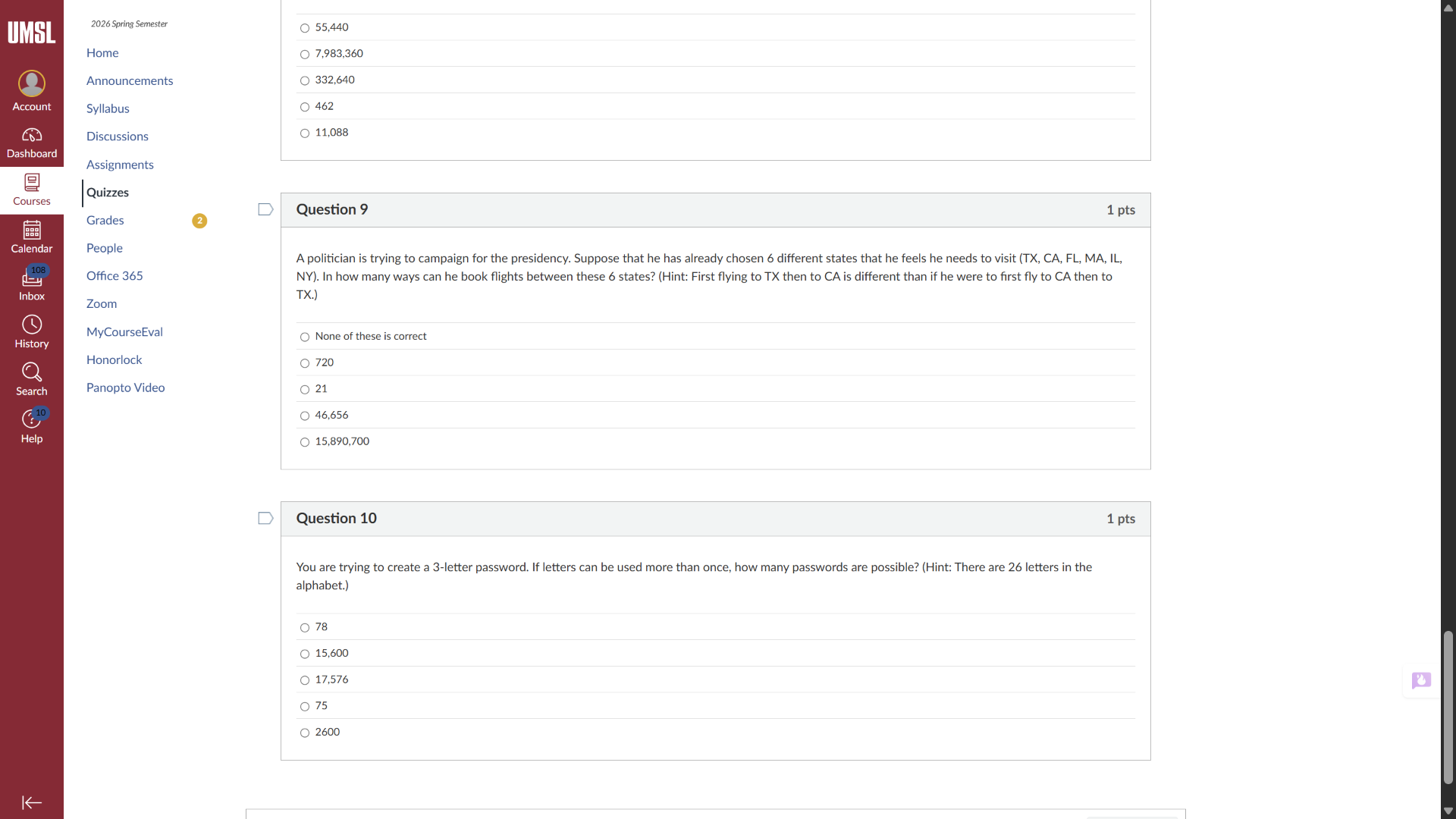
a politician is trying to campaign for the presidency. suppose that he has already chosen 6 different states that he feels he needs to visit (tx, ca, fl, ma, il, ny). in how many ways can he book flights between these 6 states? (hint: first flying to tx then to ca is different than if he were to first fly to ca then to tx.)
none of these is correct
720
21
46,656
15,890,700
question 10
1 pts
you are trying to create a 3 - letter password. if letters can be used more than once, how many passwords are possible? (hint: there are 26 letters in the alphabet.)
78
15,600
17,576
75
2600
Question 9
Step1: Identify the problem type
This is a permutation problem since the order of visiting (flying between) the states matters (flying TX to CA is different from CA to TX). We need to find the number of permutations of 6 states taken 2 at a time? Wait, no—wait, actually, when booking flights between the 6 states, for each flight, we are choosing a departure and an arrival state, where departure and arrival can be any of the 6 states, and order matters. Wait, no, the problem says "between these 6 states"—so it's the number of ordered pairs (departure, arrival) where departure and arrival are from the 6 states, and departure ≠ arrival? Wait, no, the hint says first flying to TX then to CA is different from CA then to TX, so it's permutations of 6 states taken 2 at a time? Wait, no, actually, if we consider that for each flight, we have a start and end, and we can have flights between any two distinct states (since you can't fly from a state to itself? Wait, the problem says "between these 6 states"—maybe it's the number of directed edges between 6 nodes, where each edge is a flight from one state to another (different state). So the number of permutations of 6 states taken 2 at a time, which is \( P(6,2) \)? Wait, no, wait, maybe I misread. Wait, the politician has 6 states, and he needs to book flights between them. So for each pair of distinct states, there are two possible flights (A to B and B to A). The number of ways to choose a departure and arrival state, where departure ≠ arrival. So the number of such flights is \( 6 \times 5 = 30 \)? Wait, no, that can't be. Wait, maybe the problem is about arranging the order of visiting all 6 states? Wait, no, the hint says first flying to TX then to CA is different from CA then to TX, so it's about the number of ordered pairs (i.e., permutations of 2 states from 6). Wait, but the options include 720, which is \( 6! \). Wait, maybe the problem is that he is visiting all 6 states, and the number of possible orderings (permutations) of the 6 states, since each flight is a sequence. Wait, if he is flying between the 6 states, maybe it's the number of permutations of 6 states, i.e., \( 6! \), because each permutation represents a sequence of flights (first state, second state, etc.). Let's check: \( 6! = 720 \), which is one of the options. Let's re-examine the problem: "In how many ways can he book flights between these 6 states? (Hint: First flying to TX then to CA is different than if he were to first fly to CA then to TX.)" So if we consider that each flight is a segment of the journey, and the order of visiting the states matters, then the number of possible sequences of visiting the 6 states is the number of permutations of 6 elements, which is \( 6! = 720 \). So that's the answer.
Step1: Recognize permutation of 6 states
We need to find the number of ways to arrange 6 states in order (since the order of flying matters). The formula for permutations of \( n \) distinct objects is \( n! \) (n factorial).
Step2: Calculate \( 6! \)
\( 6! = 6 \times 5 \times 4 \times 3 \times 2 \times 1 = 720 \)
Step1: Identify the problem type
This is a problem of counting the number of possible 3-letter passwords where letters can be repeated. For each position in the password (first, second, third), we have 26 choices (since there are 26 letters in the alphabet), and since repetition is allowed, we use the multiplication principle.
Step2: Apply the multiplication principle
For the first letter: 26 choices.
For the second letter: 26 choices (since repetition is allowed).
For the third letter: 26 choices.
So the total number of passwords is \( 26 \times 26 \times 26 \).
Step3: Calculate the result
\( 26 \times 26 \times 26 = 26^3 = 17,576 \)

Snap & solve any problem in the app
Get step-by-step solutions on Sovi AI
Photo-based solutions with guided steps
Explore more problems and detailed explanations
720