QUESTION IMAGE
Question
question 6
1 pts
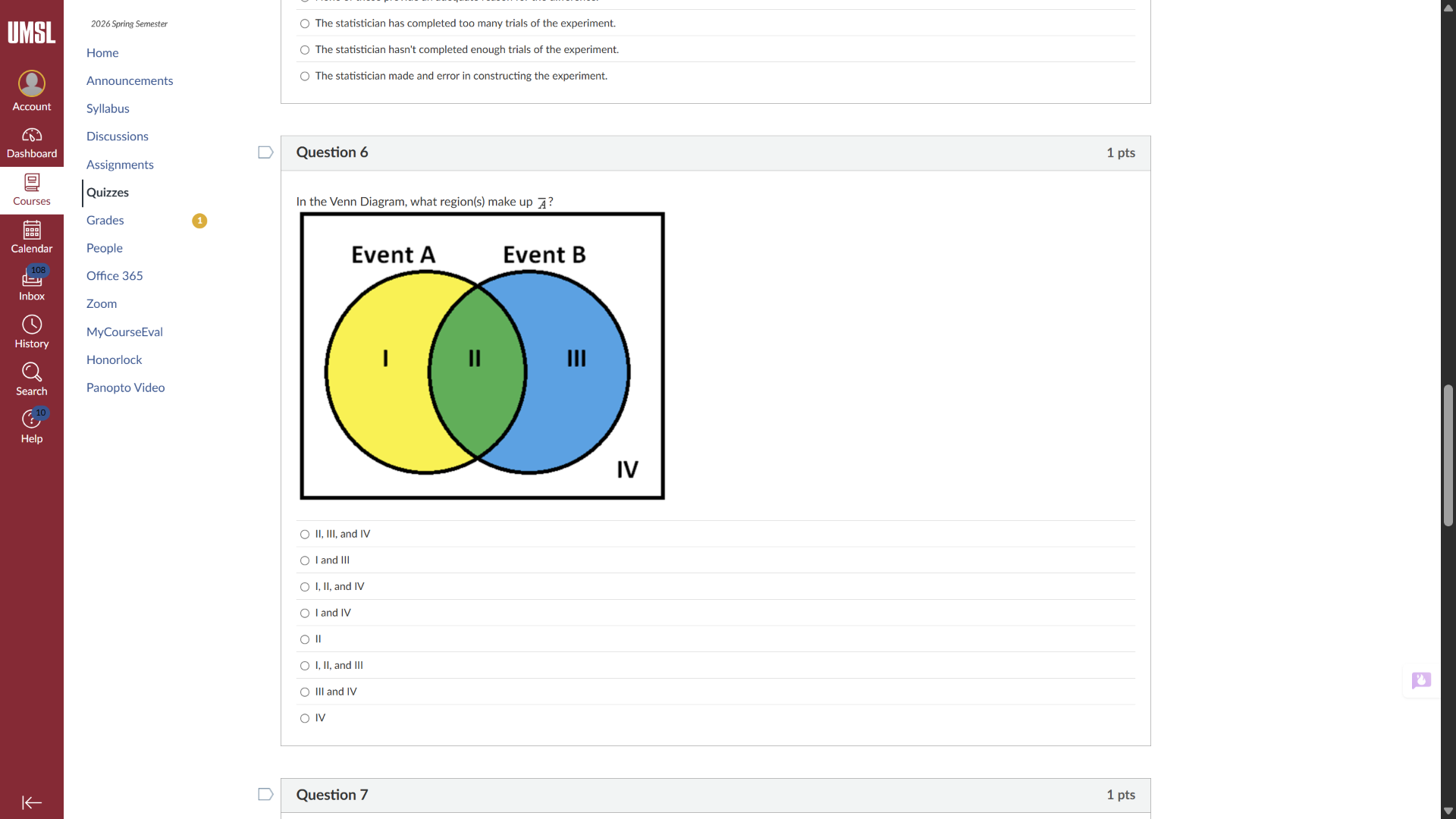
in the venn diagram, what region(s) make up \\(\overline{a}\\)?
\\(\bigcirc\\) ii, iii, and iv
\\(\bigcirc\\) i and iii
\\(\bigcirc\\) i, ii, and iv
\\(\bigcirc\\) i and iv
\\(\bigcirc\\) ii
\\(\bigcirc\\) i, ii, and iii
\\(\bigcirc\\) iii and iv
\\(\bigcirc\\) iv
Step1: Recall the definition of complement
The complement of a set (or event) \( \overline{A} \) (read as "A bar") consists of all elements (or outcomes) that are not in set \( A \).
Step2: Identify regions in Venn Diagram
- Region I: Inside Event A (only A, not overlapping with B)
- Region II: Overlap of A and B (in both A and B)
- Region III: Inside Event B (only B, not overlapping with A)
- Region IV: Outside both A and B
So, the regions not in A are Region III (only B) and Region IV (outside both A and B), and also Region II? Wait, no. Wait, Event A includes Region I (only A) and Region II (A and B). So \( \overline{A} \) is all regions not in A. So regions not in A are:
- Region III: only B (not in A)
- Region IV: outside both (not in A)
- Wait, Region II is in A (since it's the overlap of A and B). Wait, no: Event A is the yellow circle, which includes Region I (yellow only) and Region II (green, overlap). So \( \overline{A} \) is everything not in the yellow circle (Event A). So the yellow circle is I and II. So not in A: III (blue only) and IV (outside both). Wait, but the options include "III and IV"? Wait, let's check the options again.
Wait the options are:
- II, III, and IV
- I and III
- I, II, and IV
- I and IV
- II
- I, II, and III
- III and IV
- IV
Wait, let's re-express:
Event A (yellow circle) has regions: I (yellow only) and II (green, overlap with B). So \( \overline{A} \) is all regions not in A: that is, regions not in I or II. So:
- Region III: blue only (not in A)
- Region IV: outside both (not in A)
Wait, but Region II is in A (since it's part of the yellow circle? Wait no, the yellow circle is Event A, the blue is Event B. The green region (II) is the intersection of A and B, so it is in A (because it's inside the yellow circle). So \( \overline{A} \) is regions not in A: so III (blue only, not in A) and IV (outside both, not in A). Wait, but the first option is "II, III, and IV" – that can't be, because II is in A. Wait maybe I made a mistake. Wait, maybe the Venn Diagram: Event A is yellow (I and II), Event B is blue (II and III), and IV is outside both. So \( \overline{A} \) is all elements not in A. So elements not in A are those not in I or II. So:
- Region III: in B, not in A (since II is in A, III is only B)
- Region IV: not in A or B
- Wait, Region II is in A (because it's in the yellow circle, Event A). So \( \overline{A} \) is III and IV? Wait, but the option "III and IV" is there. Wait, but let's check again.
Wait, maybe the initial analysis is wrong. Let's think again:
The complement of A, \( \overline{A} \), is the set of all outcomes not in A. So in the Venn Diagram:
- A is the yellow circle: includes I (yellow only) and II (green, overlap with B). So \( \overline{A} \) is everything not in the yellow circle. So:
- Region III: blue circle, not overlapping with yellow (so not in A)
- Region IV: outside both circles (not in A)
- Region II: is in the yellow circle? Wait, the yellow circle is Event A, so the yellow circle includes I (yellow) and II (green, which is the overlap). So II is in A. So \( \overline{A} \) is III and IV. Wait, but the option "III and IV" is present. Wait, but let's check the options again.
Wait the options are:
- II, III, and IV
- I and III
- I, II, and IV
- I and IV
- II
- I, II, and III
- III and IV
- IV
So according to the definition, \( \overline{A} \) is regions not in A. A is I (only A) and II (A and B). So not in A: III (only B) and IV (outside both). So the correct option is "III and IV". Wait, but let's confirm with the Venn Diag…

Snap & solve any problem in the app
Get step-by-step solutions on Sovi AI
Photo-based solutions with guided steps
Explore more problems and detailed explanations
III and IV