QUESTION IMAGE
Question
question 4 of 9 a sample of 860 drivers was asked the following question:
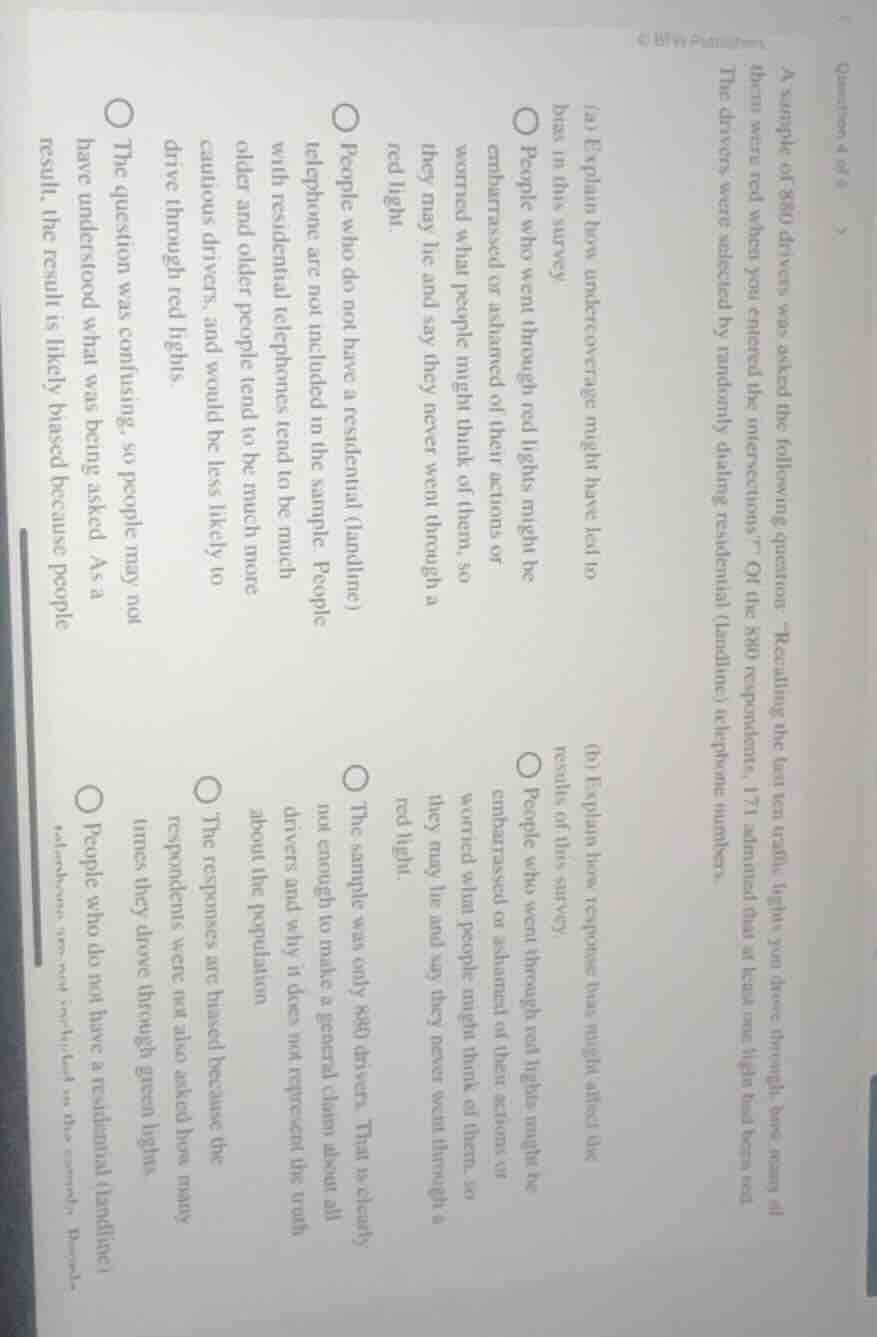
ecalling the last ten traffic lights you drove through, how many of them were red when you entered the intersections?\ of the 860 respondents, 171 admitted that at least one light had been red. the drivers were selected by randomly dialing residential (landline) telephone numbers. (a) explain how undercoverage might have led to bias in this survey. people who went through red lights might be embarrassed or ashamed of their actions or worried what people might think of them, so they may lie and say they never went through a red light. people who do not have a residential (landline) telephone are not included in the sample. people with residential telephones tend to be much older and older people tend to be much more cautious drivers, and would be less likely to drive through red lights. the question was confusing, so people may not have understood what was being asked. as a result, the result is likely biased because people (b) explain how response bias might affect the results of this survey. people who went through red lights might be embarrassed or ashamed of their actions or worried what people might think of them, so they may lie and say they never went through a red light. the sample was only 860 drivers. that is clearly not enough to make a general claim about all drivers and why it does not represent the truth about the population. the responses are biased because the respondents were not also asked how many times they drove through green lights. people who do not have a residential (landline) telephone were not included in the sample, so...
Part (a)
To determine the undercoverage bias, we analyze each option:
- The first option: People who went through red lights might be embarrassed or worried about others' opinions, so they lie about never doing it. This is response bias, not undercoverage.
- The second option: People without residential (landline) telephones (like those with only cell phones, often younger people) are excluded. Older people with landlines are more in the sample, and they're more cautious, so undercoverage (missing a group) leads to bias as the sample doesn't represent all drivers (e.g., younger, cell - only users who might be more likely to run red lights are missing).
- The third option: This is about people misunderstanding the question, which is non - response or response bias due to confusion, not undercoverage.
So the correct option for (a) is the second one: "People who do not have a residential (landline) telephone are not included in the sample. People with residential telephones tend to be much older and older people tend to be much more cautious drivers, and would be less likely to drive through red lights."
Part (b)
For response bias, we analyze:
- The first option: People who ran red lights lie about it due to embarrassment/worry about others' opinions. This is response bias (lying in responses to avoid negative perception), which affects the survey results as the reported data is untrue.
- The second option: This is about sample size (800 drivers not being enough for all drivers), which is a sampling size issue, not response bias.
- The third option: This is about the question being confusing (non - response or misunderstanding), not the act of lying due to embarrassment about the action.
So the correct option for (b) is the first one: "People who went through red lights might be embarrassed or ashamed of their actions or worried what people might think of them, so they may lie and say they never went through a red light."

Snap & solve any problem in the app
Get step-by-step solutions on Sovi AI
Photo-based solutions with guided steps
Explore more problems and detailed explanations
s:
(a) People who do not have a residential (landline) telephone are not included in the sample. People with residential telephones tend to be much older and older people tend to be much more cautious drivers, and would be less likely to drive through red lights.
(b) People who went through red lights might be embarrassed or ashamed of their actions or worried what people might think of them, so they may lie and say they never went through a red light.