QUESTION IMAGE
Question
question #3
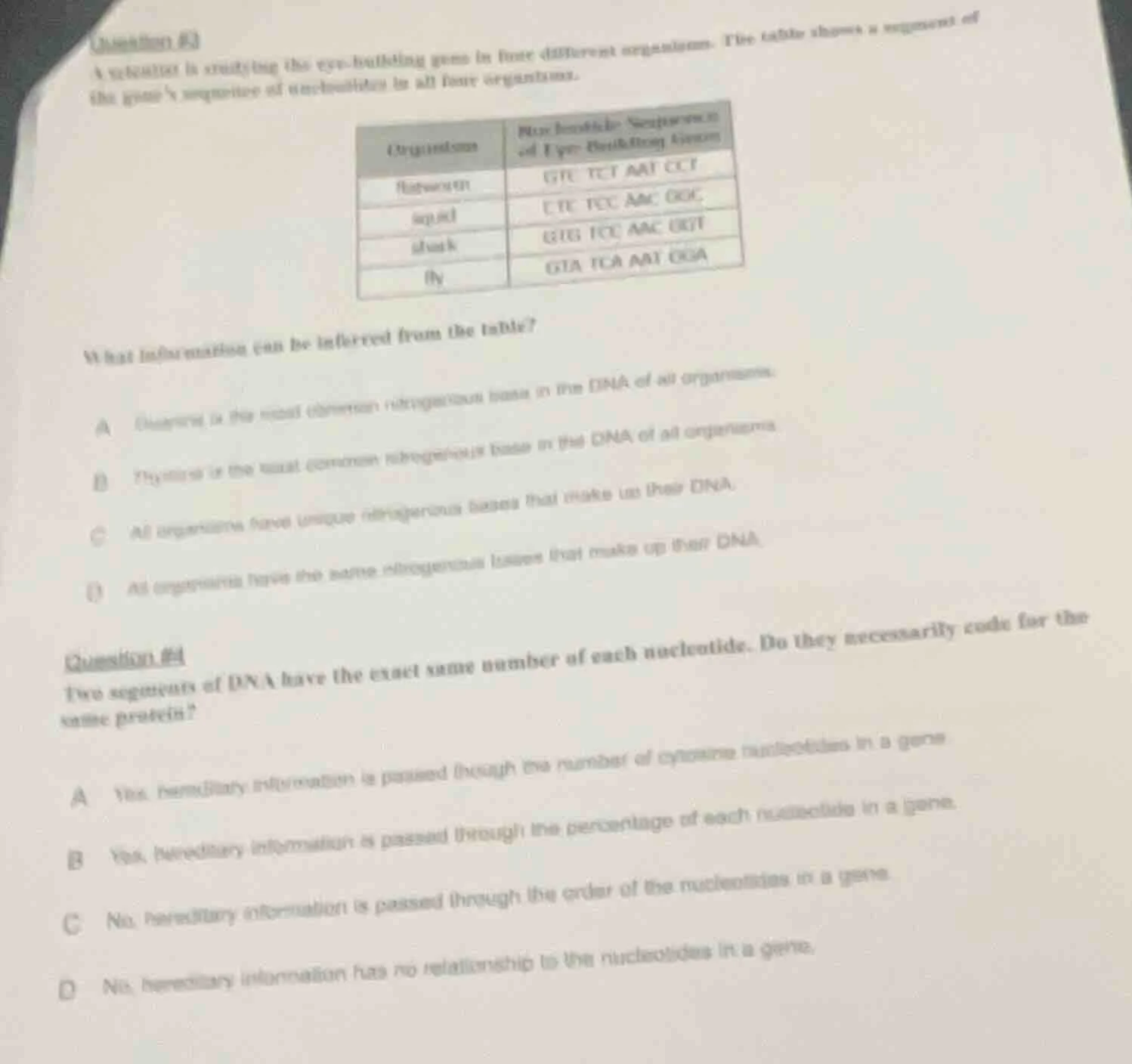
a scientist is studying the eye - building gene in four different organisms. the table shows a segment of the gene’s sequence of nucleotides in all four organisms.
chart showing nucleotide sequences for four organisms: flatworm, squid, shark, fly
what information can be inferred from the table?
a. guanine is the most common nitrogenous base in the dna of all organisms.
b. thymine is the most common nitrogenous base in the dna of all organisms.
c. all organisms have unique nitrogenous bases that make up their dna.
d. all organisms have the same nitrogenous bases that make up their dna.
question #4
two segments of dna have the exact same number of each nucleotide. do they necessarily code for the same protein?
a. yes, hereditary information is passed through the number of cytosine nucleotides in a gene.
b. yes, hereditary information is passed through the percentage of each nucleotide in a gene.
c. no, hereditary information is passed through the order of the nucleotides in a gene.
d. no, hereditary information has no relationship to the nucleotides in a gene.
Question #3
Looking at the nucleotide sequences: all organisms use the same four nitrogenous bases (G, T, C, A). Option A and B are incorrect because we only have a small segment, so we can't infer the most common base across the entire genome. Option C is wrong because all use the same four bases, not unique ones.
The genetic code relies on the order (sequence) of nucleotides, not just the total number of each nucleotide. Two DNA segments can have the same count of each nucleotide but a different order, which will code for a different protein (or no functional protein at all).

Snap & solve any problem in the app
Get step-by-step solutions on Sovi AI
Photo-based solutions with guided steps
Explore more problems and detailed explanations
D. All organisms have the same nitrogenous bases that make up their DNA.
---