QUESTION IMAGE
Question
question 6 of 8
select the correct answer.
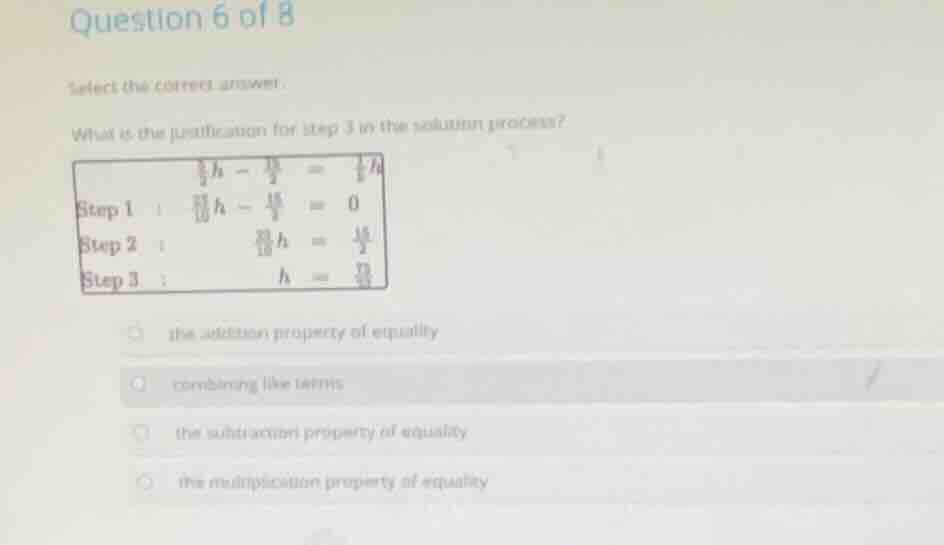
what is the justification for step 3 in the solution process?
\\(\frac{3}{5}h - \frac{4}{3} = \frac{1}{4}\\)
step 1 : \\(\frac{36}{60}h - \frac{80}{60} = 0\\)
step 2 : \\(\frac{36}{60}h = \frac{80}{60}\\)
step 3 : \\(h = \frac{80}{36}\\)
\\(\circ\\) the addition property of equality
\\(\circ\\) combining like terms
\\(\circ\\) the subtraction property of equality
\\(\circ\\) the multiplication property of equality
To determine the justification for Step 3, we analyze the operations. In Step 2, we have \(\frac{8}{10}h=\frac{4}{2}\). To solve for \(h\), we need to isolate \(h\). The multiplication property of equality states that if we multiply both sides of an equation by the same non - zero number, the equation remains true. Here, we multiply both sides of \(\frac{8}{10}h=\frac{4}{2}\) by the reciprocal of \(\frac{8}{10}\) (or divide both sides by \(\frac{8}{10}\), which is equivalent to multiplying by \(\frac{10}{8}\)), which is an application of the multiplication property of equality. Combining like terms is used when we have similar terms (like \(3x + 5x\)), which is not the case here. The addition/subtraction properties are for adding/subtracting the same number to both sides, not for isolating a variable multiplied by a fraction.

Snap & solve any problem in the app
Get step-by-step solutions on Sovi AI
Photo-based solutions with guided steps
Explore more problems and detailed explanations
the multiplication property of equality