QUESTION IMAGE
Question
question 3
in a species of oyster, the color of the oysters’ flesh is controlled by a single gene with two alleles, b and b. the allele for black flesh (b) is dominant to the allele for orange flesh (b). the diagram shows each type of oyster.
diagram of black and orange oyster flesh
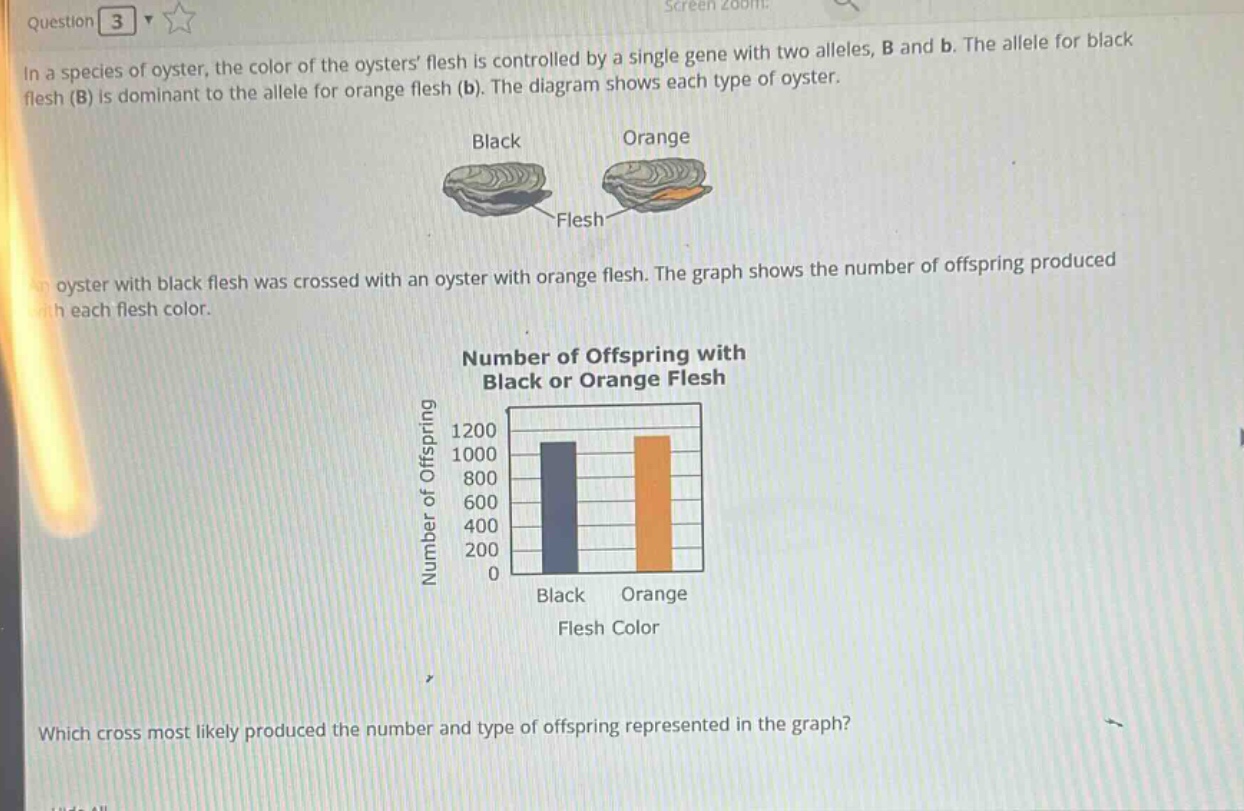
an oyster with black flesh was crossed with an oyster with orange flesh. the graph shows the number of offspring produced with each flesh color.
bar graph: number of offspring with black or orange flesh, black and orange bars nearly equal
which cross most likely produced the number and type of offspring represented in the graph?
To solve this, we analyze the genetics of the oyster cross:
Step 1: Determine Genotypes of Parents
- Orange flesh (recessive) must be \( bb \) (since recessive traits only express when homozygous).
- Black flesh is dominant, so possible genotypes: \( BB \) (homozygous dominant) or \( Bb \) (heterozygous).
Step 2: Analyze Offspring Ratios
The bar graph shows roughly equal numbers of black and orange offspring.
- If the black parent were \( BB \) (homozygous dominant), all offspring would inherit \( B \) from the black parent and \( b \) from the orange parent (\( bb \)), so all offspring would be \( Bb \) (black). This does not match the graph (equal black/orange).
- If the black parent were \( Bb \) (heterozygous), the cross is \( Bb \times bb \):
- Gametes from \( Bb \): \( B \) or \( b \).
- Gametes from \( bb \): \( b \) (only).
- Offspring genotypes: \( Bb \) (black, 50%) and \( bb \) (orange, 50%). This matches the graph’s roughly equal numbers of black and orange offspring.
Step 3: Identify the Cross
The cross is \( Bb \) (black) \( \times \) \( bb \) (orange), producing a 1:1 ratio of black (\( Bb \)) to orange (\( bb \)) offspring, consistent with the graph.

Snap & solve any problem in the app
Get step-by-step solutions on Sovi AI
Photo-based solutions with guided steps
Explore more problems and detailed explanations
The cross is between a heterozygous black oyster (\( Bb \)) and a homozygous recessive orange oyster (\( bb \)) (i.e., \( Bb \times bb \)).