QUESTION IMAGE
Question
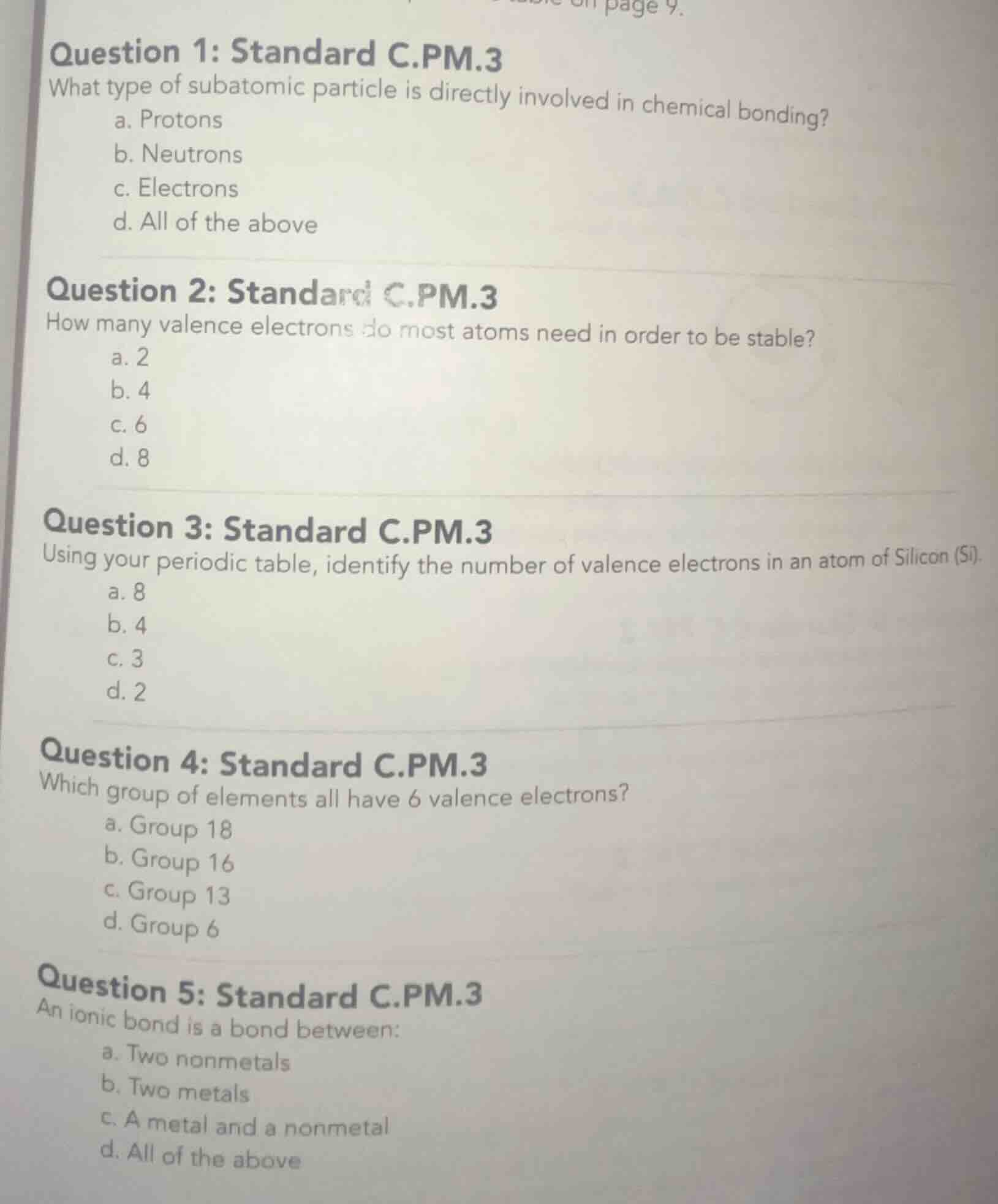
question 1: standard c.pm.3
what type of subatomic particle is directly involved in chemical bonding?
a. protons
b. neutrons
c. electrons
d. all of the above
question 2: standard c.pm.3
how many valence electrons do most atoms need in order to be stable?
a. 2
b. 4
c. 6
d. 8
question 3: standard c.pm.3
using your periodic table, identify the number of valence electrons in an atom of silicon (si).
a. 8
b. 4
c. 3
d. 2
question 4: standard c.pm.3
which group of elements all have 6 valence electrons?
a. group 18
b. group 16
c. group 13
d. group 6
question 5: standard c.pm.3
an ionic bond is a bond between:
a. two nonmetals
b. two metals
c. a metal and a nonmetal
d. all of the above
- Chemical bonding involves the transfer or sharing of electrons in the outermost shell of atoms; protons and neutrons are in the nucleus and not directly involved.
- The octet rule states most atoms need 8 valence electrons to achieve a stable noble gas electron configuration.
- Silicon is in Group 14 of the periodic table, and elements in this group have 4 valence electrons.
- Group 16 (chalcogens) of the periodic table contains elements with 6 valence electrons.
- Ionic bonds form when a metal transfers electrons to a nonmetal, creating oppositely charged ions that attract.

Snap & solve any problem in the app
Get step-by-step solutions on Sovi AI
Photo-based solutions with guided steps
Explore more problems and detailed explanations
- c. Electrons
- d. 8
- b. 4
- b. Group 16
- c. A metal and a nonmetal