QUESTION IMAGE
Question
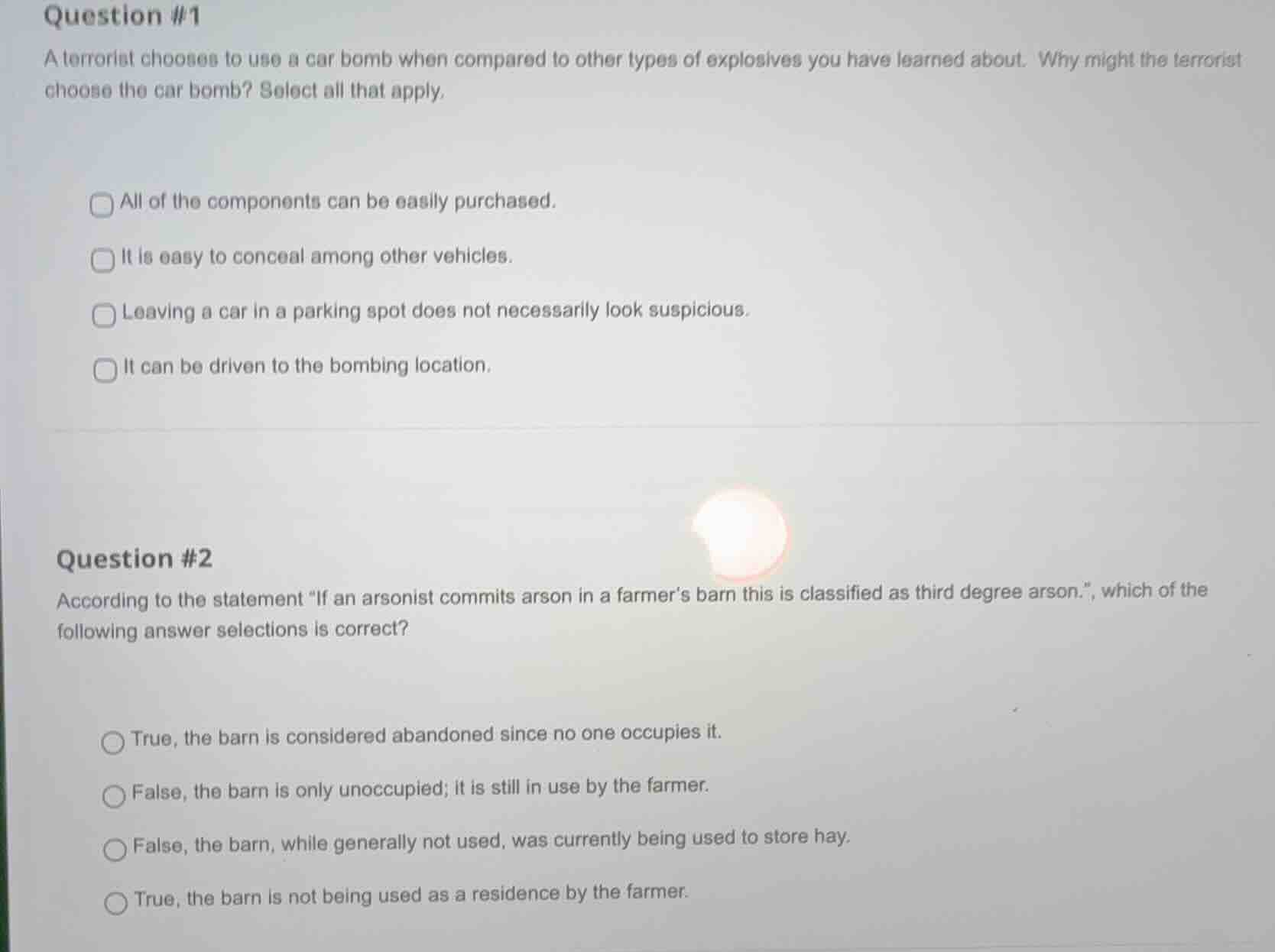
question #1
a terrorist chooses to use a car bomb when compared to other types of explosives you have learned about. why might the terrorist choose the car bomb? select all that apply.
all of the components can be easily purchased.
it is easy to conceal among other vehicles.
leaving a car in a parking spot does not necessarily look suspicious.
it can be driven to the bombing location.
question #2
according to the statement \if an arsonist commits arson in a farmer’s barn this is classified as third degree arson.\, which of the following answer selections is correct?
true, the barn is considered abandoned since no one occupies it.
false, the barn is only unoccupied; it is still in use by the farmer.
false, the barn, while generally not used, was currently being used to store hay.
true, the barn is not being used as a residence by the farmer.
Question #1
- "All of the components can be easily purchased": Car bomb components (like car parts, explosives precursors) can be acquired legally or illicitly with relative ease.
- "It is easy to conceal among other vehicles": A car bomb blends in with regular traffic/vehicles, making detection harder.
- "Leaving a car in a parking spot does not necessarily look suspicious": Cars in parking spots are common, so a parked car with a bomb won’t immediately raise alarms.
- "It can be driven to the bombing location": Mobility allows targeting specific areas, delivering the bomb to a precise site.
Third - degree arson typically involves unoccupied or abandoned structures (not used as residences or actively occupied). A farmer’s barn, even if used for storage (like hay) or by the farmer for agricultural purposes, is not a residence. The statement says arson in a farmer’s barn is third - degree arson. Option A: If the barn is considered abandoned (no one occupies it), then it fits third - degree arson. But let's analyze other options:
- Option B: Saying the barn is still in use by the farmer (for non - residential purposes) would not make it non - third - degree? No, third - degree is about occupancy as a residence.
- Option C: The “currently being used to store hay” doesn't change the fact that it's not a residence. But the key for third - degree is unoccupied (not as a residence).
- Option D: The barn not being used as a residence is the key. But the original statement's classification: If the barn is unoccupied (not a residence), then arson there is third - degree. Option A says the barn is considered abandoned (no one occupies it) which aligns with third - degree arson criteria. Wait, maybe a better way: Third - degree arson is for structures that are not dwellings (residences) and may be unoccupied or abandoned. A farmer’s barn is not a residence. So the statement “If an arsonist commits arson in a farmer’s barn this is classified as third degree arson.” is true because the barn is not a residence (or is considered abandoned/unoccupied). Option A: "True, the barn is considered abandoned since no one occupies it." and Option D: "True, the barn is not being used as a residence by the farmer." But let's check arson degree definitions. Third - degree arson: burning of an unoccupied structure (not a dwelling, like a barn, shed, etc.). So if the barn is unoccupied (no one lives there) and not a residence, it's third - degree. So the statement is true. Among the options, Option A: "True, the barn is considered abandoned since no one occupies it." and Option D: "True, the barn is not being used as a residence by the farmer." But maybe the correct answer is A? Wait, no. Wait, a barn used by a farmer for storage is not abandoned. Wait, maybe I got it wrong. Let's re - think. Third - degree arson: usually involves structures that are not inhabited (not used as homes) and may be vacant or used for other purposes but not as a residence. So a farmer’s barn is used by the farmer (for farming, storage) but not as a residence. So arson in it is third - degree. So the statement is true. Now, the options:
- Option A: "True, the barn is considered abandoned since no one occupies it." But a barn used for storage is not abandoned. So this is incorrect.
- Option B: "False, the barn is only unoccupied; it is still in use by the farmer." But third - degree is about unoccupied (not as a residence). So if it's unoccupied (no one lives there) and in use by the farmer for non - residential purposes, it's third - degree. So the statement is true, so B is wrong.
- Option C: "False, the barn, while generally not used, was currently being used to store hay." The “generally not used” is wrong, and storage use doesn't make it non - third - degree.
- Option D: "True, the barn is not being used as a residence by the farmer." This is correct. Because third - degree arson is for structures not used as residences. So the statement is true because the barn is not a residence. So the correct answer is D? Wait, no, the original statement's classification: if arson in a farmer’s barn is third - degree, then the reason is that the barn is not a residence. So the state…

Snap & solve any problem in the app
Get step-by-step solutions on Sovi AI
Photo-based solutions with guided steps
Explore more problems and detailed explanations
A. All of the components can be easily purchased.
B. It is easy to conceal among other vehicles.
C. Leaving a car in a parking spot does not necessarily look suspicious.
D. It can be driven to the bombing location.