QUESTION IMAGE
Question
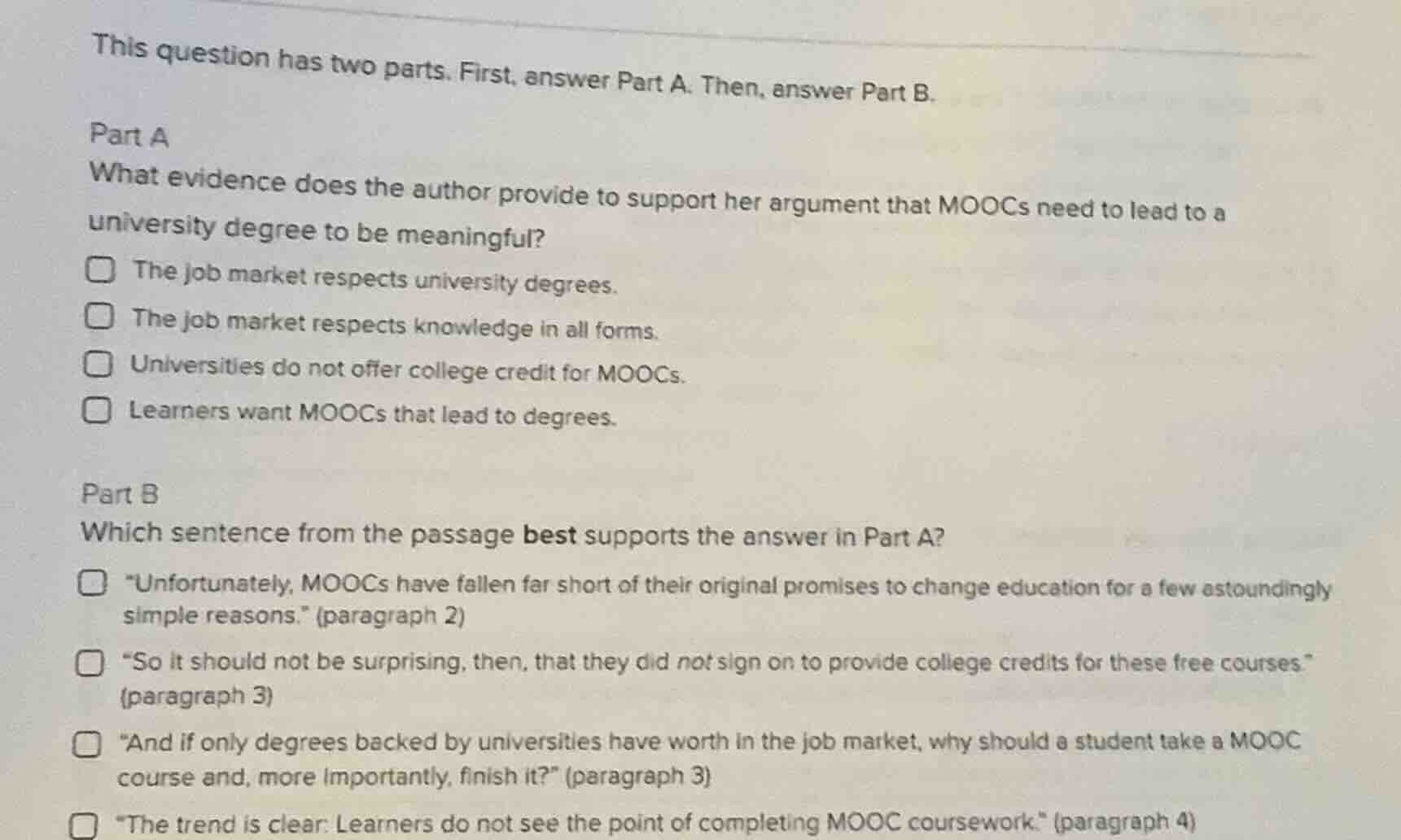
this question has two parts. first, answer part a. then, answer part b.
part a
what evidence does the author provide to support her argument that moocs need to lead to a university degree to be meaningful?
the job market respects university degrees.
the job market respects knowledge in all forms.
universities do not offer college credit for moocs.
learners want moocs that lead to degrees.
part b
which sentence from the passage best supports the answer in part a?
\unfortunately, moocs have fallen far short of their original promises to change education for a few astoundingly simple reasons.\ (paragraph 2)
\so it should not be surprising, then, that they did not sign on to provide college credits for these free courses.\ (paragraph 3)
\and if only degrees backed by universities have worth in the job market, why should a student take a mooc course and, more importantly, finish it?\ (paragraph 3)
\the trend is clear: learners do not see the point of completing mooc coursework.\ (paragraph 4)
Part A
To determine the evidence for the argument that MOOCs need to lead to a university degree to be meaningful, we analyze each option:
- "The job market respects university degrees" supports the idea that a university degree (which MOOCs leading to it would provide) is valued in the job market, making MOOCs meaningful if they lead to such a degree.
- "The job market respects knowledge in all forms" would imply MOOCs (as a form of knowledge) are meaningful without needing a degree, so this is incorrect.
- "Universities do not offer college credit for MOOCs" is a statement about credit, not about why MOOCs need a degree to be meaningful.
- "Learners want MOOCs that lead to degrees" is about learner preference, not evidence about why they need to lead to a degree to be meaningful (the argument is about meaningfulness, likely tied to job market or value, not just learner want).
We need a sentence that supports the answer in Part A (job market respects university degrees, so MOOCs need to lead to a degree to be meaningful).
- The sentence "And if only degrees backed by universities have worth in the job market, why should a student take a MOOC course and, more importantly, finish it?" (paragraph 3) connects the job market's value of university - backed degrees to the meaningfulness of MOOCs (implying MOOCs need to lead to such degrees to be worth taking/finishing), which supports Part A's answer.
- The other sentences:
- "Unfortunately, MOOCs have fallen far short of their original promises to change education for a few astoundingly simple reasons." (paragraph 2) is about MOOCs not meeting promises, not about job market and degrees.
- "So it should not be surprising, then, that they did not sign on to provide college credits for these free courses." (paragraph 3) is about college credit for MOOCs, not job market value of degrees.
- "The trend is clear: Learners do not see the point of completing MOOC coursework." (paragraph 4) is about learner perception of completing MOOCs, not about job market and degrees.

Snap & solve any problem in the app
Get step-by-step solutions on Sovi AI
Photo-based solutions with guided steps
Explore more problems and detailed explanations
A. The job market respects university degrees.