QUESTION IMAGE
Question
question
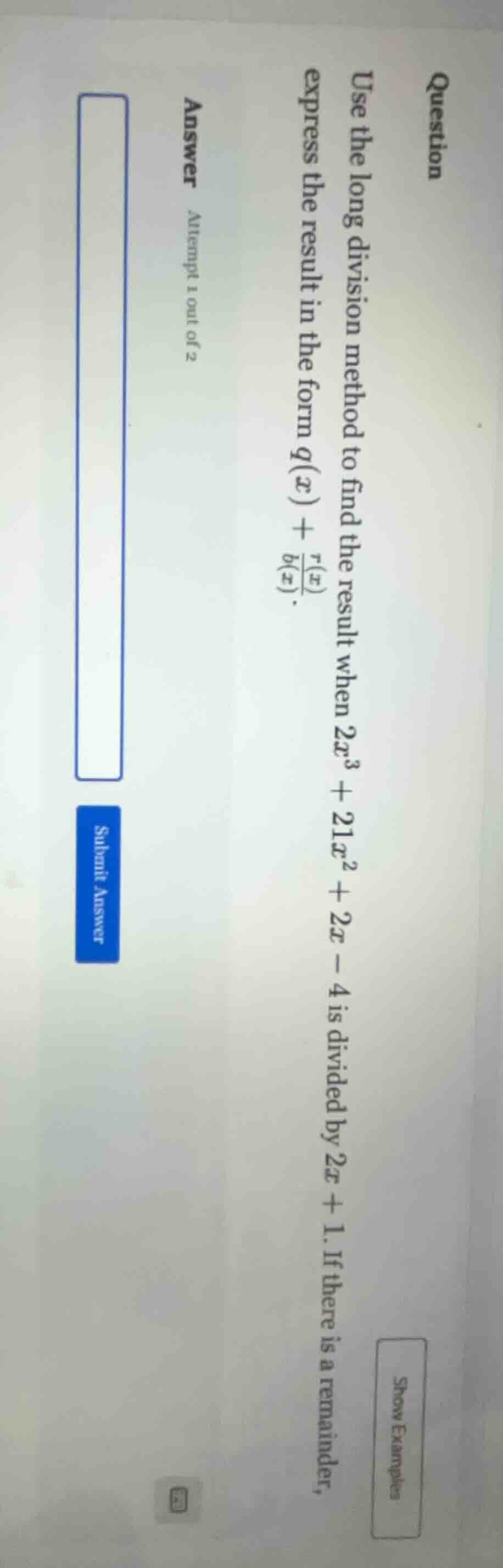
use the long division method to find the result when $2x^3 + 21x^2 + 2x - 4$ is divided by $2x + 1$. if there is a remainder, express the result in the form $q(x) + \frac{r(x)}{b(x)}$.
answer
attempt 1 out of 2
submit answer
show examples
Step1: Divide leading terms
$\frac{2x^3}{2x} = x^2$
Multiply divisor by $x^2$: $(2x+1)x^2 = 2x^3 + x^2$
Subtract from dividend:
$(2x^3+21x^2+2x-4) - (2x^3+x^2) = 20x^2 + 2x - 4$
Step2: Divide new leading terms
$\frac{20x^2}{2x} = 10x$
Multiply divisor by $10x$: $(2x+1)10x = 20x^2 + 10x$
Subtract from current polynomial:
$(20x^2+2x-4) - (20x^2+10x) = -8x - 4$
Step3: Divide new leading terms
$\frac{-8x}{2x} = -4$
Multiply divisor by $-4$: $(2x+1)(-4) = -8x - 4$
Subtract from current polynomial:
$(-8x-4) - (-8x-4) = 0$

Snap & solve any problem in the app
Get step-by-step solutions on Sovi AI
Photo-based solutions with guided steps
Explore more problems and detailed explanations
$x^2 + 10x - 4 + \frac{0}{2x+1}$ or simplified: $x^2 + 10x - 4$