QUESTION IMAGE
Question
question
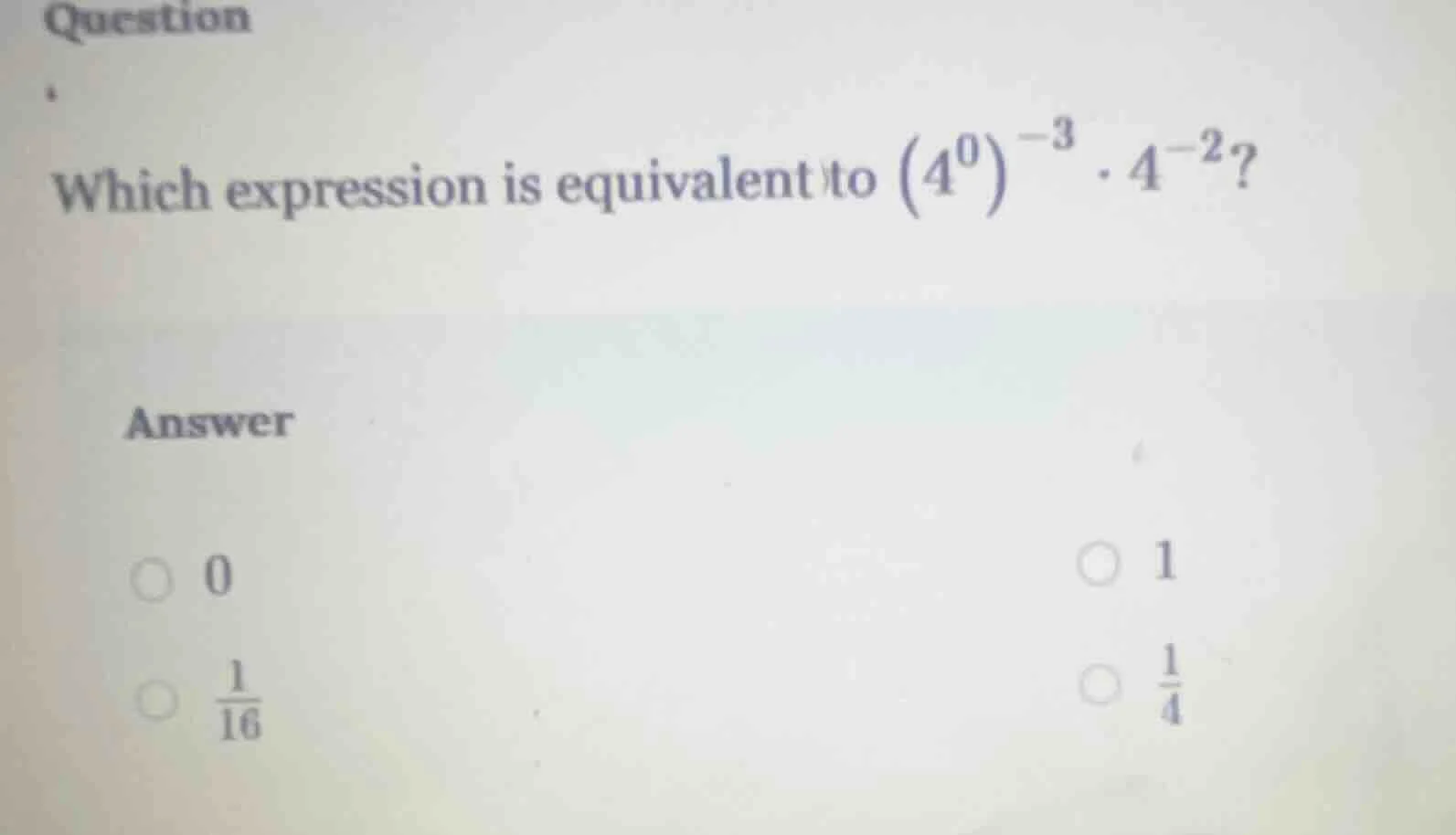
which expression is equivalent to \\(\left(4^{0}\
ight)^{-3} \cdot 4^{-2}\\)?
answer
\\(\circ\\) 0 \\(\circ\\) 1
\\(\circ\\) \\(\frac{1}{16}\\) \\(\circ\\) \\(\frac{1}{4}\\)
Step1: Simplify \(4^0\)
Any non - zero number to the power of 0 is 1. So \(4^0 = 1\). Then \((4^0)^{-3}=1^{-3}\). And any non - zero number to the power of - 3 (or any real number power) when the base is 1 is 1, because \(1^n = 1\) for any real number \(n\). So \((4^0)^{-3}=1\).
Step2: Simplify the product
Now we have \((4^0)^{-3}\cdot4^{-2}=1\cdot4^{-2}\). By the definition of negative exponents, \(a^{-n}=\frac{1}{a^{n}}\) (where \(a
eq0\) and \(n\) is a positive integer). So \(4^{-2}=\frac{1}{4^{2}}\).
Step3: Calculate \(4^{2}\)
We know that \(4^{2}=4\times4 = 16\). So \(4^{-2}=\frac{1}{16}\). And since \(1\cdot\frac{1}{16}=\frac{1}{16}\), the expression \((4^0)^{-3}\cdot4^{-2}\) is equivalent to \(\frac{1}{16}\).

Snap & solve any problem in the app
Get step-by-step solutions on Sovi AI
Photo-based solutions with guided steps
Explore more problems and detailed explanations
\(\frac{1}{16}\) (the option with \(\frac{1}{16}\))