QUESTION IMAGE
Question
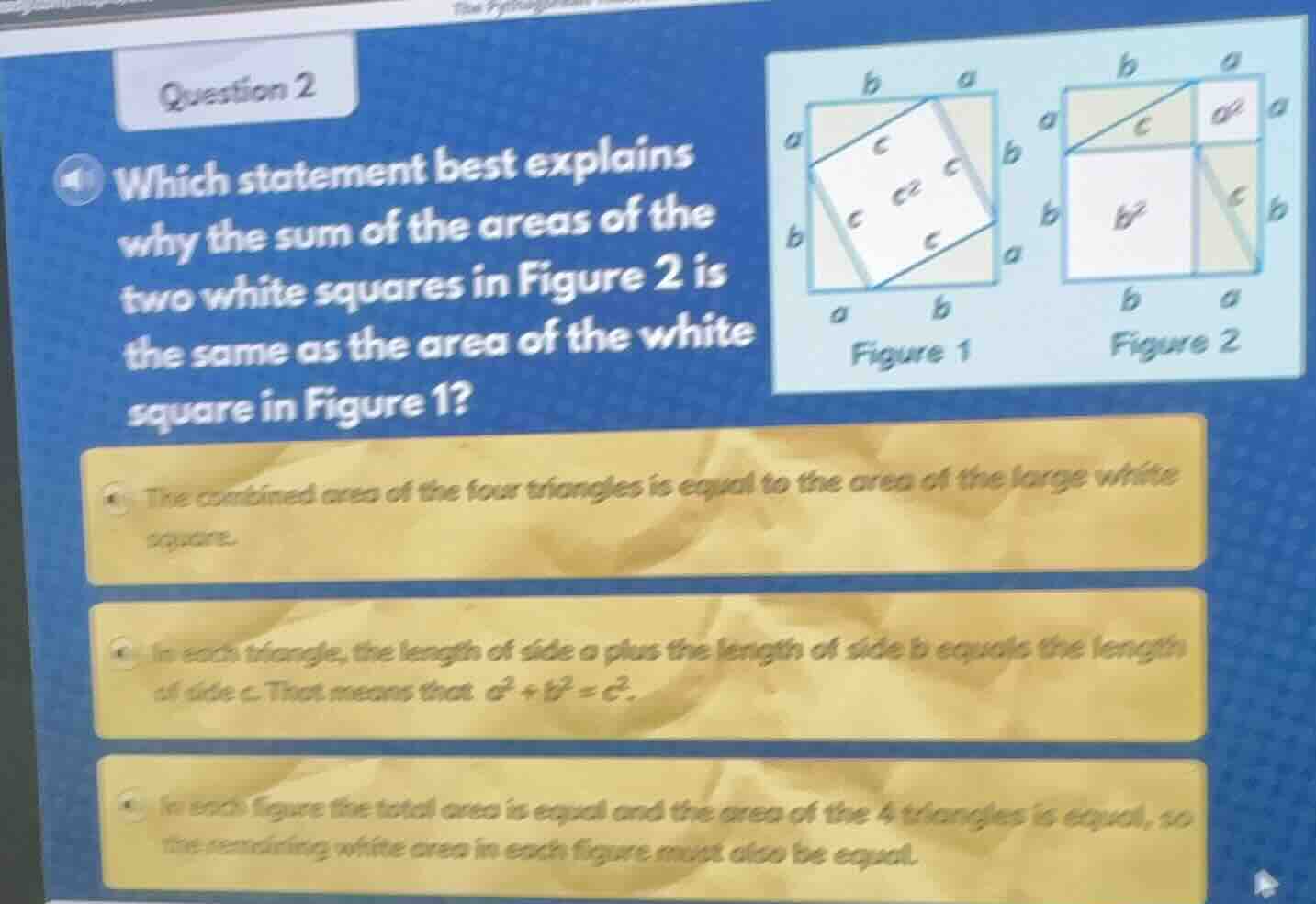
question 2 which statement best explains why the sum of the areas of the two white squares in figure 2 is the same as the area of the white square in figure 1? the combined area of the four triangles is equal to the area of the large white square. in each triangle, the length of side a plus the length of side b equals the length of side c. that means that $a^2 + b^2 = c^2$. in each figure the total area is equal and the area of the 4 triangles is equal, so the remaining white area in each figure must also be equal.
Both Figure 1 and Figure 2 are made up of a large outer square with identical total area. The blue right triangles in both figures are congruent, so their combined areas are equal. Subtracting the equal total area of the triangles from the equal total area of the large outer squares leaves the remaining white areas (the square in Figure 1, and the two squares in Figure 2) equal.

Snap & solve any problem in the app
Get step-by-step solutions on Sovi AI
Photo-based solutions with guided steps
Explore more problems and detailed explanations
- The correct option: In each figure the total area is equal and the area of the 4 triangles is equal, so the remaining white area in each figure must also be equal.