QUESTION IMAGE
Question
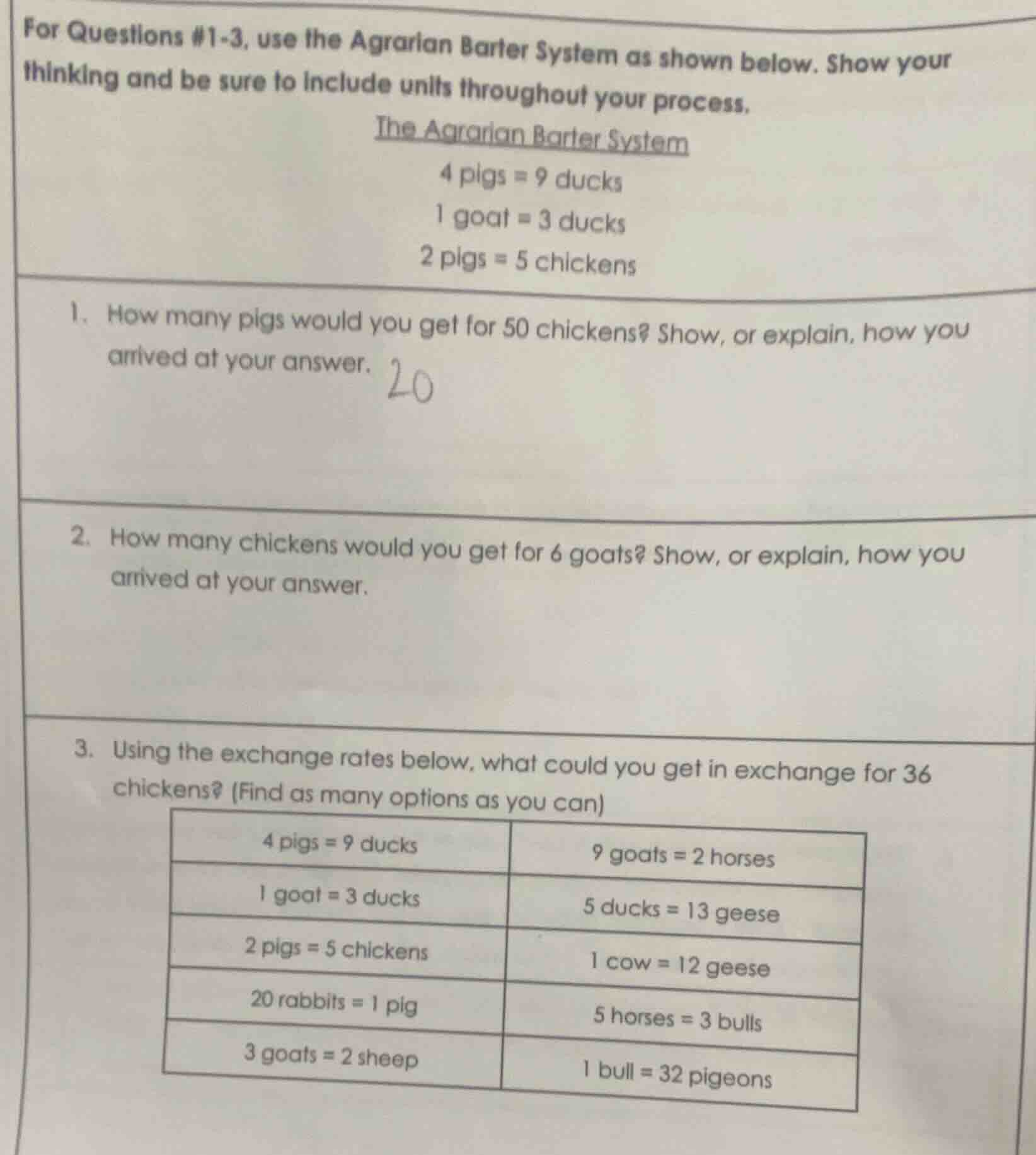
for questions #1-3, use the agrarian barter system as shown below. show your thinking and be sure to include units throughout your process.
the agrarian barter system
4 pigs = 9 ducks
1 goat = 3 ducks
2 pigs = 5 chickens
- how many pigs would you get for 50 chickens? show, or explain, how you arrived at your answer.
- how many chickens would you get for 6 goats? show, or explain, how you arrived at your answer.
- using the exchange rates below, what could you get in exchange for 36 chickens? (find as many options as you can)
4 pigs = 9 ducks\t9 goats = 2 horses
1 goat = 3 ducks\t5 ducks = 13 geese
2 pigs = 5 chickens\t1 cow = 12 geese
20 rabbits = 1 pig\t5 horses = 3 bulls
3 goats = 2 sheep\t1 bull = 32 pigeons
Question 1
Step1: Relate pigs and chickens
We know that \(2\) pigs \( = 5\) chickens. Let \(x\) be the number of pigs for \(50\) chickens. We can set up a proportion: \(\frac{2\ \text{pigs}}{5\ \text{chickens}}=\frac{x\ \text{pigs}}{50\ \text{chickens}}\)
Step2: Solve the proportion
Cross - multiply: \(5\times x=2\times50\)
\(5x = 100\)
Divide both sides by \(5\): \(x=\frac{100}{5}=20\)
Step1: Relate goats to ducks, then ducks to pigs, then pigs to chickens
First, from \(1\) goat \( = 3\) ducks, for \(6\) goats, the number of ducks is \(6\times3 = 18\) ducks.
From \(4\) pigs \( = 9\) ducks, we can find out how many pigs are equivalent to \(18\) ducks. Let \(y\) be the number of pigs for \(18\) ducks. \(\frac{4\ \text{pigs}}{9\ \text{ducks}}=\frac{y\ \text{pigs}}{18\ \text{ducks}}\), cross - multiply: \(9y=4\times18\), \(9y = 72\), \(y = 8\) pigs.
From \(2\) pigs \( = 5\) chickens, let \(z\) be the number of chickens for \(8\) pigs. \(\frac{2\ \text{pigs}}{5\ \text{chickens}}=\frac{8\ \text{pigs}}{z\ \text{chickens}}\), cross - multiply: \(2z=5\times8\), \(2z = 40\), \(z = 20\) chickens. (Alternative way: We can also first find the relation between goats and chickens. Since \(2\) pigs \( = 5\) chickens and \(4\) pigs \( = 9\) ducks, \(2\) pigs \(=\frac{9}{2}\) ducks. And \(1\) goat \( = 3\) ducks, so \(1\) goat \(=\frac{2}{9}\times2\) pigs \(=\frac{4}{9}\) pigs. Then from \(2\) pigs \( = 5\) chickens, \(1\) pig \(=\frac{5}{2}\) chickens. So \(1\) goat \(=\frac{4}{9}\times\frac{5}{2}=\frac{10}{9}\) chickens. Then for \(6\) goats, the number of chickens is \(6\times\frac{10}{9}=\frac{20}{3}\)? Wait, no, the first method is correct. Wait, there is a mistake in the alternative way. Let's correct the first method. Wait, actually, we can also use the relation between pigs and chickens directly. Wait, we know that \(2\) pigs \( = 5\) chickens and \(4\) pigs \( = 9\) ducks and \(1\) goat \( = 3\) ducks. Let's do it step by step:
- Convert goats to ducks: \(6\) goats \(\times3\) ducks/goat \( = 18\) ducks.
- Convert ducks to pigs: Since \(4\) pigs \( = 9\) ducks, the number of pigs for \(18\) ducks: \(\frac{4\ \text{pigs}}{9\ \text{ducks}}\times18\ \text{ducks}=8\) pigs.
- Convert pigs to chickens: Since \(2\) pigs \( = 5\) chickens, the number of chickens for \(8\) pigs: \(\frac{5\ \text{chickens}}{2\ \text{pigs}}\times8\ \text{pigs}=20\) chickens.

Snap & solve any problem in the app
Get step-by-step solutions on Sovi AI
Photo-based solutions with guided steps
Explore more problems and detailed explanations
\(20\) pigs