QUESTION IMAGE
Question
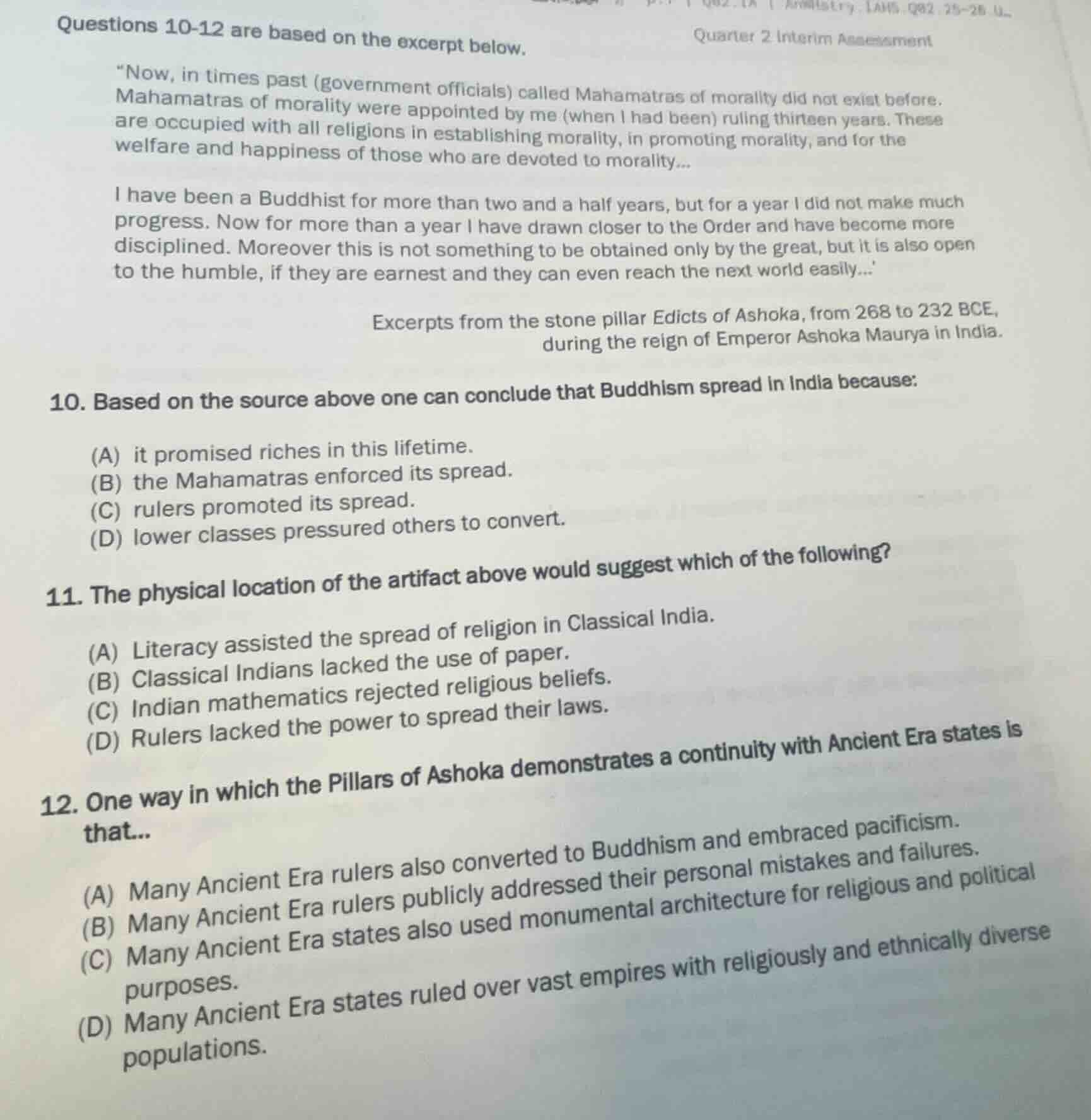
questions 10-12 are based on the excerpt below.
ow, in times past (government officials) called mahamatras of morality did not exist before. mahamatras of morality were appointed by me (when i had been) ruling thirteen years. these are occupied with all religions in establishing morality, in promoting morality, and for the welfare and happiness of those who are devoted to morality...
i have been a buddhist for more than two and a half years, but for a year i did not make much progress. now for more than a year i have drawn closer to the order and have become more disciplined. moreover this is not something to be obtained only by the great, but it is also open to the humble, if they are earnest and they can even reach the next world easily...
excerpts from the stone pillar edicts of ashoka, from 268 to 232 bce, during the reign of emperor ashoka maurya in india.
- based on the source above one can conclude that buddhism spread in india because:
(a) it promised riches in this lifetime.
(b) the mahamatras enforced its spread.
(c) rulers promoted its spread.
(d) lower classes pressured others to convert.
- the physical location of the artifact above would suggest which of the following?
(a) literacy assisted the spread of religion in classical india.
(b) classical indians lacked the use of paper.
(c) indian mathematics rejected religious beliefs.
(d) rulers lacked the power to spread their laws.
- one way in which the pillars of ashoka demonstrates a continuity with ancient era states is that...
(a) many ancient era rulers also converted to buddhism and embraced pacificism.
(b) many ancient era rulers publicly addressed their personal mistakes and failures.
(c) many ancient era states also used monumental architecture for religious and political purposes.
(d) many ancient era states ruled over vast empires with religiously and ethnically diverse populations.
Question 10
- Option A: The excerpt doesn't mention Buddhism promising riches, so A is incorrect.
- Option B: Mahamatras were for establishing morality in all religions, not enforcing Buddhism's spread, so B is wrong.
- Option C: Emperor Ashoka (a ruler) appointed officials for morality (related to his Buddhist faith) and his own Buddhist journey is described, showing rulers promoted Buddhism's spread. This matches.
- Option D: The excerpt says Buddhism is open to the humble, not that lower classes pressured others, so D is incorrect.
- The artifact is stone pillar edicts. In Classical India, paper wasn't widely used, so they used stone for inscriptions.
- Option A: The edicts are on stone, not about literacy aiding spread directly.
- Option B: Using stone pillars for edicts suggests paper wasn't commonly used (since they used durable stone for public messages), so B is correct.
- Option C: The edicts show rulers spreading their ideas (moral and religious), so C is wrong.
- Option D: The edicts show rulers spreading laws/morality, so D is wrong.
- Option A: The excerpt is about Ashoka's Buddhism, but not many Ancient Era rulers converting.
- Option B: The pillars are about public moral/religious messages, not personal mistakes.
- Option C: Pillars of Ashoka were monumental architecture used for religious (Buddhist morality) and political (ruling, spreading edicts) purposes. Ancient states like Egyptian (monuments), Mesopotamian (steles) also used monumental architecture for such purposes, showing continuity.
- Option D: The pillars don't focus on empire's diversity, but on edicts. So C is correct.

Snap & solve any problem in the app
Get step-by-step solutions on Sovi AI
Photo-based solutions with guided steps
Explore more problems and detailed explanations
C. rulers promoted its spread.