QUESTION IMAGE
Question
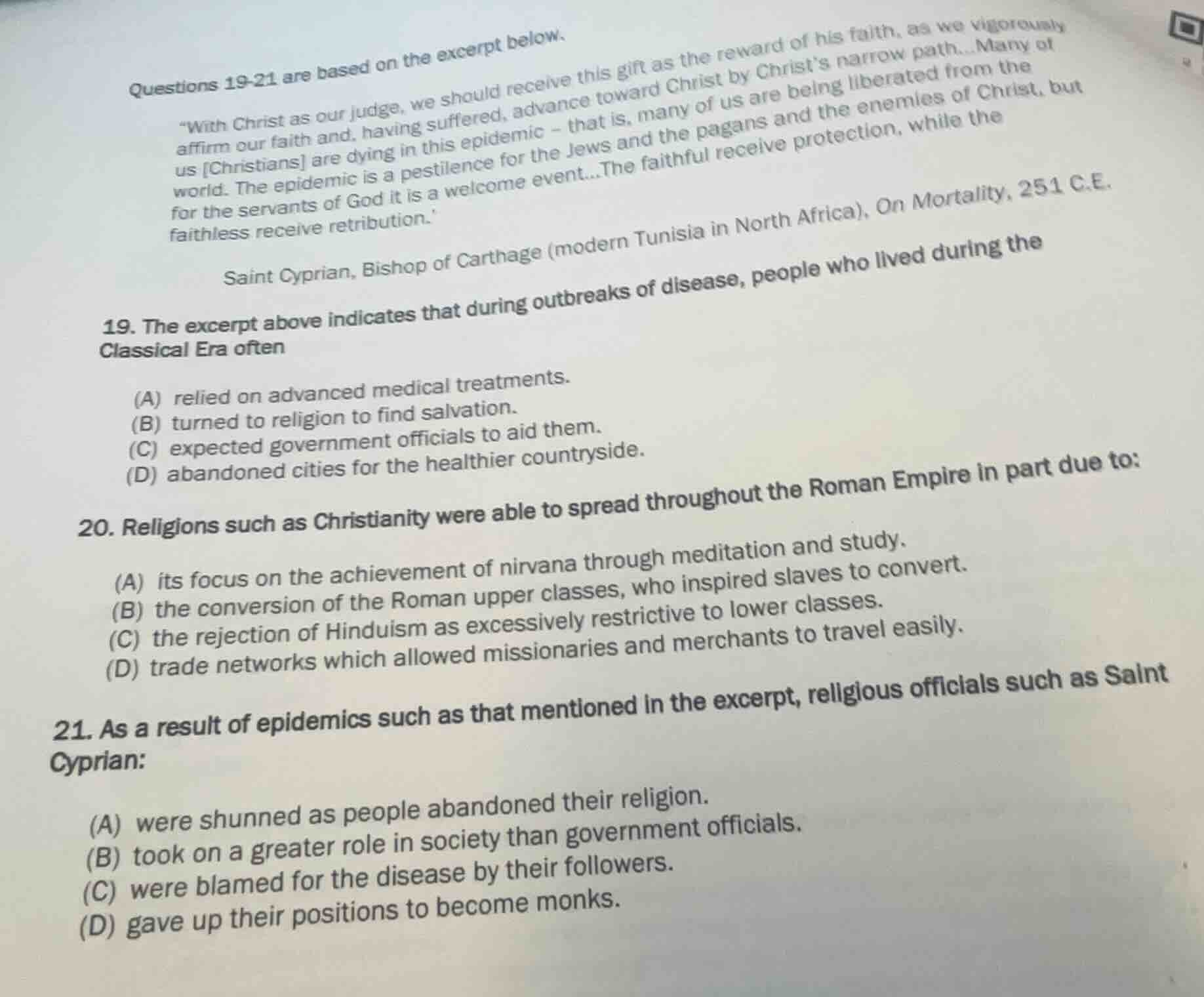
questions 19-21 are based on the excerpt below.
\with christ as our judge, we should receive this gift as the reward of his faith, as we vigorously affirm our faith and, having suffered, advance toward christ by christ’s narrow path...many of us christians are dying in this epidemic - that is, many of us are being liberated from the world. the epidemic is a pestilence for the jews and the pagans and the enemies of christ, but for the servants of god it is a welcome event...the faithful receive protection, while the faithless receive retribution.\
saint cyprian, bishop of carthage (modern tunisia in north africa), on mortality, 251 c.e.
- the excerpt above indicates that during outbreaks of disease, people who lived during the classical era often
(a) relied on advanced medical treatments.
(b) turned to religion to find salvation.
(c) expected government officials to aid them.
(d) abandoned cities for the healthier countryside.
- religions such as christianity were able to spread throughout the roman empire in part due to:
(a) its focus on the achievement of nirvana through meditation and study.
(b) the conversion of the roman upper classes, who inspired slaves to convert.
(c) the rejection of hinduism as excessively restrictive to lower classes.
(d) trade networks which allowed missionaries and merchants to travel easily.
- as a result of epidemics such as that mentioned in the excerpt, religious officials such as saint cyprian:
(a) were shunned as people abandoned their religion.
(b) took on a greater role in society than government officials.
(c) were blamed for the disease by their followers.
(d) gave up their positions to become monks.
Question 19
The excerpt shows people viewing the epidemic as a divine event, with faithful receiving protection and faithless retribution. Option A is wrong as advanced medical treatments weren't relied on. Option C is wrong as there's no mention of government aid. Option D is wrong as no mention of moving to countryside. Option B fits as people turned to religion (Christ) for salvation during disease outbreaks.
Christianity spread in Roman Empire. Option A is about Buddhism (nirvana), so wrong. Option B: Roman upper classes weren't main converters initially, and slaves converted more from lower - class appeal, so wrong. Option C: Hinduism is not relevant to Roman Empire's Christianity spread. Option D: Trade networks in Roman Empire allowed missionaries and merchants to travel, facilitating Christianity's spread, which is correct.
During epidemics, religious officials like Saint Cyprian had a role. Option A: People didn't abandon religion; the excerpt shows faith was affirmed. Option C: Religious officials weren't blamed; the epidemic was seen as divine, so wrong. Option D: No mention of giving up positions to be monks. Option B: Religious officials took on a greater role (providing spiritual guidance, interpreting divine will) than government officials during epidemics, which fits.

Snap & solve any problem in the app
Get step-by-step solutions on Sovi AI
Photo-based solutions with guided steps
Explore more problems and detailed explanations
B. turned to religion to find salvation.