QUESTION IMAGE
Question
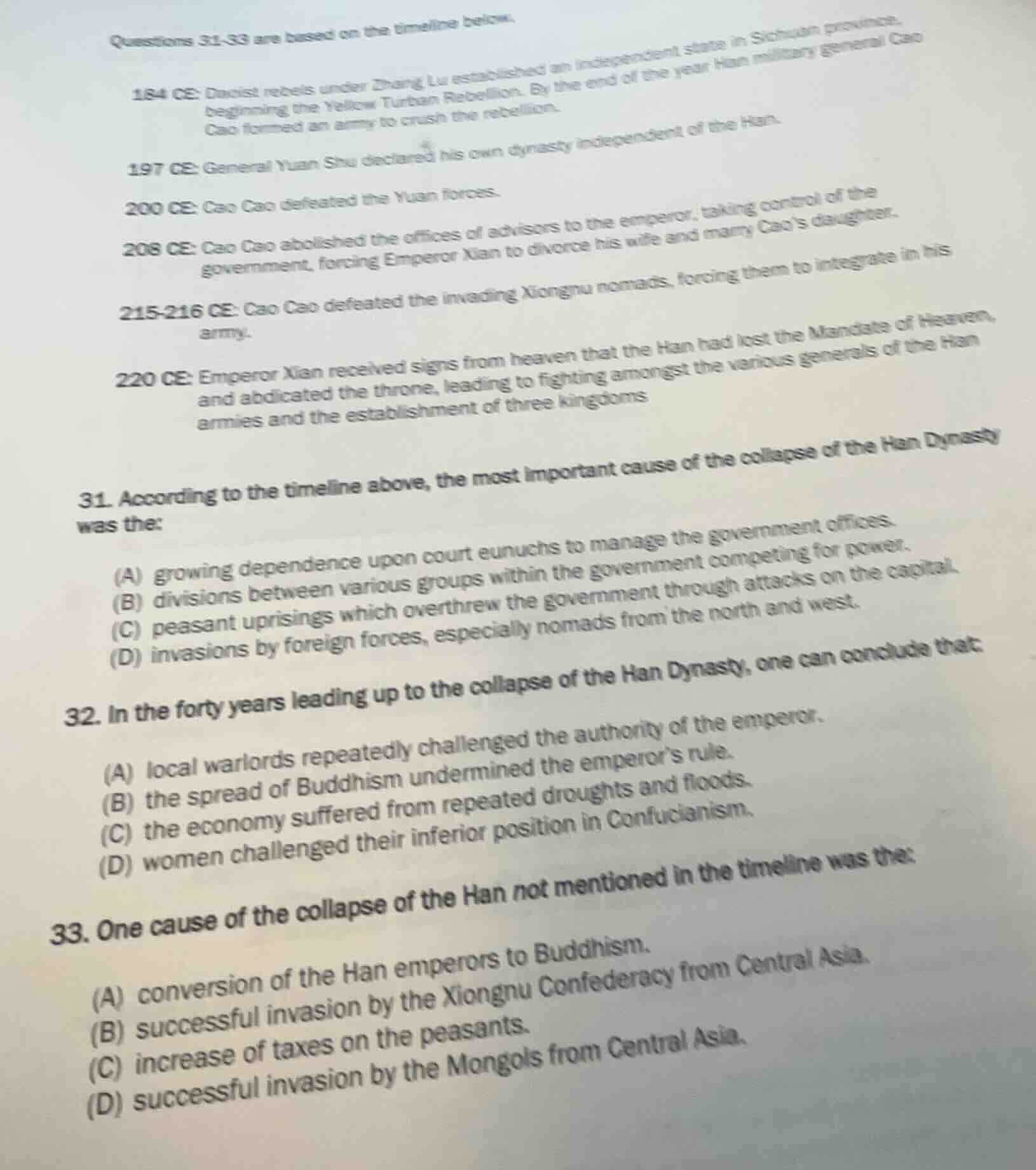
questions 31-33 are based on the timeline below.
184 ce: daoist rebels under zhang lu established an independent state in sichuan province, beginning the yellow turban rebellion. by the end of the year han military general cao cao formed an army to crush the rebellion.
197 ce: general yuan shu declared his own dynasty independent of the han.
200 ce: cao cao defeated the yuan forces.
208 ce: cao cao abolished the offices of advisors to the emperor, taking control of the government, forcing emperor xian to divorce his wife and marry cao’s daughter.
215-216 ce: cao cao defeated the invading xiongnu nomads, forcing them to integrate in his army.
220 ce: emperor xian received signs from heaven that the han had lost the mandate of heaven, and abdicated the throne, leading to fighting amongst the various generals of the han armies and the establishment of three kingdoms
- according to the timeline above, the most important cause of the collapse of the han dynasty was the:
(a) growing dependence upon court eunuchs to manage the government offices.
(b) divisions between various groups within the government competing for power.
(c) peasant uprisings which overthrew the government through attacks on the capital.
(d) invasions by foreign forces, especially nomads from the north and west.
- in the forty years leading up to the collapse of the han dynasty, one can conclude that:
(a) local warlords repeatedly challenged the authority of the emperor.
(b) the spread of buddhism undermined the emperor’s rule.
(c) the economy suffered from repeated droughts and floods.
(d) women challenged their inferior position in confucianism.
- one cause of the collapse of the han not mentioned in the timeline was the:
(a) conversion of the han emperors to buddhism.
(b) successful invasion by the xiongnu confederacy from central asia.
(c) increase of taxes on the peasants.
(d) successful invasion by the mongols from central asia.
Question 31
- Option A: The timeline has no mention of court eunuchs managing government offices. Eliminate A.
- Option B: The timeline shows events like Zhang Lu's independent state, Yuan Shu's dynasty, Cao Cao's actions, and later fighting among generals. These indicate divisions and power struggles within the government (warlords/groups competing). This matches.
- Option C: The Yellow Turban Rebellion (peasant uprising) was crushed by Cao Cao, and the timeline doesn't show it overthrowing the government. Eliminate C.
- Option D: The Xiongnu were defeated and integrated, not a main cause of collapse. Eliminate D.
- Option A: The timeline has events like Zhang Lu's rebellion, Yuan Shu's dynasty, Cao Cao's defeats of forces and taking control, showing local warlords (Zhang Lu, Yuan Shu, Cao Cao) challenging imperial authority. This fits.
- Option B: The timeline has no mention of Buddhism. Eliminate B.
- Option C: No mention of droughts/floods. Eliminate C.
- Option D: No mention of women challenging their position. Eliminate D.
- Option A: The timeline has no mention of Han emperors converting to Buddhism. But we check other options too.
- Option B: The Xiongnu were defeated (215 - 216 CE: Cao Cao defeated them and integrated into his army), so no successful invasion. Eliminate B.
- Option C: The timeline doesn't mention tax increases, but we need to check which is not mentioned. Wait, the question is "not mentioned in the timeline". Let's re - evaluate:
- The timeline has peasant uprisings (Yellow Turban), foreign invasions (Xiongnu, but they were defeated), but no mention of tax increase on peasants? Wait, no, let's check again. Wait, the options:
- Option A: No mention of emperor's conversion to Buddhism.
- Option B: Xiongnu were defeated, so their invasion was not successful (as per timeline: Cao Cao defeated them). So B is incorrect (since the timeline shows they were defeated, so B's "successful invasion" is wrong, but the question is about what's NOT mentioned? Wait, no, the question is "one cause of the collapse of the Han not mentioned in the timeline was the:". Wait, maybe I misread. Let's re - analyze:
- The timeline includes: peasant uprising (Yellow Turban), foreign invasion (Xiongnu, but defeated), warlord conflicts. Now, the options:
- A: Conversion to Buddhism: not in timeline.
- B: Xiongnu successful invasion: timeline says Cao Cao defeated them, so B's "successful invasion" is false (so it's a wrong cause, but also not mentioned as a cause? Wait, no, the timeline shows Xiongnu were defeated, so B's event didn't happen as described. But the question is about a cause not mentioned. Wait, maybe the intended answer is C? Wait, no, let's check again.
Wait, the Han Dynasty's collapse causes: common causes include tax increases on peasants (a typical cause of peasant uprisings and dynasty collapse, not mentioned in the timeline). But let's check the options again:
- Option A: No mention of emperor's Buddhism conversion.
- Option B: Xiongnu were defeated, so their invasion was not successful (timeline shows Cao Cao defeated them), so B's "successful invasion" is incorrect (so it's not a cause as per timeline, but also not mentioned as a cause? Maybe I made a mistake. Wait, the question is "not mentioned in the timeline". Let's check each option:
- A: No mention of emperor's conversion to Buddhism.
- B: Timeline shows Xiongnu were defeated (Cao Cao defeated them), so B's "successful invasion" is not what the timeline shows (so B is a wrong statement, but is it not mentioned? The timeline has the Xiongnu invasion attempt, but they were defeated. So B's "successful invasion" is not in the timeline (since they were defeated). But let's check other options.
- C: Tax increase on peasants: not mentioned in the timeline.
- D: Mongols: The Han Dynasty collapsed around 220 CE, and the Mongol invasions were much later (like during Yuan Dynasty - related, but Mongols as a force for Han collapse? No, Mongols came later. Wait, the Han Dynasty (Eastern Han) collapsed in 220 CE. Mongols were not a factor then. So D's "successful invasion by the Mongols" is not mentioned (and is historically incorrect as Mongols rose much later). But the question is about what's not mentioned in the timeline.
Wait, maybe the intended answer is C? No, let's go back. The timeline has peasant uprisings (Yellow Turban), foreign invasions (Xiongnu, but defeated), warlord conflicts. The options:
- A: Conversion to Buddhism: not in timeline.
- B: Xiongnu successful invasion: timeline shows they were defeated, so B's event is not as per time…

Snap & solve any problem in the app
Get step-by-step solutions on Sovi AI
Photo-based solutions with guided steps
Explore more problems and detailed explanations
B. divisions between various groups within the government competing for power.