QUESTION IMAGE
Question
questions
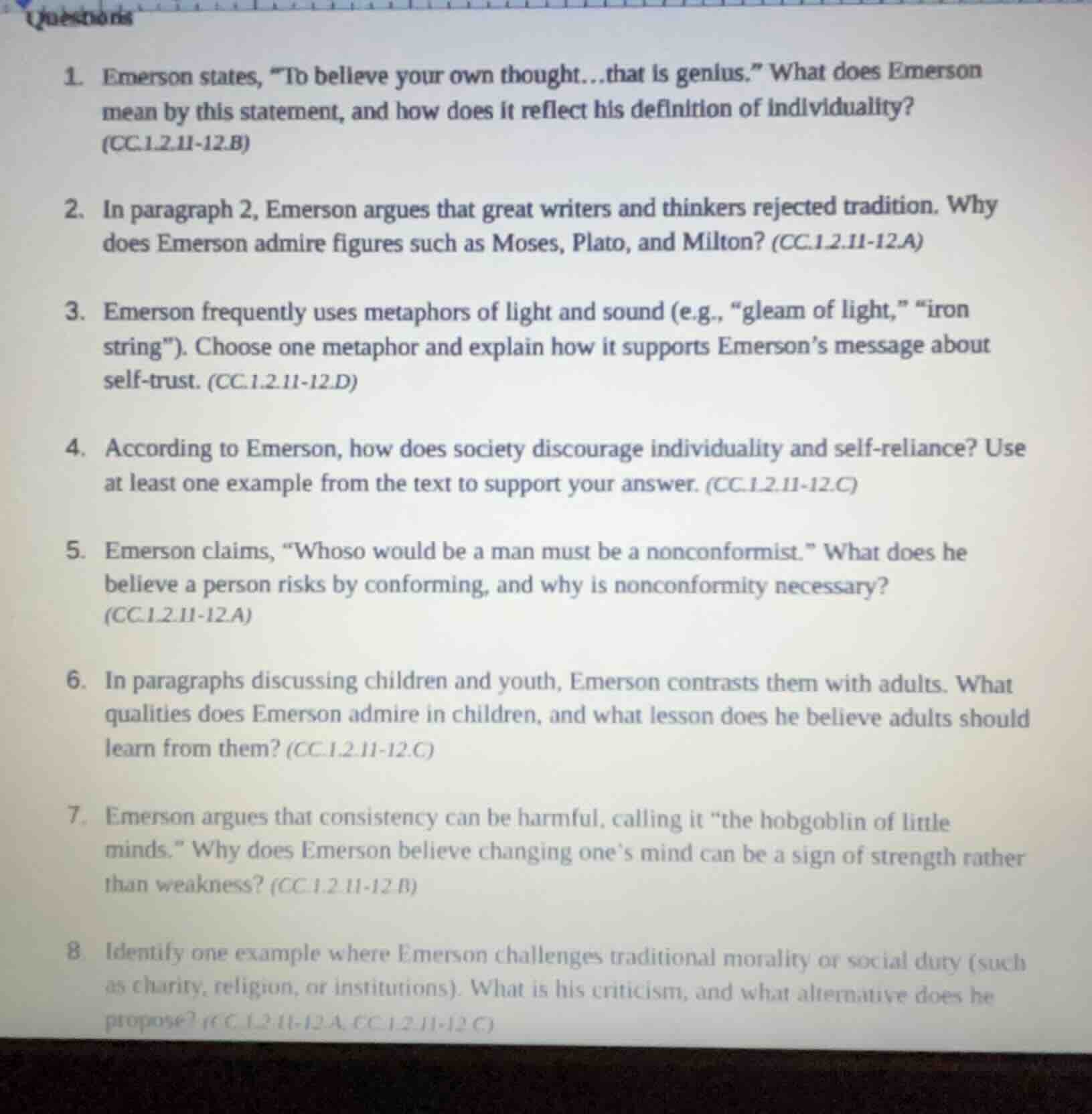
- emerson states, \to believe your own thought...that is genius.\ what does emerson mean by this statement, and how does it reflect his definition of individuality? (cc.1.2.11-12.b)
- in paragraph 2, emerson argues that great writers and thinkers rejected tradition. why does emerson admire figures such as moses, plato, and milton? (cc.1.2.11-12.a)
- emerson frequently uses metaphors of light and sound (e.g., \gleam of light,\ \iron string\). choose one metaphor and explain how it supports emersons message about self-trust. (cc.1.2.11-12.d)
- according to emerson, how does society discourage individuality and self-reliance? use at least one example from the text to support your answer. (cc.1.2.11-12.c)
- emerson claims, \whoso would be a man must be a nonconformist.\ what does he believe a person risks by conforming, and why is nonconformity necessary? (cc.1.2.11-12.a)
- in paragraphs discussing children and youth, emerson contrasts them with adults. what qualities does emerson admire in children, and what lesson does he believe adults should learn from them? (cc.1.2.11-12.c)
- emerson argues that consistency can be harmful, calling it \the hobgoblin of little minds.\ why does emerson believe changing ones mind can be a sign of strength rather than weakness? (cc.1.2.11-12.b)
- identify one example where emerson challenges traditional morality or social duty (such as charity, religion, or institutions). what is his criticism, and what alternative does he propose? (cc.1.2.11-12.a, cc.1.2.11-12.c)
Brief Explanations
- Question 1: Emerson means trusting one's innate, unfiltered ideas is the core of genius. This reflects his definition of individuality as embracing one's unique inner voice instead of conforming to external opinions; genius lies in refusing to dismiss one's own thoughts for the sake of fitting in.
- Question 2: Emerson admires these figures because they did not parrot existing traditions or ideas. Instead, they spoke and wrote from their own original, authentic perspectives, embodying the self-reliance and rejection of conformity he champions.
- Question 3: Taking the "iron string" metaphor: it represents the unbreakable, innate inner guide of self-trust. Emerson uses it to argue that people should rely on this internal "string" (their own convictions) rather than bending to external pressures, framing self-trust as a steadfast, unyielding force.
- Question 4: Society discourages these traits by enforcing conformity through norms and judgment. For example, Emerson notes that society favors "consistency" over authenticity, shaming people for changing their minds or deviating from group expectations, which pressures individuals to suppress their unique thoughts to avoid criticism.
- Question 5: Conforming risks losing one's true self, autonomy, and moral integrity, as people abandon their own values to follow others. Nonconformity is necessary because it is the only way to uphold individual identity, live authentically, and contribute original ideas to the world instead of being a passive follower.
- Question 6: Emerson admires children's unapologetic authenticity—they act on their immediate thoughts and desires without worrying about others' opinions. He argues adults should learn to reclaim this unselfconscious trust in their own instincts, instead of letting social norms suppress their individuality.
- Question 7: Emerson believes changing one's mind shows intellectual honesty and growth. It means a person is actively engaging with new ideas, trusting their evolving judgment instead of clinging to old beliefs just to appear consistent. This flexibility is a sign of a strong, independent mind rather than weakness.
- Question 8: Emerson challenges traditional charity: he criticizes it as a superficial, performative act that lets people feel virtuous without addressing root issues or truly connecting with those in need. He proposes that people should act on their own innate moral intuition instead of following rigid, institutionalized ideas of charity, prioritizing authentic, individual acts of care over formalized systems.

Snap & solve any problem in the app
Get step-by-step solutions on Sovi AI
Photo-based solutions with guided steps
Explore more problems and detailed explanations
- Emerson means trusting one's unique, unfiltered inner thoughts is genius. This reflects his view that individuality centers on embracing one's authentic voice rather than conforming to external expectations.
- He admires them because they rejected tradition to share their original, authentic ideas, embodying the self-reliance he advocates.
- The "iron string" metaphor represents the steadfast inner guide of self-trust. It supports his message by framing self-trust as an unbreakable force people should rely on instead of external pressures.
- Society enforces conformity via judgment and norms; for example, it shames people for changing their minds, pressuring them to suppress unique thoughts to avoid criticism.
- Conforming risks losing one's authentic self and autonomy. Nonconformity is necessary to uphold individual identity, live truthfully, and contribute original ideas.
- He admires children's unapologetic authenticity. Adults should learn to reclaim this unselfconscious trust in their own instincts.
- Changing one's mind shows intellectual growth and honesty, reflecting a strong, independent mind that adapts to new ideas instead of clinging to consistency for appearances.
- He challenges traditional charity, criticizing it as superficial and performative. He proposes acting on innate moral intuition instead of rigid institutionalized charity norms, prioritizing authentic, individual care.