QUESTION IMAGE
Question
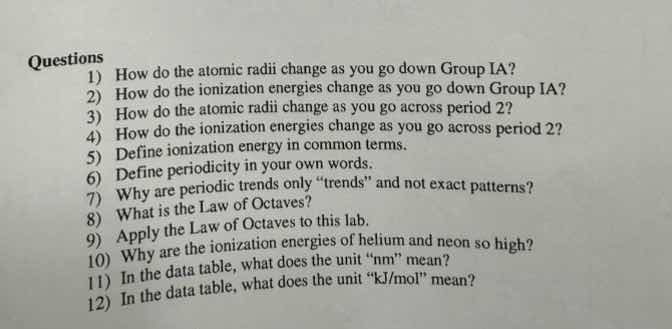
questions
- how do the atomic radii change as you go down group ia?
- how do the ionization energies change as you go down group ia?
- how do the atomic radii change as you go across period 2?
- how do the ionization energies change as you go across period 2?
- define ionization energy in common terms.
- define periodic in your own words.
- why are periodic trends only \trends\ and not exact patterns?
- what is the law of octaves?
- apply the law of octaves to this lab.
- why are the ionization energies of helium and neon so high?
- in the data table, what does the unit
m\ mean?
- in the data table, what does the unit \kj/mol\ mean?
1)
Group IA (alkali metals) has elements with increasing principal quantum number (\(n\)) as we go down. Atomic radius is related to the distance from nucleus to valence electrons. Larger \(n\) means electrons are in higher energy levels, farther from nucleus. So atomic radii increase down Group IA.
Ionization energy is energy to remove an electron. Down Group IA, atoms get larger (more electron shells), valence electrons are farther from nucleus, less attracted. So less energy needed to remove, ionization energies decrease down Group IA.
Across period 2, nuclear charge increases (more protons) while number of electron shells (\(n\)) stays same. More protons pull electrons closer, so ionic radii (for isoelectronic or same - shell species) decrease as nuclear charge dominates. So ionic radii decrease as you go across period 2.

Snap & solve any problem in the app
Get step-by-step solutions on Sovi AI
Photo-based solutions with guided steps
Explore more problems and detailed explanations
Atomic radii increase as you go down Group IA.