QUESTION IMAGE
Question
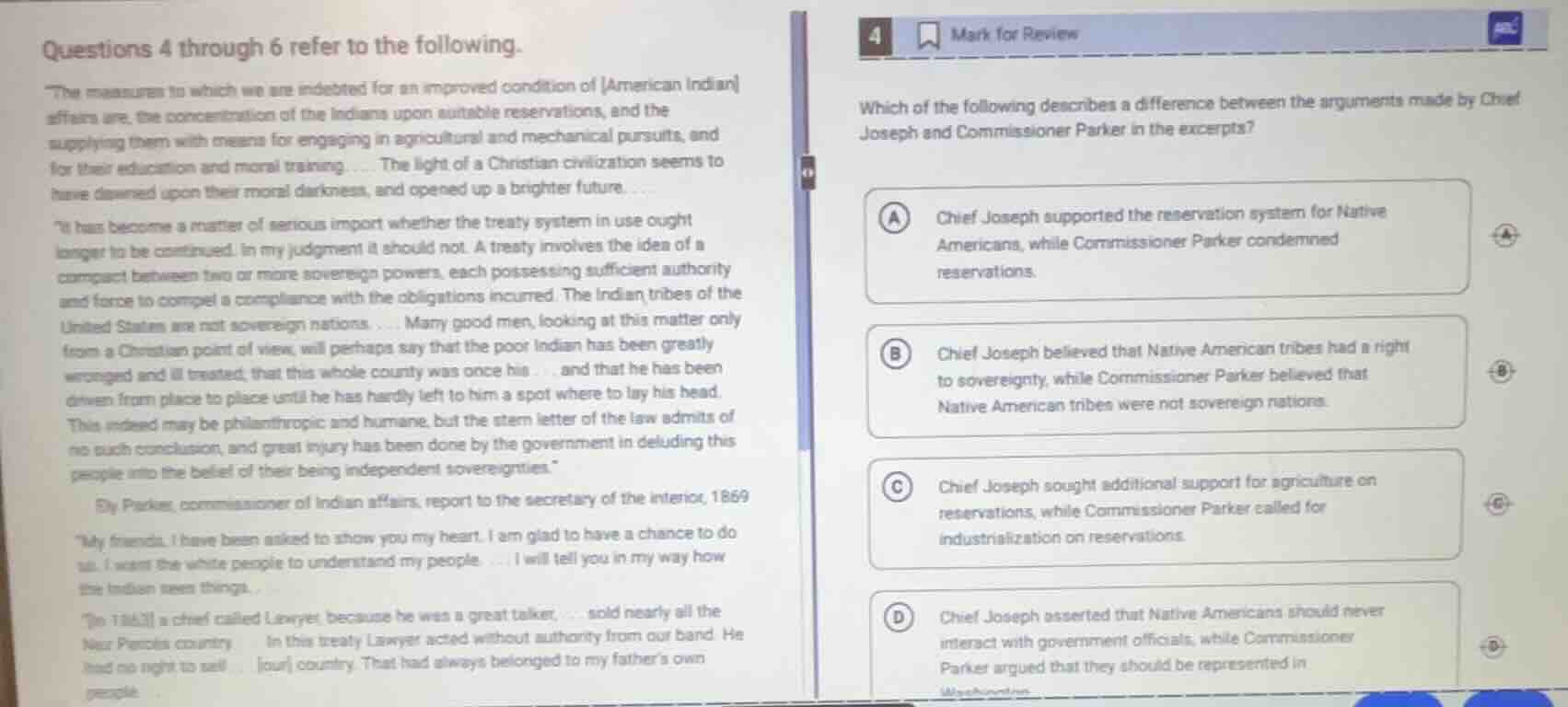
questions 4 through 6 refer to the following.\the measures to which we are indebted for an improved condition of american indian affairs are, the concentration of the indians upon suitable reservations, and the supplying them with means for engaging in agricultural and mechanical pursuits, and for their education and moral training. . . . the light of a christian civilization seems to have dawned upon their moral darkness, and opened up a brighter future. . .\it has become a matter of serious import whether the treaty system in use ought longer to be continued. in my judgment it should not. a treaty involves the idea of a compact between two or more sovereign powers, each possessing sufficient authority and force to compel a compliance with the obligations incurred. the indian tribes of the united states are not sovereign nations. . . . many good men, looking at this matter only from a christian point of view, will perhaps say that the poor indian has been greatly wronged and ill treated; that this whole county was once his. . . and that he has been driven from place to place until he has hardly left to him a spot where to lay his head. this indeed may be philanthropic and humane, but the stern letter of the law admits of no such conclusion, and great injury has been done by the government in deluding this people into the belief of their being independent sovereignties.\by parker, commissioner of indian affairs, report to the secretary of the interior, 1869\my friends, i have been asked to show you my heart. i am glad to have a chance to do so. i want the white people to understand my people. . . . i will tell you in my way how the indian sees things. . .\in 1863 a chief called lawyer because he was a great talker. . . sold nearly all the nez perces country. . . in this treaty lawyer acted without authority from our band. he had no right to sell. . . our country. that had always belonged to my fathers own people.4 mark for reviewwhich of the following describes a difference between the arguments made by chief joseph and commissioner parker in the excerpts?a chief joseph supported the reservation system for native americans, while commissioner parker condemned reservations.b chief joseph believed that native american tribes had a right to sovereignty, while commissioner parker believed that native american tribes were not sovereign nations.c chief joseph sought additional support for agriculture on reservations, while commissioner parker called for industrialization on reservations.d chief joseph asserted that native americans should never interact with government officials, while commissioner parker argued that they should be represented in
- Analyze Commissioner Parker's argument: He explicitly states "The Indian tribes of the United States are not sovereign nations" and argues against the treaty system (which relies on sovereign status).
- Analyze Chief Joseph's argument: He objects to a treaty signed without his band's authority, stating the land "had always belonged to my father's own people"—this implies he views his tribe as having inherent sovereignty and the right to control its land.
- Evaluate other options:
- A is incorrect: Parker supports reservations; Joseph opposes the system that displaced his people.
- C is incorrect: Parker mentions agricultural support, Joseph does not focus on agriculture/industrialization demands.
- D is incorrect: Joseph is communicating with white/government figures, not refusing interaction.

Snap & solve any problem in the app
Get step-by-step solutions on Sovi AI
Photo-based solutions with guided steps
Explore more problems and detailed explanations
B. Chief Joseph believed that Native American tribes had a right to sovereignty, while Commissioner Parker believed that Native American tribes were not sovereign nations.