QUESTION IMAGE
Question
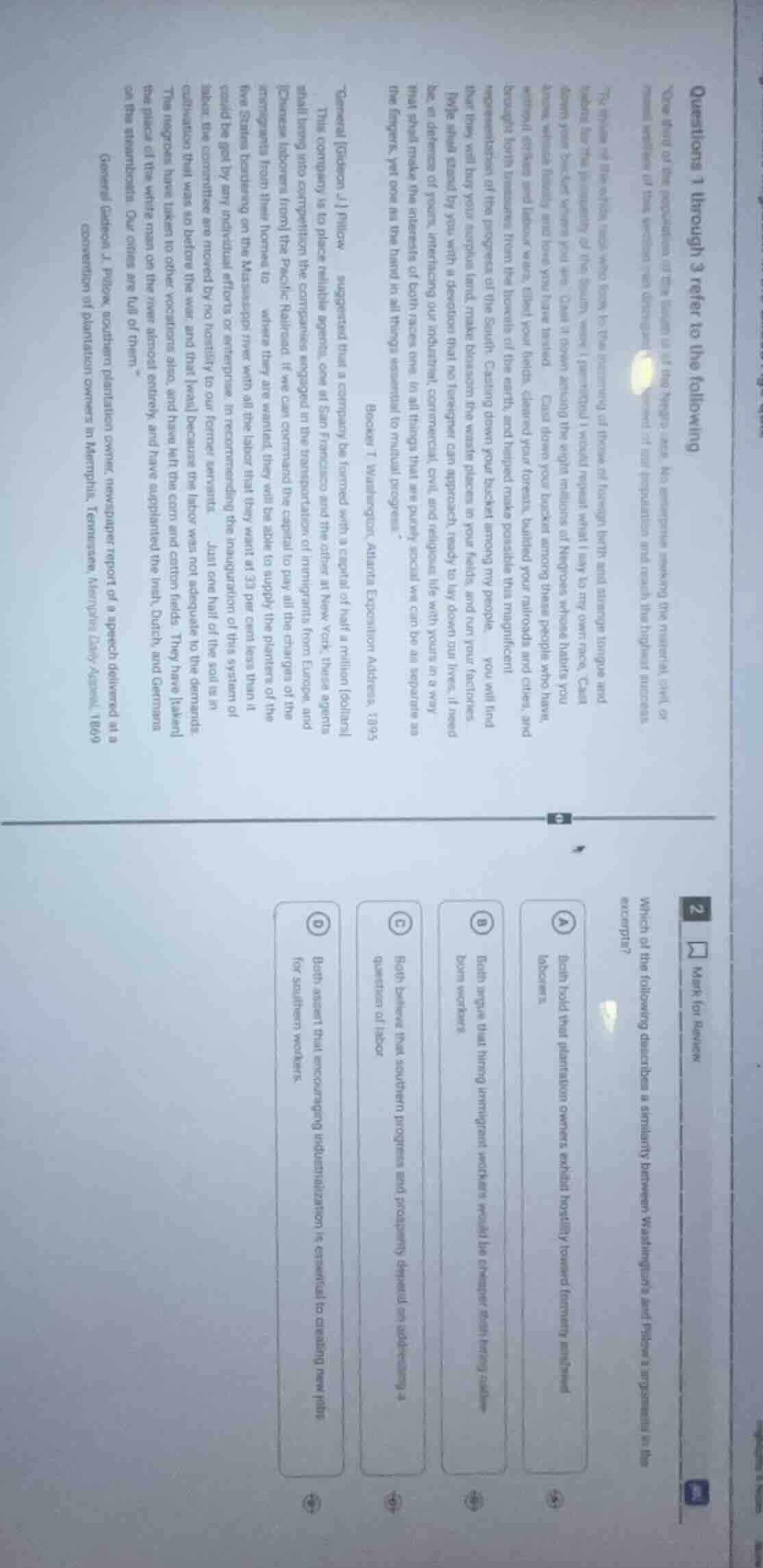
questions 1 through 3 refer to the following
view that of the production of the south is to the negro one no surprise seeking the material, steel, or
manual workers of the section new discoveries of the power of our population and reach the highest success.
to those of the white men who look to the incoming of those of foreign birth and strange tongue and
doubt the prosperity of the south, were i tempted i would repeat what i say to my own race. cast
down your bucket where you are. cast it down among the eight millions of negroes whose habits you
know, whose fidelity and love you have tested.
cast down your bucket among these people who have,
without strikes and labour wars, tilled your fields, cleared your forests, builded your railroads and cities, and
brought forth treasures from the bowels of the earth, and helped make possible this magnificent
representation of the progress of the south. casting down your bucket among my people,
you will find
that they will buy your surplus land, make blossom the waste places of your fields, and run your factories.
while shall stand by you with a devotion that no foreigner can approach, ready to lay down our lives, if need
be, in defence of yours, interlacing our industrial, commercial, civil, and religious life with yours in a way
that shall make the interests of both races one, in all things that are pure, social we can be as separate as
the fingers, yet one as the hand in all things essential to mutual progress.
booker t. washington, atlanta exposition address, 1895
general (josiah) j. pillow
suggested that a company be formed with a capital of half a million dollars
this company is to place reliable agents, one at san francisco and the other at new york, these agents
to be thrown into competition the companies employed in the transportation of the
chinese labourers from the pacific railroad. if we can command the side to supply the planters of the
south with their homes to
where they are wanted, they will be able to pay all the charges of the
few states bordering on the mississippi river with all the labour that they want at 33 per cent less than it
could be got by any individual efforts or enterprise in forwarding the inauguration of this system of
labor the committee are moved by no hostility to our former servants.
just our half of the soil is in
cultivation that was so before the war, and that soil because the labor was not adequate to the demands.
the negroes have taken to other vocations also, and have left the corn and cotton fields. they have taken
the place of the white men on the river almost entirely, and have supplanted the irish, dutch, and germans
on the steamboats. our cities are full of them.”
general gideon j. pillow, southern plantation owner, newspaper report of a speech delivered at a
convention of plantation owners in memphis, tennessee, memphis daily appeal, 1869
2 mark for review
which of the following describes a similarity between washington’s and pillow’s arguments in the
excerpts?
a
both hold that plantation owners exhibit hostility toward formerly enslaved
laborers.
b
both argue that bringing immigrant workers would be cheaper than using
born workers.
c
both believe that southern progress and prosperity depend on addressing a
question of labor.
d
both assert that encouraging industrialization is essential to creating new jobs
for southern workers.
- Booker T. Washington's address emphasizes Black labor's role in building the South's progress, framing cooperation for mutual advancement.
- General Pillow's speech proposes importing cheaper immigrant labor (Chinese workers) as a solution for Southern plantation labor needs, noting it would cost 33% less than individual enterprise labor.
- Option A is incorrect: Washington expresses no hostility to formerly enslaved people; Pillow refers to them as "former servants" with no stated hostility.
- Option B is incorrect: Washington does not argue for hiring immigrant workers; he focuses on Black labor's contributions.
- Option C is correct: Both tie Southern progress to labor solutions—Washington highlights existing Black labor's role in growth, Pillow frames immigrant labor as a way to meet plantation labor demands for prosperity.
- Option D is incorrect: Washington does not mention industrialization for new jobs; Pillow focuses on plantation labor replacement, not industrial job creation.

Snap & solve any problem in the app
Get step-by-step solutions on Sovi AI
Photo-based solutions with guided steps
Explore more problems and detailed explanations
C. Both believe that southern progress and prosperity depend on addressing a question of labor