QUESTION IMAGE
Question
questions:
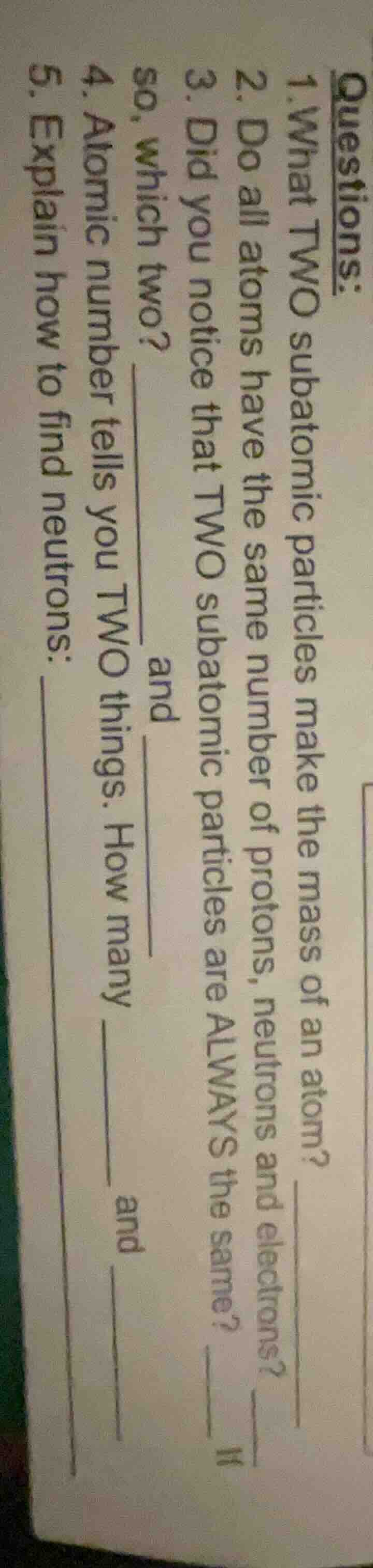
- what two subatomic particles make the mass of an atom?
- do all atoms have the same number of protons, neutrons and electrons?
- did you notice that two subatomic particles are always the same? so, which two?
____ and ____
- atomic number tells you two things. how many ____ and ____
- explain how to find neutrons:
Brief Explanations
- Electrons have negligible mass, so protons and neutrons contribute almost all of an atom's mass.
- Atoms can be ions (gain/lose electrons) or isotopes (different neutron counts), so these particle numbers vary.
- In neutral atoms, the positive charge of protons balances the negative charge of electrons, so their counts are equal.
- The atomic number is defined as the number of protons in an atom, and in neutral atoms, this equals the number of electrons.
- The mass number of an atom is the total of protons and neutrons, so rearranging this gives the neutron count.

Snap & solve any problem in the app
Get step-by-step solutions on Sovi AI
Photo-based solutions with guided steps
Explore more problems and detailed explanations
- Protons and neutrons
- No
- Protons and electrons
- Protons; electrons
- Subtract the atomic number (number of protons) from the mass number of the atom, i.e., $\text{Number of neutrons} = \text{Mass number} - \text{Atomic number}$