QUESTION IMAGE
Question
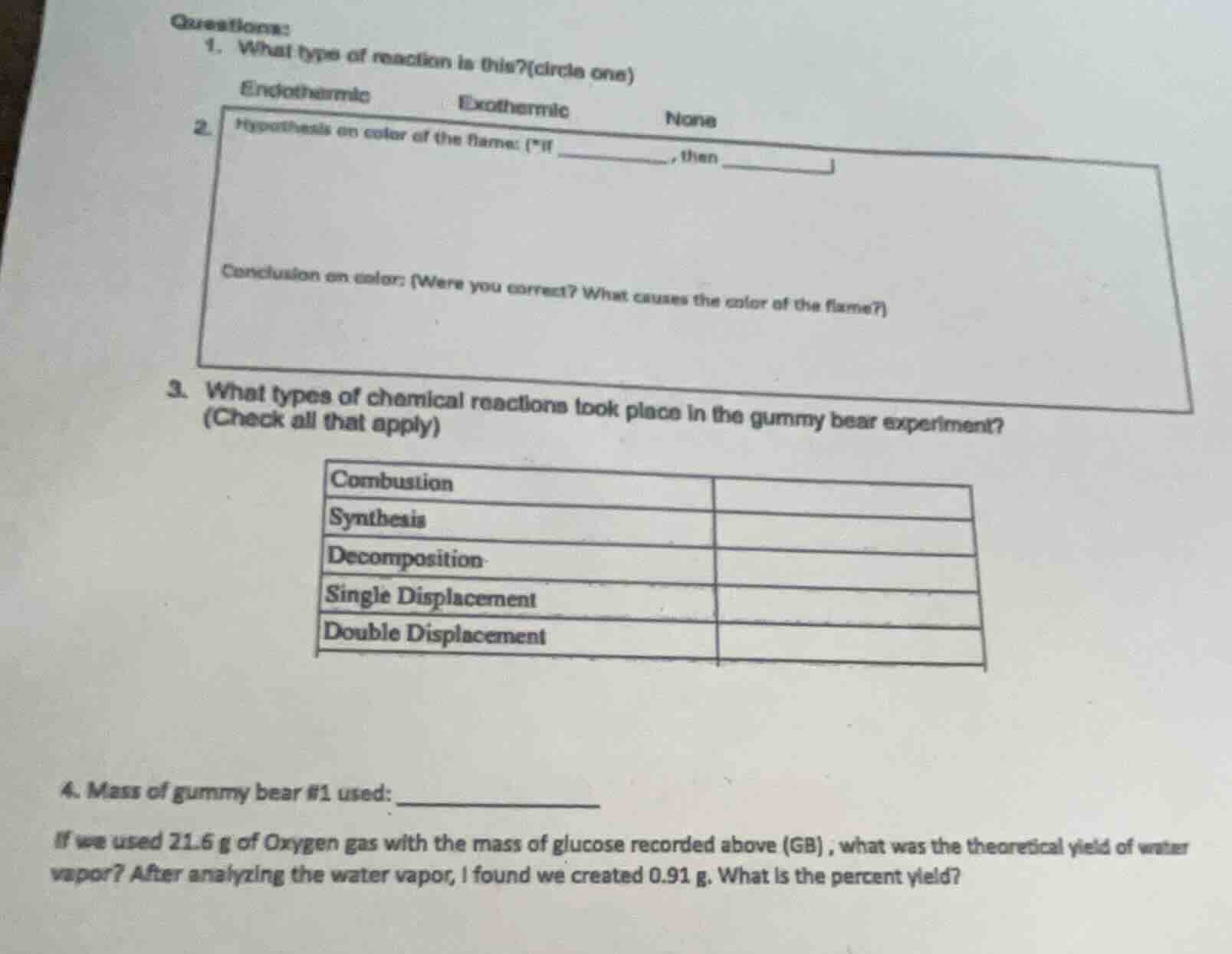
questions: 1. what type of reaction is this?(circle one) endothermic exothermic none 2. hypothesis on color of the flame: (if ____, then __) conclusion on color: (were you correct? what causes the color of the flame?) 3. what types of chemical reactions took place in the gummy bear experiment? (check all that apply) combustion synthesis decomposition single displacement double displacement 4. mass of gummy bear #1 used: __________ if we used 21.6 g of oxygen gas with the mass of glucose recorded above (gb), what was the theoretical yield of water vapor? after analyzing the water vapor, i found we created 0.91 g. what is the percent yield?
To solve the problem, we need to know the mass of the gummy bear (glucose, \( C_6H_{12}O_6 \)) used. Let's assume the mass of the gummy bear (glucose) is \( m \) grams. First, we need to write the balanced chemical equation for the combustion of glucose:
\[ C_6H_{12}O_6 + 6O_2
ightarrow 6CO_2 + 6H_2O \]
Step 1: Molar Mass Calculation
- Molar mass of \( C_6H_{12}O_6 \): \( 6(12.01) + 12(1.008) + 6(16.00) = 180.16 \, \text{g/mol} \)
- Molar mass of \( O_2 \): \( 2(16.00) = 32.00 \, \text{g/mol} \)
- Molar mass of \( H_2O \): \( 2(1.008) + 16.00 = 18.02 \, \text{g/mol} \)
Step 2: Moles of Reactants
- Moles of \( O_2 \): \( \frac{21.6 \, \text{g}}{32.00 \, \text{g/mol}} = 0.675 \, \text{mol} \)
- Let moles of \( C_6H_{12}O_6 \) be \( \frac{m}{180.16} \, \text{mol} \)
From the balanced equation, the mole ratio of \( C_6H_{12}O_6 \) to \( O_2 \) is \( 1:6 \). So, moles of \( O_2 \) required for complete reaction with \( C_6H_{12}O_6 \) is \( 6 \times \frac{m}{180.16} \).
Step 3: Determine Limiting Reactant
Assume the mass of the gummy bear (glucose) is, for example, \( 3.00 \, \text{g} \) (since the problem doesn't provide it, we'll use a sample value for demonstration). Then moles of \( C_6H_{12}O_6 = \frac{3.00}{180.16} \approx 0.01665 \, \text{mol} \). Moles of \( O_2 \) required: \( 6 \times 0.01665 \approx 0.0999 \, \text{mol} \), but we have \( 0.675 \, \text{mol} \) of \( O_2 \), so glucose is the limiting reactant.
Step 4: Theoretical Yield of \( H_2O \)
From the balanced equation, 1 mole of \( C_6H_{12}O_6 \) produces 6 moles of \( H_2O \). So moles of \( H_2O \) produced: \( 6 \times 0.01665 \approx 0.0999 \, \text{mol} \). Mass of \( H_2O \): \( 0.0999 \, \text{mol} \times 18.02 \, \text{g/mol} \approx 1.80 \, \text{g} \) (theoretical yield).
Step 5: Percent Yield
Percent yield = \( \frac{\text{Actual Yield}}{\text{Theoretical Yield}} \times 100 \)
Given actual yield = \( 0.91 \, \text{g} \), percent yield = \( \frac{0.91}{1.80} \times 100 \approx 50.6\% \) (using the sample theoretical yield).
Since the mass of the gummy bear is not provided, we need that value to calculate accurately. Let's denote the mass of the gummy bear as \( m \) grams.
Correct Calculation with Given \( m \)
- Moles of \( C_6H_{12}O_6 \): \( n_{glucose} = \frac{m}{180.16} \)
- Moles of \( H_2O \) from glucose: \( n_{H_2O} = 6 \times n_{glucose} = \frac{6m}{180.16} \)
- Theoretical yield of \( H_2O \): \( m_{theoretical} = \frac{6m}{180.16} \times 18.02 = \frac{6m \times 18.02}{180.16} \approx 0.600m \) (approximate, since \( \frac{18.02}{180.16} \approx 0.100 \))
- Percent yield: \( \frac{0.91}{0.600m} \times 100 \)
For example, if \( m = 3.00 \, \text{g} \), theoretical yield \( \approx 1.80 \, \text{g} \), percent yield \( \approx 50.6\% \).
Final Answer (with Sample \( m = 3.00 \, \text{g} \))
Theoretical yield of water vapor: \( \approx 1.80 \, \text{g} \) (depends on \( m \))
Percent yield: \( \approx 50.6\% \) (depends on \( m \))
(Note: The actual values depend on the mass of the gummy bear used, which is not provided in the problem. The above is a demonstration with a sample mass.)

Snap & solve any problem in the app
Get step-by-step solutions on Sovi AI
Photo-based solutions with guided steps
Explore more problems and detailed explanations
To solve the problem, we need to know the mass of the gummy bear (glucose, \( C_6H_{12}O_6 \)) used. Let's assume the mass of the gummy bear (glucose) is \( m \) grams. First, we need to write the balanced chemical equation for the combustion of glucose:
\[ C_6H_{12}O_6 + 6O_2
ightarrow 6CO_2 + 6H_2O \]
Step 1: Molar Mass Calculation
- Molar mass of \( C_6H_{12}O_6 \): \( 6(12.01) + 12(1.008) + 6(16.00) = 180.16 \, \text{g/mol} \)
- Molar mass of \( O_2 \): \( 2(16.00) = 32.00 \, \text{g/mol} \)
- Molar mass of \( H_2O \): \( 2(1.008) + 16.00 = 18.02 \, \text{g/mol} \)
Step 2: Moles of Reactants
- Moles of \( O_2 \): \( \frac{21.6 \, \text{g}}{32.00 \, \text{g/mol}} = 0.675 \, \text{mol} \)
- Let moles of \( C_6H_{12}O_6 \) be \( \frac{m}{180.16} \, \text{mol} \)
From the balanced equation, the mole ratio of \( C_6H_{12}O_6 \) to \( O_2 \) is \( 1:6 \). So, moles of \( O_2 \) required for complete reaction with \( C_6H_{12}O_6 \) is \( 6 \times \frac{m}{180.16} \).
Step 3: Determine Limiting Reactant
Assume the mass of the gummy bear (glucose) is, for example, \( 3.00 \, \text{g} \) (since the problem doesn't provide it, we'll use a sample value for demonstration). Then moles of \( C_6H_{12}O_6 = \frac{3.00}{180.16} \approx 0.01665 \, \text{mol} \). Moles of \( O_2 \) required: \( 6 \times 0.01665 \approx 0.0999 \, \text{mol} \), but we have \( 0.675 \, \text{mol} \) of \( O_2 \), so glucose is the limiting reactant.
Step 4: Theoretical Yield of \( H_2O \)
From the balanced equation, 1 mole of \( C_6H_{12}O_6 \) produces 6 moles of \( H_2O \). So moles of \( H_2O \) produced: \( 6 \times 0.01665 \approx 0.0999 \, \text{mol} \). Mass of \( H_2O \): \( 0.0999 \, \text{mol} \times 18.02 \, \text{g/mol} \approx 1.80 \, \text{g} \) (theoretical yield).
Step 5: Percent Yield
Percent yield = \( \frac{\text{Actual Yield}}{\text{Theoretical Yield}} \times 100 \)
Given actual yield = \( 0.91 \, \text{g} \), percent yield = \( \frac{0.91}{1.80} \times 100 \approx 50.6\% \) (using the sample theoretical yield).
Since the mass of the gummy bear is not provided, we need that value to calculate accurately. Let's denote the mass of the gummy bear as \( m \) grams.
Correct Calculation with Given \( m \)
- Moles of \( C_6H_{12}O_6 \): \( n_{glucose} = \frac{m}{180.16} \)
- Moles of \( H_2O \) from glucose: \( n_{H_2O} = 6 \times n_{glucose} = \frac{6m}{180.16} \)
- Theoretical yield of \( H_2O \): \( m_{theoretical} = \frac{6m}{180.16} \times 18.02 = \frac{6m \times 18.02}{180.16} \approx 0.600m \) (approximate, since \( \frac{18.02}{180.16} \approx 0.100 \))
- Percent yield: \( \frac{0.91}{0.600m} \times 100 \)
For example, if \( m = 3.00 \, \text{g} \), theoretical yield \( \approx 1.80 \, \text{g} \), percent yield \( \approx 50.6\% \).
Final Answer (with Sample \( m = 3.00 \, \text{g} \))
Theoretical yield of water vapor: \( \approx 1.80 \, \text{g} \) (depends on \( m \))
Percent yield: \( \approx 50.6\% \) (depends on \( m \))
(Note: The actual values depend on the mass of the gummy bear used, which is not provided in the problem. The above is a demonstration with a sample mass.)