QUESTION IMAGE
Question
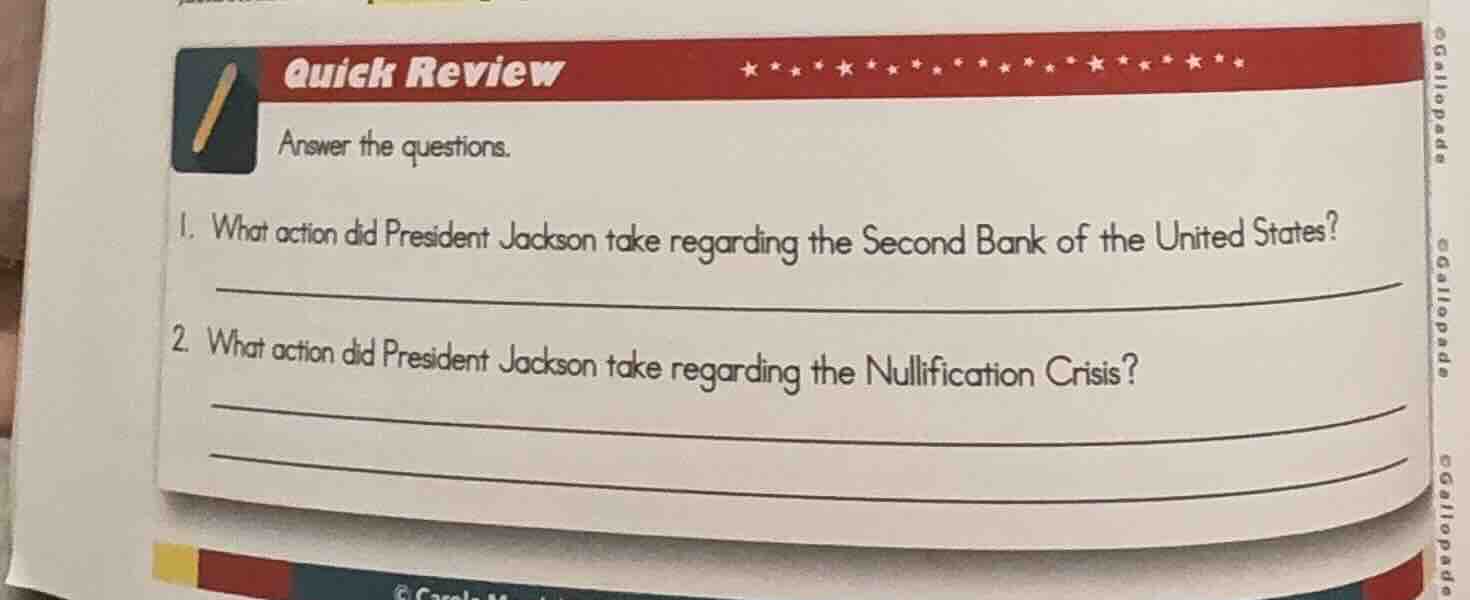
quick review
answer the questions.
- what action did president jackson take regarding the second bank of the united states?
- what action did president jackson take regarding the nullification crisis?
Brief Explanations
- President Andrew Jackson viewed the Second Bank as an elitist institution that favored the wealthy over ordinary citizens, so he took direct steps to eliminate its federal support and power.
- During the Nullification Crisis (centered on South Carolina's refusal to enforce federal tariffs), Jackson prioritized upholding federal authority while also accepting a tariff compromise to avoid armed conflict.

Snap & solve any problem in the app
Get step-by-step solutions on Sovi AI
Photo-based solutions with guided steps
Explore more problems and detailed explanations
- He vetoed the recharter of the Second Bank of the United States in 1832, and then moved federal funds into state-chartered "pet banks" to weaken the national bank, effectively dismantling it by the end of his presidency.
- He firmly opposed nullification, declared it unconstitutional, pushed Congress to pass the Force Bill (authorizing him to use military force to enforce federal tariffs in South Carolina), and also reached a compromise tariff to defuse tensions.