QUESTION IMAGE
Question
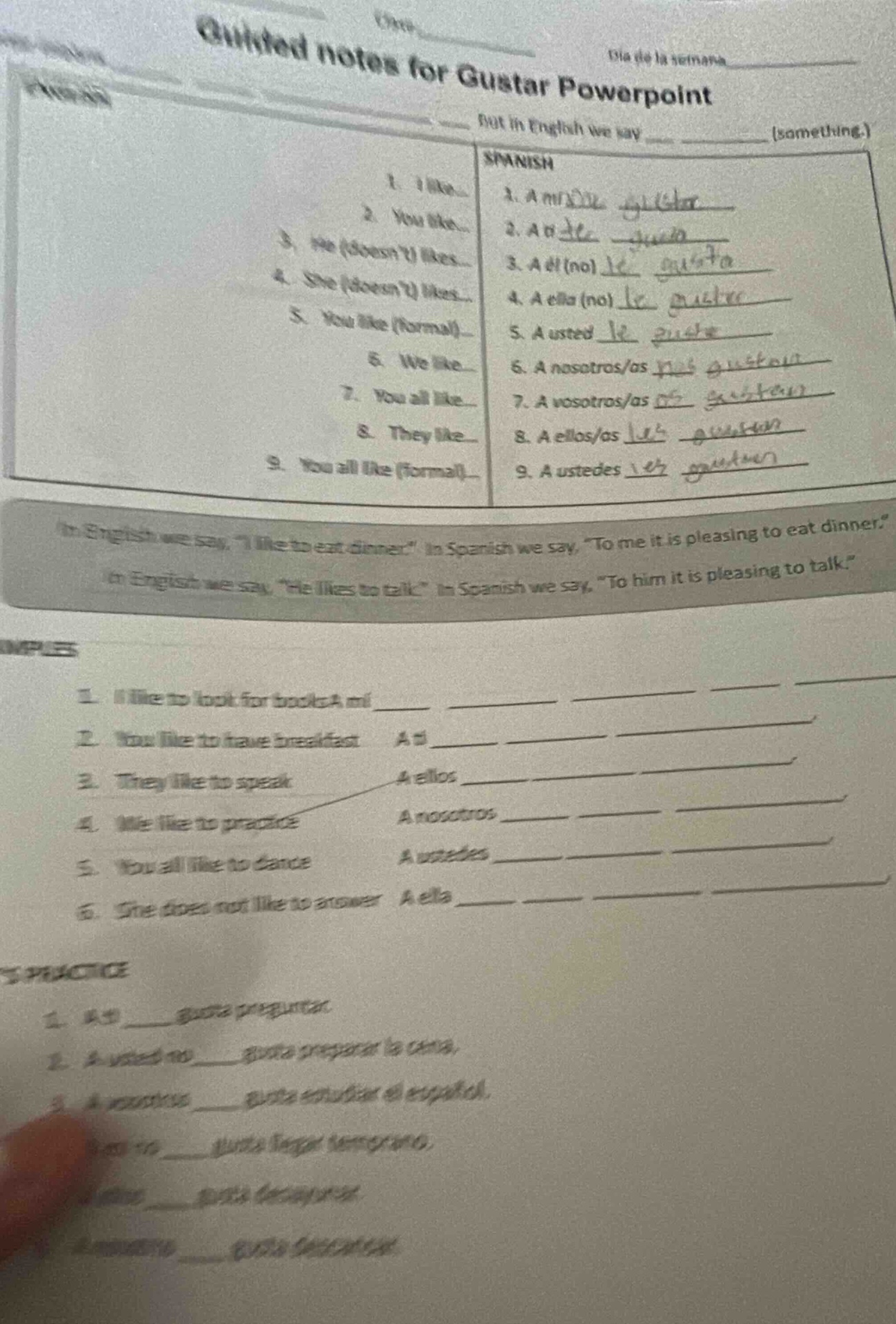
quitfed notes for gustar powerpoint
but in english we say (something.)
- i like...
- you like...
- he (doesnt) likes...
- she (doesnt) likes...
- you like (formal)...
- we like...
- you all like...
- they like...
- you all like (formal)...
spanish
- a mí
- a ti
- a él (no)
- a ella (no)
- a usted
- a nosotros/as
- a vosotros/as
- a ellos/as
- a ustedes
in english we say, \i like to eat dinner.\ in spanish we say, \to me it is pleasing to eat dinner.\
in english we say, \he likes to talk.\ in spanish we say, \to him it is pleasing to talk.\
examples
- i like to look for books a mí
- you like to have breakfast a ti
- they like to speak a ellos
- we like to practice a nosotros
- you all like to dance a ustedes
- she does not like to answer a ella
practice
- a él gusta preguntar.
- a usted no gusta preparar la cena.
- a vosotros gusta estudiar el español.
gusta llegar temprano.
gusta descansar.
gusta bailar.
To solve these Spanish "gustar" - related problems, we use the structure of the verb "gustar" which is used to express likes or dislikes. The general structure is "A + [person] + [indirect object pronoun] + gusta/gustan + [infinitive/noun]". The indirect object pronouns depend on the person: me (for I), te (for you - informal), le (for he, she, you - formal), nos (for we), os (for you all - informal), les (for they, you all - formal). For singular nouns or infinitives, we use "gusta", and for plural nouns, we use "gustan".
Examples Section
- I like to look for books
- Step 1: Identify the person: "I" corresponds to "me" as the indirect object pronoun. The infinitive verb is "buscar" (to look for) and the noun "libros" (books, plural). Since "libros" is plural, we use "gustan".
- Step 2: Construct the sentence: "A mí me gustan buscar libros"
- You like to have breakfast
- Step 1: The person is "you" (informal), so the indirect object pronoun is "te". The infinitive is "desayunar" (to have breakfast). Since it's an infinitive (singular - like), we use "gusta".
- Step 2: The sentence is "A ti te gusta desayunar"
- They like to speak
- Step 1: The person is "they", so the indirect object pronoun is "les". The infinitive is "hablar" (to speak). Since it's an infinitive, we use "gusta".
- Step 2: The sentence is "A ellos les gusta hablar"
- We like to practice
- Step 1: The person is "we", so the indirect object pronoun is "nos". The infinitive is "practicar" (to practice). Since it's an infinitive, we use "gusta".
- Step 2: The sentence is "A nosotros nos gusta practicar"
- You all like to dance
- Step 1: The person is "you all" (formal - "ustedes"), so the indirect object pronoun is "les". The infinitive is "bailar" (to dance). Since it's an infinitive, we use "gusta".
- Step 2: The sentence is "A ustedes les gusta bailar"
- She does not like to answer
- Step 1: The person is "she", so the indirect object pronoun is "le". The infinitive is "responder" (to answer). We add "no" for the negative. Since it's an infinitive, we use "gusta".
- Step 2: The sentence is "A ella no le gusta responder"
Practice Section
- A él ____ gusta preguntar
- Step 1: The person is "he", so the indirect object pronoun is "le".
- Step 2: Fill in the blank: "le"
- A usted no ____ gusta preparar la cena
- Step 1: The person is "you" (formal), so the indirect object pronoun is "le".
- Step 2: Fill in the blank: "le"
- A vosotros ____ gusta estudiar el español
- Step 1: The person is "you all" (informal), so the indirect object pronoun is "os".
- Step 2: Fill in the blank: "os"
- A mí no ____ gusta llegar temprano
- Step 1: The person is "I", so the indirect object pronoun is "me".
- Step 2: Fill in the blank: "me"
- A ellos ____ gusta descansar
- Step 1: The person is "they", so the indirect object pronoun is "les".
- Step 2: Fill in the blank: "les"
- A nosotros ____ gusta bailar
- Step 1: The person is "we", so the indirect object pronoun is "nos".
- Step 2: Fill in the blank: "nos"
Qualified Notes Section (assuming we are filling the Spanish equivalents)
- I like...
- Step 1: The person is "I", indirect object pronoun "me", and for a general "like" (assuming a singular - like situation), we use "gusta".
- Step 2: "A mí me gusta"
- You like...
- Step 1: Person is "you" (informal), indirect object pronoun "te", and "gusta".
- Step 2: "A ti te gusta"
- **He (doesn't) lik…

Snap & solve any problem in the app
Get step-by-step solutions on Sovi AI
Photo-based solutions with guided steps
Explore more problems and detailed explanations
s
Examples
- A mí me gustan buscar libros
- A ti te gusta desayunar
- A ellos les gusta hablar
- A nosotros nos gusta practicar
- A ustedes les gusta bailar
- A ella no le gusta responder
Practice
- le
- le
- os
- me
- les
- nos
Qualified Notes (Spanish equivalents)
- A mí me gusta
- A ti te gusta
- A él (no) le gusta
- A ella (no) le gusta
- A usted le gusta
- A nosotros nos gusta
- A vosotros os gusta
- A ellos les gusta
- A ustedes les gusta