QUESTION IMAGE
Question
quoted words
notice & note: mark the words in paragraph 2 that tell you the author is quoting a sports expert to support her beliefs on love.
cite evidence: how does this quotation relate to the author’s thesis statement?
generate questions
annotate: mark the statements in paragraph 4 that show the author thinks love can be both a positive and a negative force.
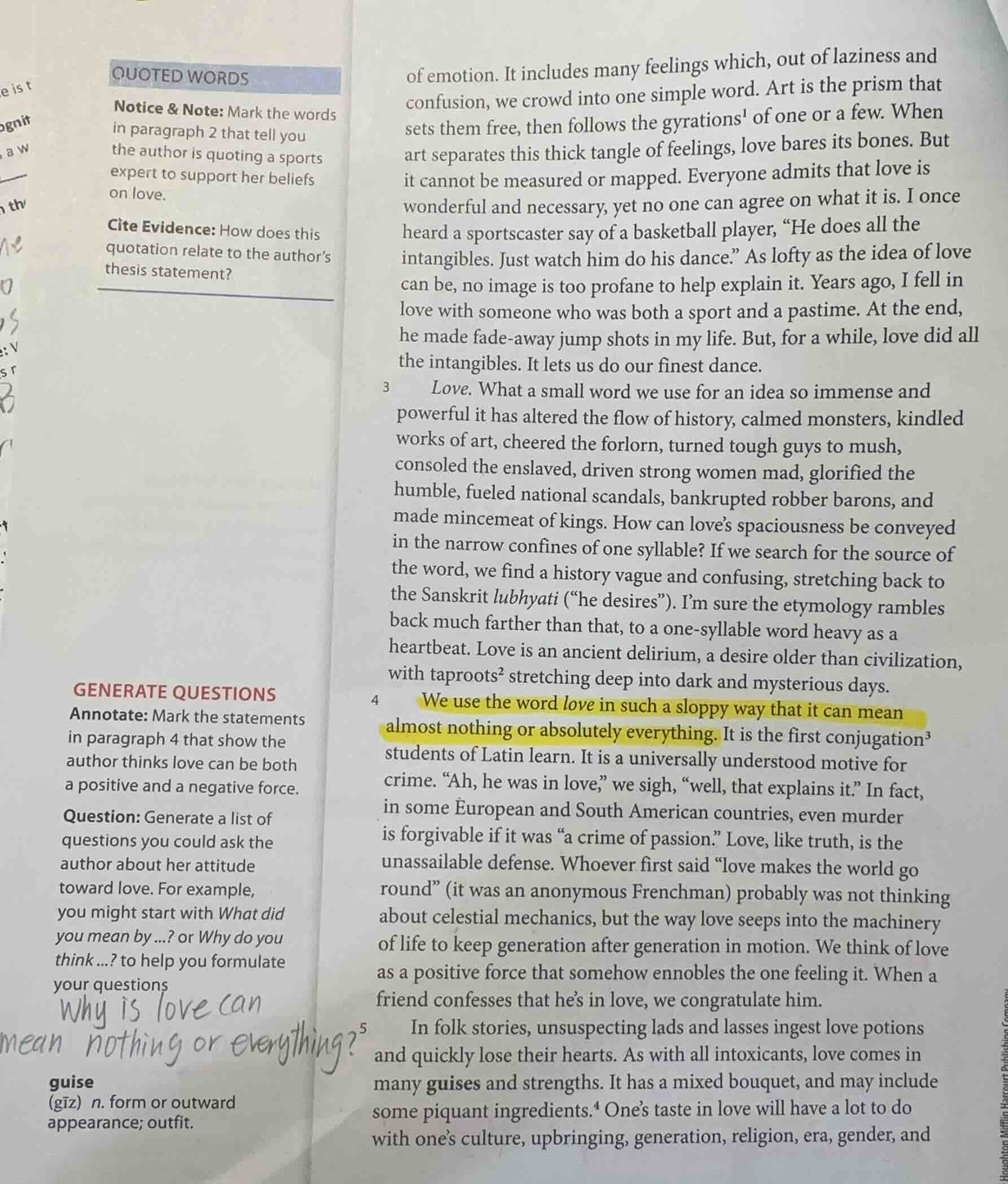
question: generate a list of questions you could ask the author about her attitude toward love. for example, you might start with what did you mean by...? or why do you think...? to help you formulate your questions
why is love can mean nothing or everything?
guise
(gīz) n. form or outward appearance; outfit.
of emotion. it includes many feelings which, out of laziness and confusion, we crowd into one simple word. art is the prism that sets them free, then follows the gyrations¹ of one or a few. when art separates this thick tangle of feelings, love bares its bones. but it cannot be measured or mapped. everyone admits that love is wonderful and necessary, yet no one can agree on what it is. i once heard a sportscaster say of a basketball player, “he does all the intangibles. just watch him do his dance.” as lofty as the idea of love can be, no image is too profane to help explain it. years ago, i fell in love with someone who was both a sport and a pastime. at the end, he made fade - away jump shots in my life. but, for a while, love did all the intangibles. it lets us do our finest dance.
3 love. what a small word we use for an idea so immense and powerful it has altered the flow of history, calmed monsters, kindled works of art, cheered the forlorn, turned tough guys to mush, consoled the enslaved, driven strong women mad, glorified the humble, fueled national scandals, bankrupted robber barons, and made mincemeat of kings. how can love’s spaciousness be conveyed in the narrow confines of one syllable? if we search for the source of the word, we find a history vague and confusing, stretching back to the sanskrit lubhyati (“he desires”). i’m sure the etymology rambles back much farther than that, to a one - syllable word heavy as a heartbeat. love is an ancient delirium, a desire older than civilization, with taproots² stretching deep into dark and mysterious days.
4 we use the word love in such a sloppy way that it can mean almost nothing or absolutely everything. it is the first conjugation³ students of latin learn. it is a universally understood motive for crime. “ah, he was in love,” we sigh, “well, that explains it.” in fact, in some european and south american countries, even murder is forgivable if it was “a crime of passion.” love, like truth, is the unassailable defense. whoever first said “love makes the world go round” (it was an anonymous frenchman) probably was not thinking about celestial mechanics, but the way love seeps into the machinery of life to keep generation after generation in motion. we think of love as a positive force that somehow ennobles the one feeling it. when a friend confesses that he’s in love, we congratulate him.
5 in folk stories, unsuspecting lads and lasses ingest love potions and quickly lose their hearts. as with all intoxicants, love comes in many guises and strengths. it has a mixed bouquet, and may include some piquant ingredients.⁴ one’s taste in love will have a lot to do with one’s culture, upbringing, generation, religion, era, gender, and
To generate questions about the author's attitude toward love, we can use the given text and the example structure. Here are some questions:
- What did you mean by saying love is "an ancient delirium"?
- Why do you think love can be both a positive and negative force?
- What made you describe love as having "taproots stretching deep into dark and mysterious days"?
- Why do you believe our use of the word "love" is sloppy?
- How does the comparison of love to an intoxicant help explain your view on love?
These questions are formulated using the suggested structures (e.g., "What did you mean by...?", "Why do you think...?") and focus on the author’s attitude and descriptions of love from the text.

Snap & solve any problem in the app
Get step-by-step solutions on Sovi AI
Photo-based solutions with guided steps
Explore more problems and detailed explanations
To generate questions about the author's attitude toward love, we can use the given text and the example structure. Here are some questions:
- What did you mean by saying love is "an ancient delirium"?
- Why do you think love can be both a positive and negative force?
- What made you describe love as having "taproots stretching deep into dark and mysterious days"?
- Why do you believe our use of the word "love" is sloppy?
- How does the comparison of love to an intoxicant help explain your view on love?
These questions are formulated using the suggested structures (e.g., "What did you mean by...?", "Why do you think...?") and focus on the author’s attitude and descriptions of love from the text.