QUESTION IMAGE
Question
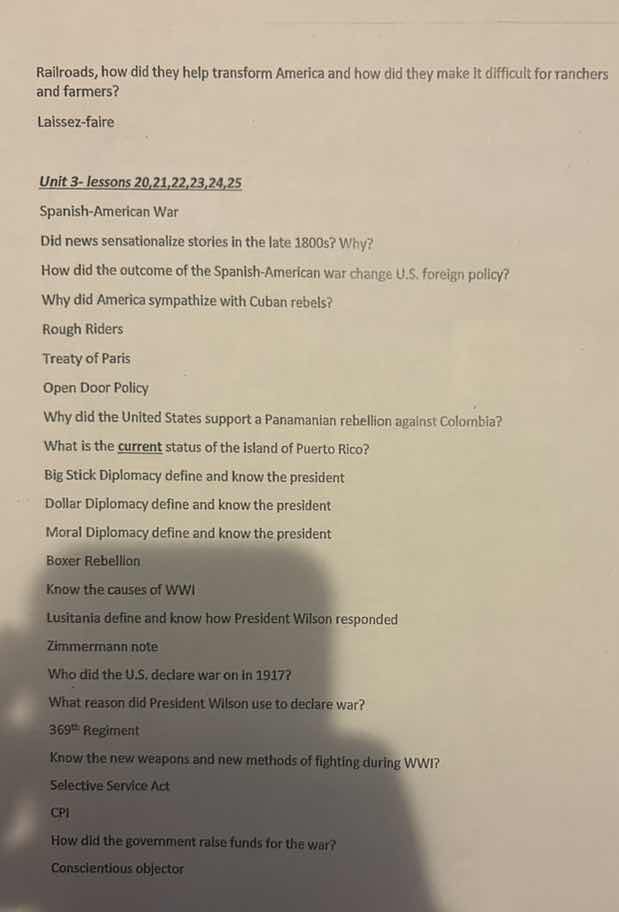
railroads, how did they help transform america and how did they make it difficult for ranchers and farmers?
laissez - faire
unit 3 - lessons 20,21,22,23,24,25
spanish - american war
did news sensationalize stories in the late 1800s? why?
how did the outcome of the spanish - american war change u.s. foreign policy?
why did america sympathize with cuban rebels?
rough riders
treaty of paris
open door policy
why did the united states support a panamanian rebellion against colombia?
what is the current status of the island of puerto rico?
big stick diplomacy define and know the president
dollar diplomacy define and know the president
moral diplomacy define and know the president
boxer rebellion
know the causes of wwi
lusitania define and know how president wilson responded
zimmermann note
who did the u.s. declare war on in 1917?
what reason did president wilson use to declare war?
369th regiment
know the new weapons and new methods of fighting during wwi?
selective service act
cpi
how did the government raise funds for the war?
conscientious objector
These questions are related to historical events and U.S. foreign policy, so the subfield of Social Science - History is the most appropriate. Here are brief explanations and answers for some of the questions:
1. Did news sensationalize stories in the late 1800s? Why?
In the late 1800s, a style of journalism called "yellow journalism" emerged. Newspapers, like those owned by William Randolph Hearst and Joseph Pulitzer, used sensationalism to attract readers. They exaggerated or fabricated stories, especially related to events like the Cuban struggle for independence from Spain, to increase circulation. This sensationalism helped shape public opinion, for example, in favor of U.S. intervention in the Cuban conflict which led to the Spanish - American War.
Before the Spanish - American War, the U.S. had a more isolationist - leaning foreign policy in terms of overseas imperialism. After the war, the U.S. acquired territories like Puerto Rico, Guam, and the Philippines (and had influence over Cuba). This marked a shift towards becoming an imperial power. The U.S. started to play a more active role in global affairs, especially in the Pacific and Caribbean regions. It began to assert its influence through actions like the Open Door Policy in China and using its new - found territories as strategic bases.
There were several reasons. Firstly, the Cuban rebels were fighting against Spanish colonial rule, and the U.S. had a sense of sympathy for those fighting for independence (similar to its own history of fighting for independence from Britain). Secondly, the sensationalist yellow journalism in the U.S. portrayed the Spanish as brutal oppressors in Cuba, which swayed public opinion in favor of the Cuban rebels. Also, there were economic interests at stake, as the U.S. had significant trade and investment in Cuba.

Snap & solve any problem in the app
Get step-by-step solutions on Sovi AI
Photo-based solutions with guided steps
Explore more problems and detailed explanations
Yes, news did sensationalize stories in the late 1800s. This was due to the rise of "yellow journalism" where newspaper publishers like Hearst and Pulitzer exaggerated or fabricated stories (especially related to events like the Cuban independence struggle) to increase circulation and shape public opinion.