QUESTION IMAGE
Question
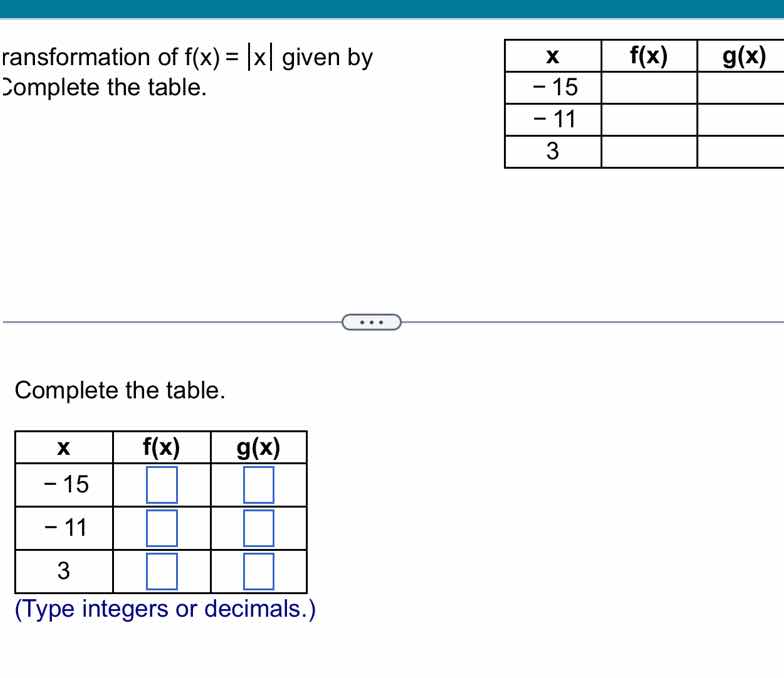
ransformation of f(x) = |x| given by complete the table. complete the table. (type integers or decimals.)
Step1: Recall the function \( f(x) = |x| \)
The absolute value function \( |x| \) gives the non - negative value of \( x \). For any real number \( x \), \( |x|=
\)
Step2: Calculate \( f(x) \) for \( x=- 15\)
Since \( x=-15<0 \), \( f(-15)=|-15|=-(-15) = 15\)
Step3: Calculate \( f(x) \) for \( x = - 11\)
Since \( x=-11<0 \), \( f(-11)=|-11|=-(-11)=11\)
Step4: Calculate \( f(x) \) for \( x = 3\)
Since \( x = 3>0 \), \( f(3)=|3|=3\)
(Note: Since the transformation for \( g(x) \) is not given in the problem, we assume that maybe there is a missing part. But for \( f(x) \) we can fill the values as above. If we assume that maybe \( g(x) \) has the same transformation as \( f(x) \) or some other common transformation, but as the problem is incomplete for \( g(x) \), we will first fill \( f(x) \) values. If we assume \( g(x)=f(x) \) (a common case if transformation is not given), then \( g(x) \) values will be same as \( f(x) \))

Snap & solve any problem in the app
Get step-by-step solutions on Sovi AI
Photo-based solutions with guided steps
Explore more problems and detailed explanations
For \( f(x) \):
- When \( x=-15 \), \( f(-15) = 15\)
- When \( x=-11 \), \( f(-11)=11\)
- When \( x = 3\), \( f(3)=3\)
If we assume \( g(x)=f(x) \) (due to lack of transformation details for \( g(x) \)):
- When \( x=-15 \), \( g(-15)=15\)
- When \( x=-11 \), \( g(-11)=11\)
- When \( x = 3\), \( g(3)=3\)
So the table for \( f(x) \) (and \( g(x) \) assuming \( g(x)=f(x) \)) is:
| \( x \) | \( f(x) \) | \( g(x) \) |
|---|---|---|
| - 11 | 11 | 11 |
| 3 | 3 | 3 |