QUESTION IMAGE
Question
rational and irrational number arithmetic
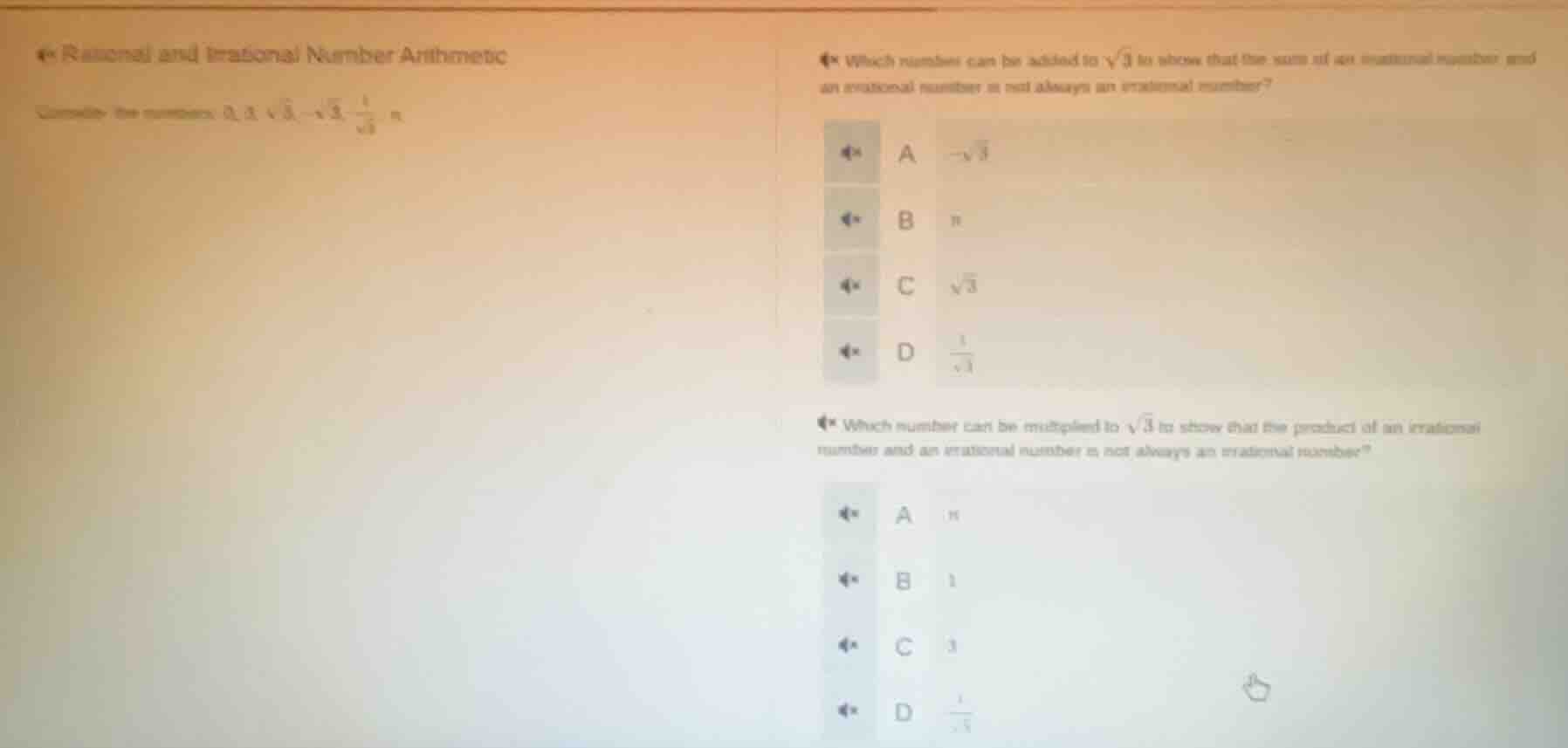
consider the numbers: $0, 3, \sqrt{3}, -\sqrt{3}, \frac{1}{\sqrt{3}}, \pi$
- which number can be added to $\sqrt{3}$ to show that the sum of a rational number and an irrational number is not always an irrational number?
a $-\sqrt{3}$
b $\pi$
c $\sqrt{3}$
d $\frac{1}{\sqrt{3}}$
- which number can be multiplied to $\sqrt{3}$ to show that the product of an irrational number and an irrational number is not always an irrational number?
Step1: Evaluate first question options
We need a number that when added to $\sqrt{3}$ (irrational) gives a rational sum.
- Option A: $\sqrt{3} + (-\sqrt{3}) = 0$, and 0 is rational.
- Option B: $\sqrt{3} + \pi$ is irrational.
- Option C: $\sqrt{3} + \sqrt{3} = 2\sqrt{3}$, irrational.
- Option D: $\sqrt{3} + \frac{1}{\sqrt{3}} = \frac{3 + 1}{\sqrt{3}} = \frac{4}{\sqrt{3}}$, irrational.
Step2: Evaluate second question options
We need a number that when multiplied by $\sqrt{3}$ (irrational) gives a rational product.
- Option A: $\sqrt{3} \times \pi = \pi\sqrt{3}$, irrational.
- Option B: $\sqrt{3} \times 1 = \sqrt{3}$, irrational.
- Option C: $\sqrt{3} \times 3 = 3\sqrt{3}$, irrational.
- Option D: $\sqrt{3} \times \frac{1}{\sqrt{3}} = 1$, and 1 is rational.

Snap & solve any problem in the app
Get step-by-step solutions on Sovi AI
Photo-based solutions with guided steps
Explore more problems and detailed explanations
First question: A. $-\sqrt{3}$
Second question: D. $\frac{1}{\sqrt{3}}$