QUESTION IMAGE
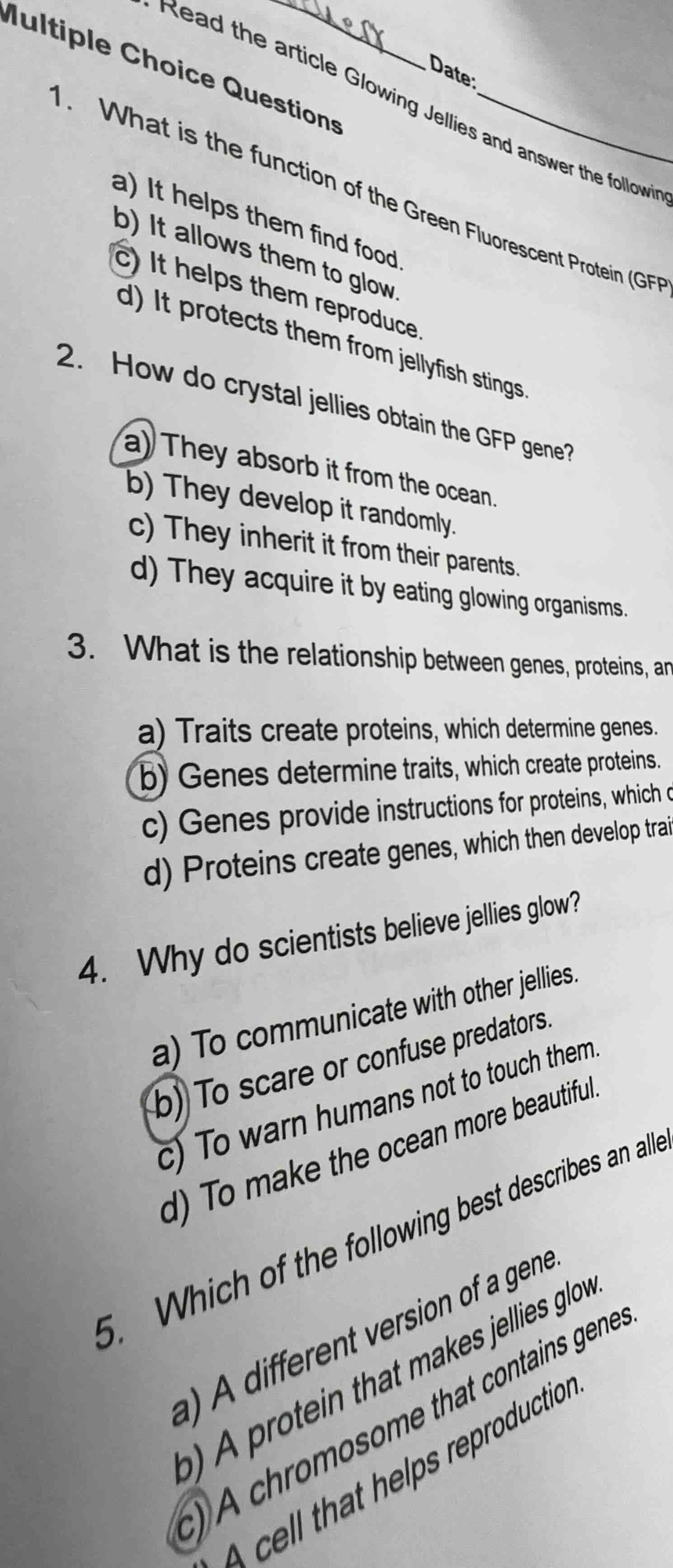
Question
read the article glowing jellies and answer the following multiple choice questions
- what is the function of the green fluorescent protein (gfp)
a) it helps them find food.
b) it allows them to glow.
c) it helps them reproduce.
d) it protects them from jellyfish stings.
- how do crystal jellies obtain the gfp gene?
a) they absorb it from the ocean.
b) they develop it randomly.
c) they inherit it from their parents.
d) they acquire it by eating glowing organisms.
- what is the relationship between genes, proteins,
a) traits create proteins, which determine genes.
b) genes determine traits, which create proteins.
c) genes provide instructions for proteins, which
d) proteins create genes, which then develop trai
- why do scientists believe jellies glow?
a) to communicate with other jellies.
b) to scare or confuse predators.
c) to warn humans not to touch them.
d) to make the ocean more beautiful.
- which of the following best describes an allel
a) a different version of a gene.
b) a protein that makes jellies glow.
c) a chromosome that contains genes.
d) a cell that helps reproduction.
Question 1
The Green Fluorescent Protein (GFP) is known for its role in making organisms glow. Option a is incorrect as GFP isn't directly for finding food. Option c is about reproduction which isn't its function. Option d is about protection from stings which is wrong. So the function of GFP is to allow them to glow.
Crystal jellies inherit the GFP gene from their parents as genes are passed down through heredity. Absorbing from the ocean (a) or developing randomly (b) is incorrect. Acquiring by eating (d) is also wrong as genes are inherited, not gained through eating in this context.
Genes provide instructions for making proteins, and proteins are responsible for traits. Option a has the order wrong (traits don't create proteins to determine genes). Option b's "traits create proteins" is incorrect. Option d (proteins create genes) is wrong. So the correct relationship is genes provide instructions for proteins which relate to traits. (Note: The original option c seems to have a typo but based on knowledge, genes → proteins → traits, so the intended correct option is likely c, but from the marked option in the image, it's b? Wait, no, the marked option in the image for Q3 is b? Wait, no, the user's image shows Q3 with option b marked? Wait, no, the standard biological concept is genes code for proteins, and proteins determine traits. So maybe the options have a typo. But based on the marked option in the image (the circle), it's option b? Wait, no, the user's image: Q3, the marked option is b? Wait, the text in Q3: option b is "Genes determine traits, which create proteins" – that's incorrect. Option c: "Genes provide instructions for proteins, which d..." (probably "which determine traits"). So maybe the intended correct option is c, but the marked one in the image is b? Wait, maybe the image's marking is a mistake, but as per the problem, we have to go with the options. Wait, the user's question is to answer the multiple-choice, so let's re - check. The correct biological concept: Genes (DNA) have the code to make proteins (via transcription and translation), and proteins are the molecules that carry out functions and determine traits. So among the options, option c (even with the typo) is the closest. But in the image, the marked option is b. Wait, maybe the question's options have errors. But assuming we follow the marked option in the image (the circle), but no, the user is asking to answer the questions, not just the marked ones. Wait, the user's problem is to answer the multiple - choice questions. Let's re - evaluate:
Option a: Traits create proteins, which determine genes. Wrong, genes are inherited, traits are a result of proteins.
Option b: Genes determine traits, which create proteins. Wrong, proteins are created from gene instructions, traits are from proteins.
Option c: Genes provide instructions for proteins, which (probably) determine traits. Correct.
Option d: Proteins create genes, which then develop trai (traits). Wrong.
So the correct answer should be c, but in the image, the marked option is b. Maybe a mistake in the image, but based on knowledge, c is correct. However, if we have to go with the options as given, and assuming the typo in c, the answer is c. But the image's marking is on b, which is incorrect. Maybe the question has a mistake. But as an academic expert, we should provide the correct biological answer. So the correct answer is c (assuming the "d" in option c is a typo for "determine traits").

Snap & solve any problem in the app
Get step-by-step solutions on Sovi AI
Photo-based solutions with guided steps
Explore more problems and detailed explanations
b) It allows them to glow.