QUESTION IMAGE
Question
- read: discussion background
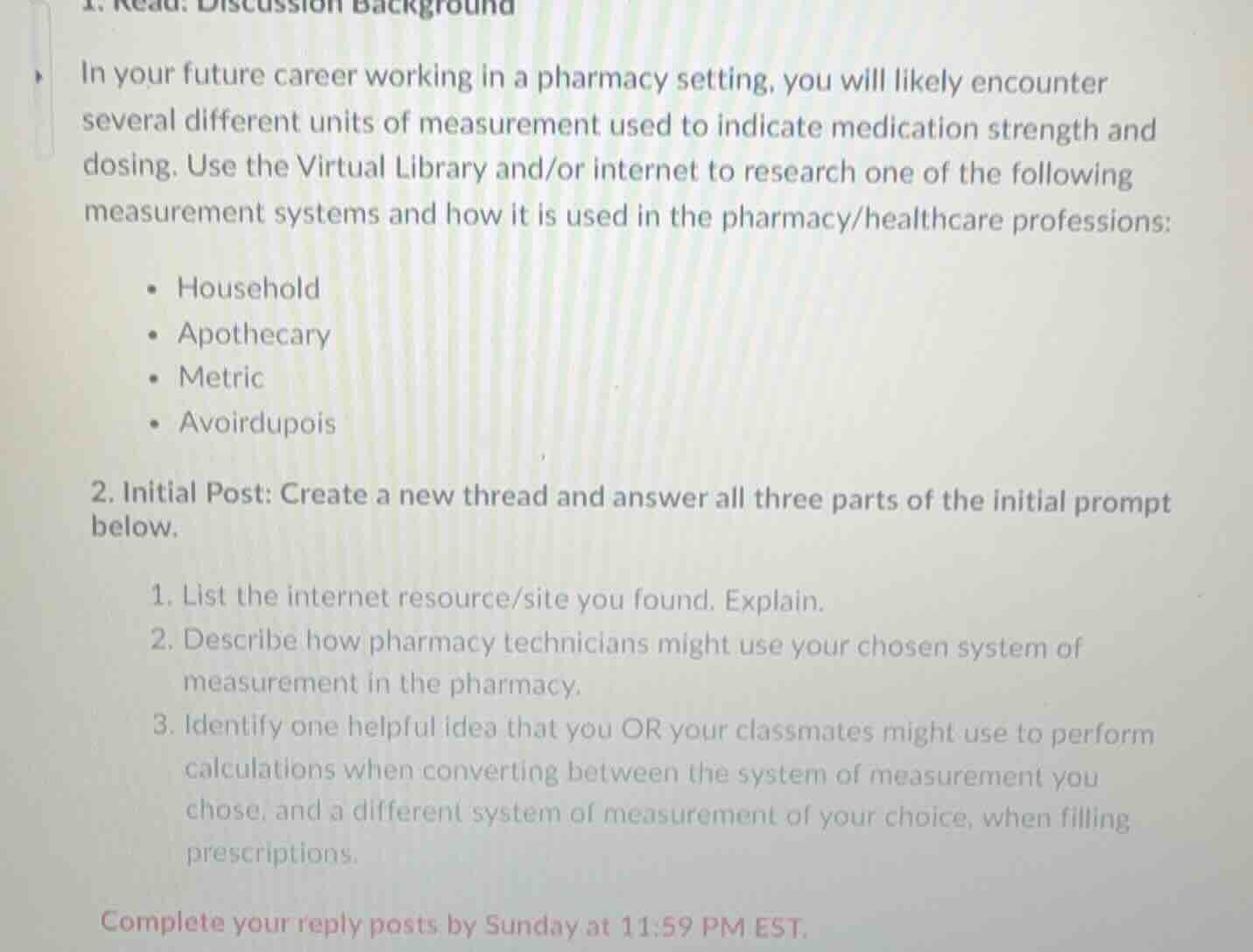
in your future career working in a pharmacy setting, you will likely encounter several different units of measurement used to indicate medication strength and dosing. use the virtual library and/or internet to research one of the following measurement systems and how it is used in the pharmacy/healthcare professions:
- household
- apothecary
- metric
- avoirdupois
- initial post: create a new thread and answer all three parts of the initial prompt below.
- list the internet resource/site you found. explain.
- describe how pharmacy technicians might use your chosen system of measurement in the pharmacy.
- identify one helpful idea that you or your classmates might use to perform calculations when converting between the system of measurement you chose, and a different system of measurement of your choice, when filling prescriptions.
complete your reply posts by sunday at 11:59 pm est.
The problem here is about researching a measurement system used in pharmacy/healthcare and answering related questions. Let's choose the Metric system as an example to answer the three parts:
1. Internet Resource/Site
I found the website of the National Institute of Standards and Technology (NIST) at https://www.nist.gov/. This site provides detailed information about the metric system, its units, and how it is used in various professional fields including healthcare. It has resources on unit conversions, the importance of the metric system in ensuring accuracy in medical dosages, and standards related to measurements which are crucial for pharmacy technicians to ensure patient safety and correct medication dispensing.
2. Use of the Metric System by Pharmacy Technicians
Pharmacy technicians use the metric system extensively in a pharmacy. For example, when measuring the volume of liquid medications like syrups or injectables, they use liters (L) and milliliters (mL). For solid medications such as tablets or capsules, they use grams (g) and milligrams (mg) to measure the mass of the active ingredient. When compounding medications (preparing customized medications), they need to accurately measure ingredients using metric units to ensure the correct strength of the medication. Also, when reading prescriptions, most prescriptions for medications (especially in a global context and in scientific medical practice) use metric units, so technicians must be proficient in interpreting and using these units to dispense the right amount of medication to patients.
3. Helpful Idea for Conversion
A helpful idea for converting between the metric system and the household system (for example) when filling prescriptions is to use a conversion chart or a mobile app that has pre - defined conversion factors. For instance, knowing that 1 teaspoon (a common household unit for liquid medications) is approximately equal to 5 milliliters (metric unit). So, if a prescription says to take 10 mL of a liquid medication, and the patient is more familiar with teaspoons, the technician can tell the patient that 10 mL is equal to 2 teaspoons (since 10 mL $\div$ 5 mL per teaspoon = 2 teaspoons). Having a quick - reference conversion chart at the pharmacy workstation or using a reliable conversion app can help in quickly and accurately converting between systems, reducing the chance of errors when communicating dosage instructions to patients or when converting units during the dispensing process.

Snap & solve any problem in the app
Get step-by-step solutions on Sovi AI
Photo-based solutions with guided steps
Explore more problems and detailed explanations
The problem here is about researching a measurement system used in pharmacy/healthcare and answering related questions. Let's choose the Metric system as an example to answer the three parts:
1. Internet Resource/Site
I found the website of the National Institute of Standards and Technology (NIST) at https://www.nist.gov/. This site provides detailed information about the metric system, its units, and how it is used in various professional fields including healthcare. It has resources on unit conversions, the importance of the metric system in ensuring accuracy in medical dosages, and standards related to measurements which are crucial for pharmacy technicians to ensure patient safety and correct medication dispensing.
2. Use of the Metric System by Pharmacy Technicians
Pharmacy technicians use the metric system extensively in a pharmacy. For example, when measuring the volume of liquid medications like syrups or injectables, they use liters (L) and milliliters (mL). For solid medications such as tablets or capsules, they use grams (g) and milligrams (mg) to measure the mass of the active ingredient. When compounding medications (preparing customized medications), they need to accurately measure ingredients using metric units to ensure the correct strength of the medication. Also, when reading prescriptions, most prescriptions for medications (especially in a global context and in scientific medical practice) use metric units, so technicians must be proficient in interpreting and using these units to dispense the right amount of medication to patients.
3. Helpful Idea for Conversion
A helpful idea for converting between the metric system and the household system (for example) when filling prescriptions is to use a conversion chart or a mobile app that has pre - defined conversion factors. For instance, knowing that 1 teaspoon (a common household unit for liquid medications) is approximately equal to 5 milliliters (metric unit). So, if a prescription says to take 10 mL of a liquid medication, and the patient is more familiar with teaspoons, the technician can tell the patient that 10 mL is equal to 2 teaspoons (since 10 mL $\div$ 5 mL per teaspoon = 2 teaspoons). Having a quick - reference conversion chart at the pharmacy workstation or using a reliable conversion app can help in quickly and accurately converting between systems, reducing the chance of errors when communicating dosage instructions to patients or when converting units during the dispensing process.