QUESTION IMAGE
Question
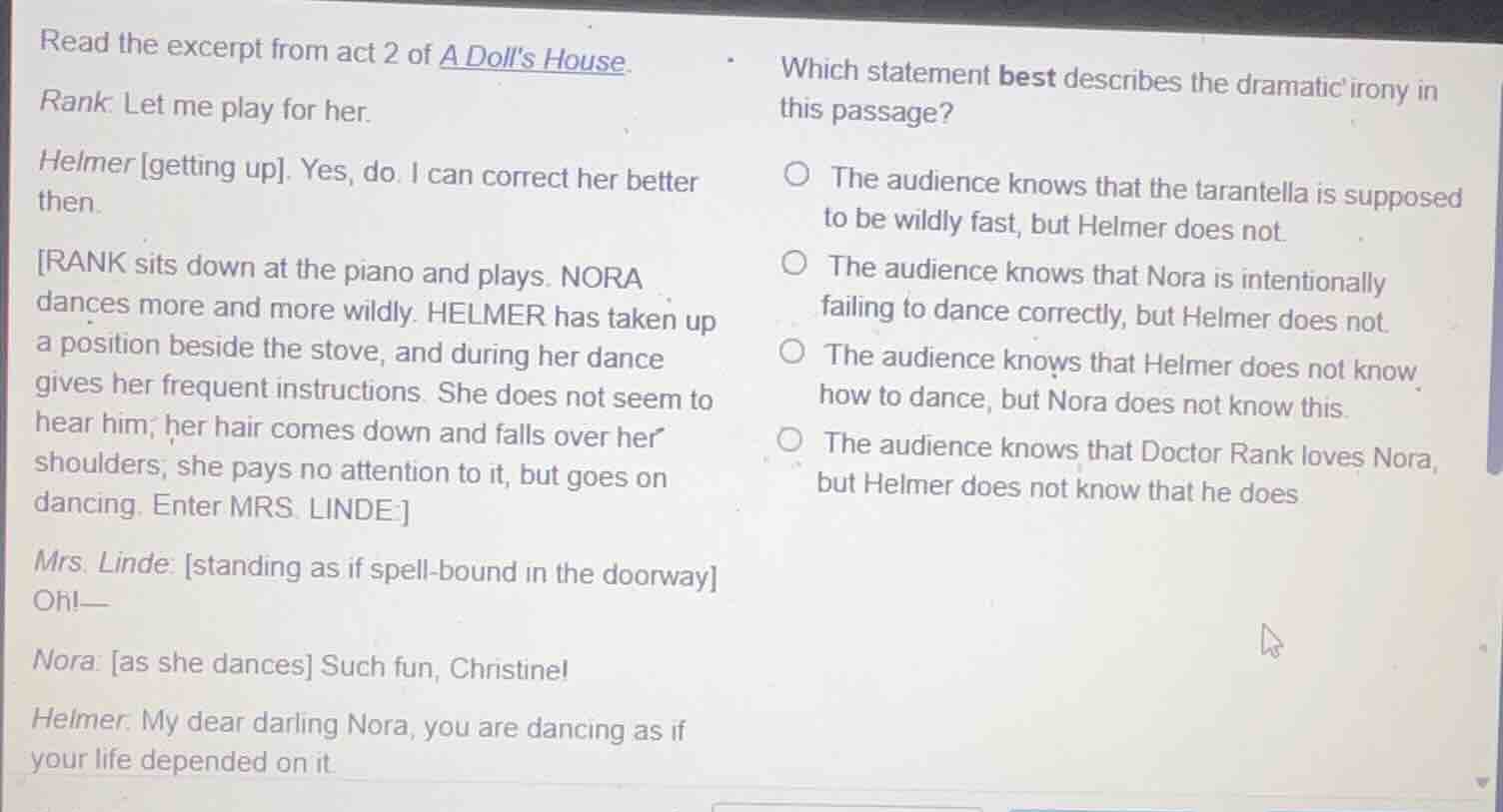
read the excerpt from act 2 of a dolls house.
rank: let me play for her.
helmer getting up. yes, do. i can correct her better then.
rank sits down at the piano and plays. nora dances more and more wildly. helmer has taken up a position beside the stove, and during her dance gives her frequent instructions. she does not seem to hear him; her hair comes down and falls over her shoulders; she pays no attention to it, but goes on dancing. enter mrs. linde.
mrs. linde: standing as if spell - bound in the doorway oh!—
nora: as she dances such fun, christine!
helmer: my dear darling nora, you are dancing as if your life depended on it
which statement best describes the dramatic irony in this passage?
○ the audience knows that the tarantella is supposed to be wildly fast, but helmer does not.
○ the audience knows that nora is intentionally failing to dance correctly, but helmer does not.
○ the audience knows that helmer does not know how to dance, but nora does not know this.
○ the audience knows that doctor rank loves nora, but helmer does not know that he does
Dramatic irony occurs when the audience knows key information that a character does not. In this excerpt from A Doll's House, Nora's wild, unresponsive dancing is a deliberate act (to distract Helmer from a looming crisis), but Helmer only sees her as dancing poorly and tries to correct her. The audience recognizes her intentional failure, while Helmer does not. The other options are incorrect: the tarantella's speed is not the core irony, Helmer's dancing ability is not relevant, and Rank's love is not the focus of this specific scene's irony.

Snap & solve any problem in the app
Get step-by-step solutions on Sovi AI
Photo-based solutions with guided steps
Explore more problems and detailed explanations
The audience knows that Nora is intentionally failing to dance correctly, but Helmer does not.