QUESTION IMAGE
Question
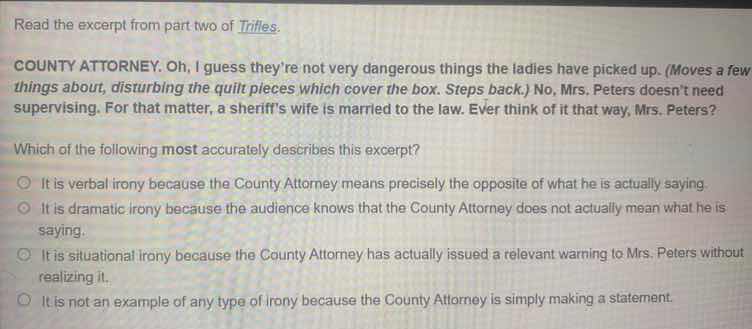
read the excerpt from part two of trifles.
county attorney. oh, i guess theyre not very dangerous things the ladies have picked up. (moves a few things about, disturbing the quilt pieces which cover the box. steps back.) no, mrs. peters doesnt need supervising. for that matter, a sheriffs wife is married to the law. ever think of it that way, mrs. peters?
which of the following most accurately describes this excerpt?
it is verbal irony because the county attorney means precisely the opposite of what he is actually saying.
it is dramatic irony because the audience knows that the county attorney does not actually mean what he is saying.
it is situational irony because the county attorney has actually issued a relevant warning to mrs. peters without realizing it.
it is not an example of any type of irony because the county attorney is simply making a statement.
First, recall the types of irony:
- Verbal irony is when a speaker says the opposite of what they mean intentionally.
- Dramatic irony is when the audience knows more than the characters, creating tension as the character's words/acts have unintended meaning.
- Situational irony is when the outcome is the opposite of what is expected.
In Trifles, the audience knows the quilt pieces cover evidence related to the crime, while the County Attorney dismisses the women's findings as trivial. He does not realize the significance of his comment about the sheriff's wife being "married to the law" and the women's access to critical evidence, but the audience does. This matches the definition of dramatic irony.

Snap & solve any problem in the app
Get step-by-step solutions on Sovi AI
Photo-based solutions with guided steps
Explore more problems and detailed explanations
B. It is dramatic irony because the audience knows that the County Attorney does not actually mean what he is saying.