QUESTION IMAGE
Question
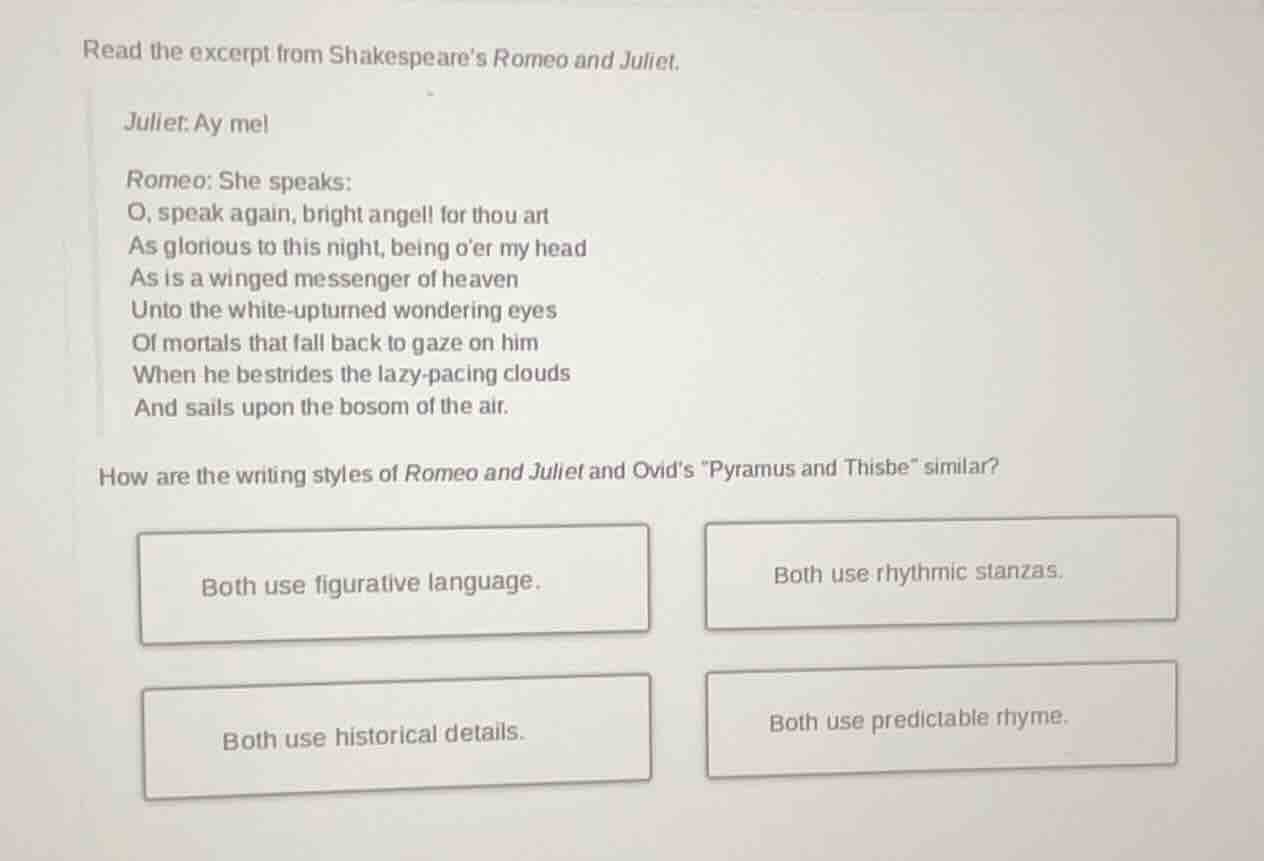
read the excerpt from shakespeare’s romeo and juliet.
juliet: ay me!
romeo: she speaks:
o, speak again, bright angel! for thou art
as glorious to this night, being o’er my head
as is a winged messenger of heaven
unto the white-upturned wondering eyes
of mortals that fall back to gaze on him
when he bestrides the lazy-pacing clouds
and sails upon the bosom of the air.
how are the writing styles of romeo and juliet and ovid’s “pyramus and thisbe” similar?
both use figurative language.
both use rhythmic stanzas.
both use historical details.
both use predictable rhyme.
To determine the similar writing style, we analyze each option:
- "Both use rhythmic stanzas": "Romeo and Juliet" uses blank verse (not stanzas with a set rhythm like typical stanzas), and "Pyramus and Thisbe" (from Ovid's Metamorphoses, often in narrative form) doesn't rely on rhythmic stanzas. Eliminate this.
- "Both use historical details": "Romeo and Juliet" is a fictional love story, and "Pyramus and Thisbe" is a myth; neither focuses on historical details. Eliminate this.
- "Both use predictable rhyme": "Romeo and Juliet" uses blank verse (no predictable rhyme scheme), and "Pyramus and Thisbe" in its common translations or original form doesn't have a predictable rhyme. Eliminate this.
- "Both use figurative language": In the excerpt, Romeo uses metaphors (e.g., "bright angel", "winged messenger of heaven") and personification ("sails upon the bosom of the air"). "Pyramus and Thisbe" also uses figurative language (e.g., descriptions of their love, the wall as a character). So this is correct.

Snap & solve any problem in the app
Get step-by-step solutions on Sovi AI
Photo-based solutions with guided steps
Explore more problems and detailed explanations
A. Both use figurative language.