QUESTION IMAGE
Question
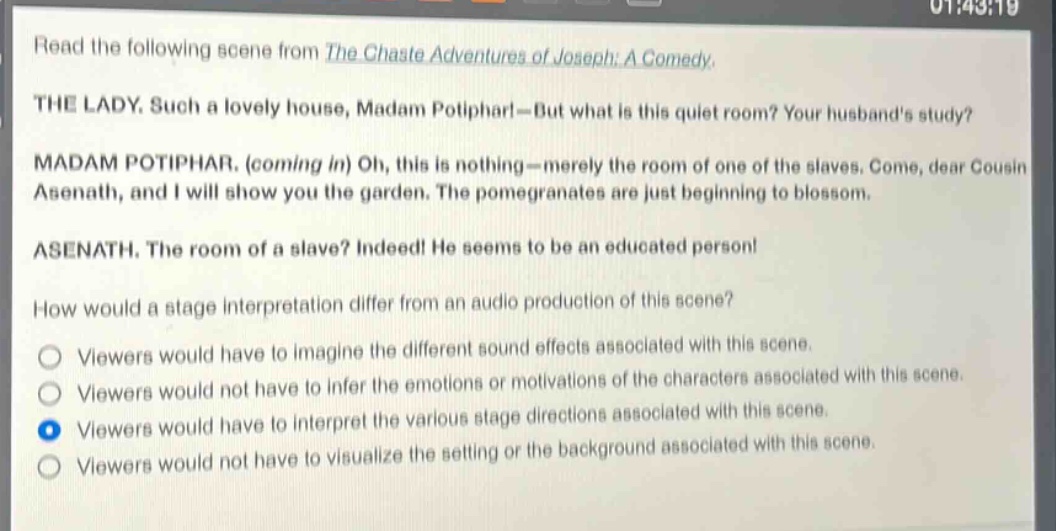
read the following scene from the chaate adventures of joseph: a comedy. the lady. such a lovely house, madam potipharl—but what is this quiet room? your husbands study? madam potiphar. (coming in) oh, this is nothing—merely the room of one of the slaves. come, dear cousin asenath, and i will show you the garden. the pomegranates are just beginning to blossom. asenath. the room of a slave? indeed! he seems to be an educated person! how would a stage interpretation differ from an audio production of this scene? viewers would have to imagine the different sound effects associated with this scene. viewers would not have to infer the emotions or motivations of the characters associated with this scene. viewers would have to interpret the various stage directions associated with this scene. viewers would not have to visualize the setting or the background associated with this scene.
- Analyze Option 1: In an audio production, sound effects are provided, while in a stage interpretation, viewers might not have to imagine sound effects as much (or the other way around? Wait, no—wait, the question is how stage differs from audio. In audio, you hear sound effects; in stage, you see actions but might not have the same audio cues, but the first option says viewers would have to imagine sound effects in stage—actually, in audio, you rely on sound, in stage, you see visuals. Wait, no, let's re-examine.
- Analyze Option 2: In both stage and audio, viewers need to infer emotions (stage through acting, audio through voice acting), so this is incorrect.
- Analyze Option 3: Wait, the selected option in the image is the fourth? No, the user's image shows a blue dot on the fourth? Wait no, the options are:
- Option 1: Viewers would have to imagine the different sound effects associated with this scene. (In audio, sound effects are present; in stage, you see the scene, so maybe in stage, you don't have to imagine sound effects as much? No, maybe the other way. Wait, no—let's think about stage vs audio.
- Stage interpretation: uses visuals (sets, actors' movements, stage directions acted out), audio production: uses sound (voices, sound effects, maybe music).
- Option 4: "Viewers would not have to visualize the setting or the background associated with this scene." Wait, no—stage has visual setting, audio doesn't. So in stage, you see the setting, so you don't have to visualize it (since it's there). In audio, you have to imagine the setting. So this option is correct? Wait, no, the option says "Viewers would not have to visualize..."—in stage, the setting is visible, so viewers don't have to visualize it (they see it). In audio, they have to imagine it. So this option is correct. Wait, but let's check the other options again.
- Wait, the original question: How would a stage interpretation differ from an audio production?
- Let's re-express each option:
- Option 1: Viewers would have to imagine sound effects in stage. But in stage, there are sound effects (maybe), but in audio, sound effects are more prominent. So in stage, you see the action, so maybe you don't have to imagine sound effects as much? No, maybe the opposite. Wait, maybe I got it wrong. Let's think again.
- Option 2: Viewers would not have to infer emotions in stage. But in stage, you infer emotions from acting; in audio, from voice. So this is wrong.
- Option 3: Wait, the third option (if there are four) – wait the options are:
- Viewers would have to imagine the different sound effects associated with this scene. (In audio, sound effects are provided; in stage, you see the scene, so maybe in stage, you don't have to imagine sound effects because you see the action. So this is incorrect, because in stage, you might have sound effects too, but maybe the option is wrong.
- Viewers would not have to infer the emotions or motivations... – in both, you do, so wrong.
- (Wait, the options as per the image: let's list them again from the image:
- Option 1: Viewers would have to imagine the different sound effects...
- Option 2: Viewers would not have to infer emotions...
- Option 3: (Wait, the third option in the image? Wait the user's image shows four options:
- Viewers would have to imagine the different sound effects associated with this scene.
- Viewers would not have to infer the emotions or motivations of the characters...
- (Wait, the third option…

Snap & solve any problem in the app
Get step-by-step solutions on Sovi AI
Photo-based solutions with guided steps
Explore more problems and detailed explanations
D. Viewers would not have to visualize the setting or the background associated with this scene.