QUESTION IMAGE
Question
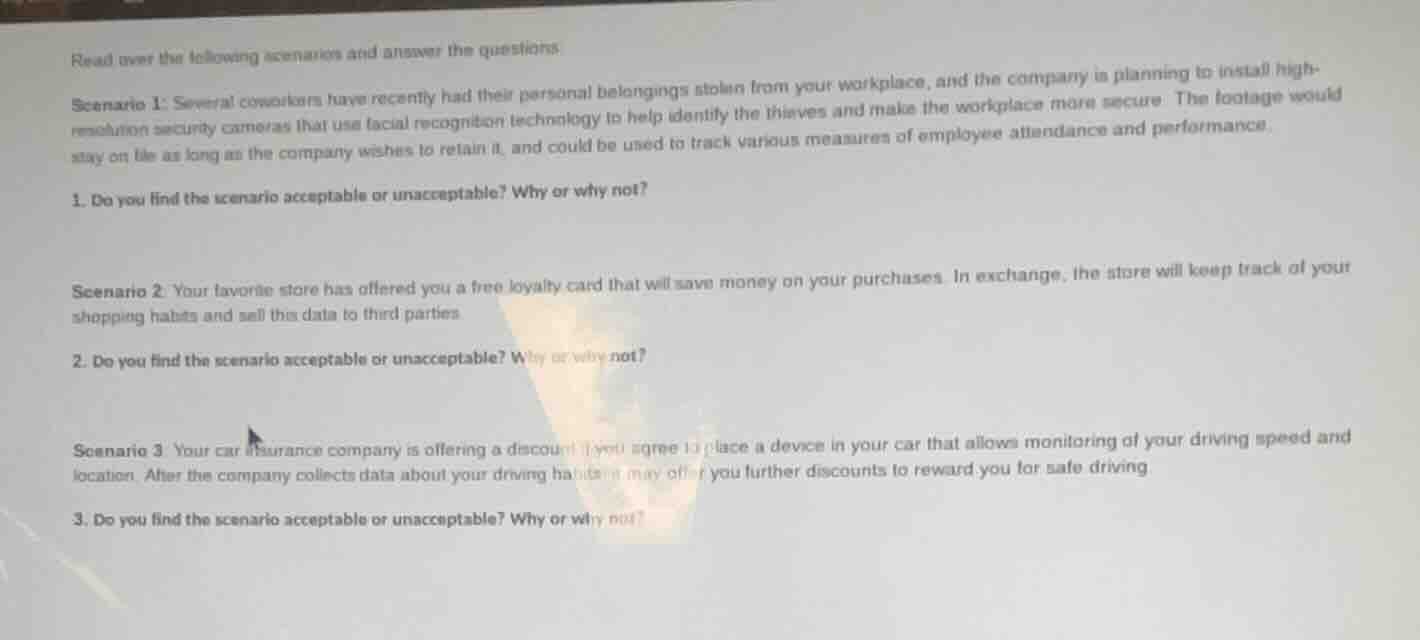
read over the following scenarios and answer the questions:
scenario 1: several coworkers have recently had their personal belongings stolen from your workplace, and the company is planning to install high - resolution security cameras that use facial recognition technology to help identify the thieves and make the workplace more secure. the footage would stay on file as long as the company wishes to retain it, and could be used to track various measures of employee attendance and performance.
- do you find the scenario acceptable or unacceptable? why or why not?
scenario 2: your favorite store has offered you a free loyalty card that will save money on your purchases. in exchange, the store will keep track of your shopping habits and sell this data to third parties.
- do you find the scenario acceptable or unacceptable? why or why not?
scenario 3: your car insurance company is offering a discount if you agree to place a device in your car that allows monitoring of your driving speed and location. after the company collects data about your driving habits, it may offer you further discounts to reward you for safe driving.
- do you find the scenario acceptable or unacceptable? why or why not?
Scenario 1
This scenario involves workplace surveillance with facial recognition. Acceptability depends on balancing security and privacy. If the company is transparent about data use (only for security, limited retention, no misuse for employee monitoring beyond security), it could be acceptable. But if it's used to overly monitor employees (tracking attendance/performance without consent, long - term data storage), it's unacceptable as it invades privacy. For example, if the footage is only used to identify thieves and not for unfair employee evaluation, it has merit for security. But if it's a guise to micromanage employees, it's wrong.
The store is offering a loyalty card but will sell shopping habit data to third parties. Acceptability depends on consent and transparency. If the store is transparent about selling data and the customer consents (knowing what data is sold, to whom, and the customer still finds the discount worth it), it could be acceptable. But if the store does not fully disclose the data - selling practice (deceiving the customer), it's unacceptable as it violates the customer's right to know how their data is used and can lead to unwanted marketing or privacy violations for the customer.
The insurance company offers a discount for a device that monitors driving. Acceptability depends on consent, data use, and benefit. If the company is transparent about data use (only for safe - driving rewards, no misuse of location/speed data), and the driver consents (finds the discount worth the monitoring), it can be acceptable. But if the company misuses the data (e.g., shares it with non - related parties, uses it to unfairly increase rates later), or does not disclose all data - use details, it's unacceptable as it invades the driver's privacy. Also, the driver gets a financial benefit (discounts) for safe driving, which can be seen as a positive incentive.

Snap & solve any problem in the app
Get step-by-step solutions on Sovi AI
Photo-based solutions with guided steps
Explore more problems and detailed explanations
- Acceptable (if used properly): If the company uses the cameras only for security (identifying thieves) and is transparent about not misusing the footage for unfair employee monitoring, it can be acceptable as it protects employees' belongings.
- Unacceptable (if misused): If the company uses the footage to overly monitor or unfairly evaluate employees (tracking attendance/performance without proper consent or justification), it is unacceptable as it invades employee privacy and can create a hostile work environment.