QUESTION IMAGE
Question
- read paragraph 4.
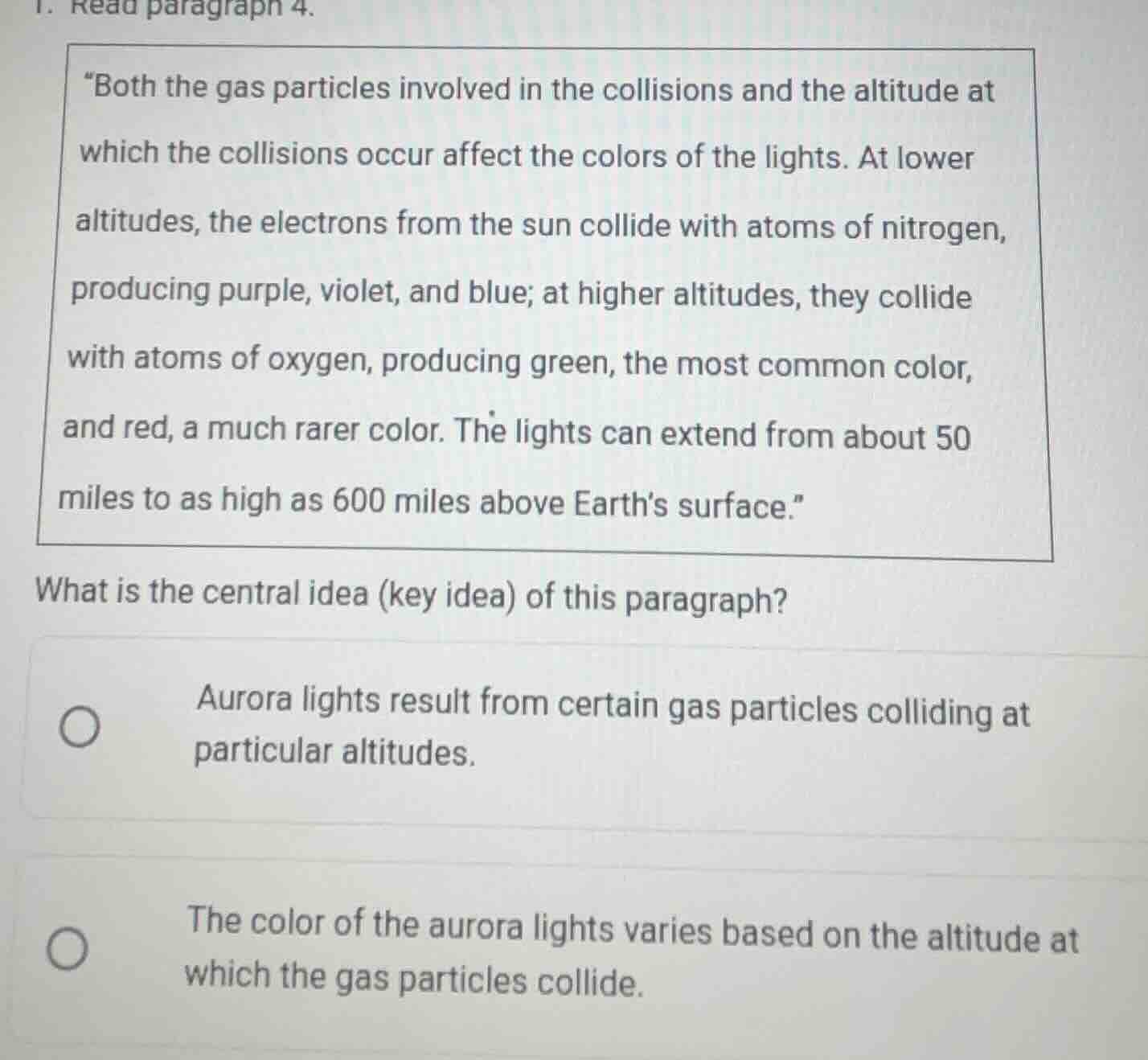
\both the gas particles involved in the collisions and the altitude at which the collisions occur affect the colors of the lights. at lower altitudes, the electrons from the sun collide with atoms of nitrogen, producing purple, violet, and blue; at higher altitudes, they collide with atoms of oxygen, producing green, the most common color, and red, a much rarer color. the lights can extend from about 50 miles to as high as 600 miles above earth’s surface.\
what is the central idea (key idea) of this paragraph?
○ aurora lights result from certain gas particles colliding at particular altitudes.
○ the color of the aurora lights varies based on the altitude at which the gas particles collide.
The paragraph opens by stating that gas particles and collision altitude affect aurora colors, then details how lower altitudes (nitrogen collisions) create purple/violet/blue, while higher altitudes (oxygen collisions) create green/red, plus the altitude range. The core focus is linking altitude (and corresponding particle collisions) to the varying colors of the lights. The first option only mentions the origin, not the key detail about color variation tied to altitude.

Snap & solve any problem in the app
Get step-by-step solutions on Sovi AI
Photo-based solutions with guided steps
Explore more problems and detailed explanations
The color of the aurora lights varies based on the altitude at which the gas particles collide.