QUESTION IMAGE
Question
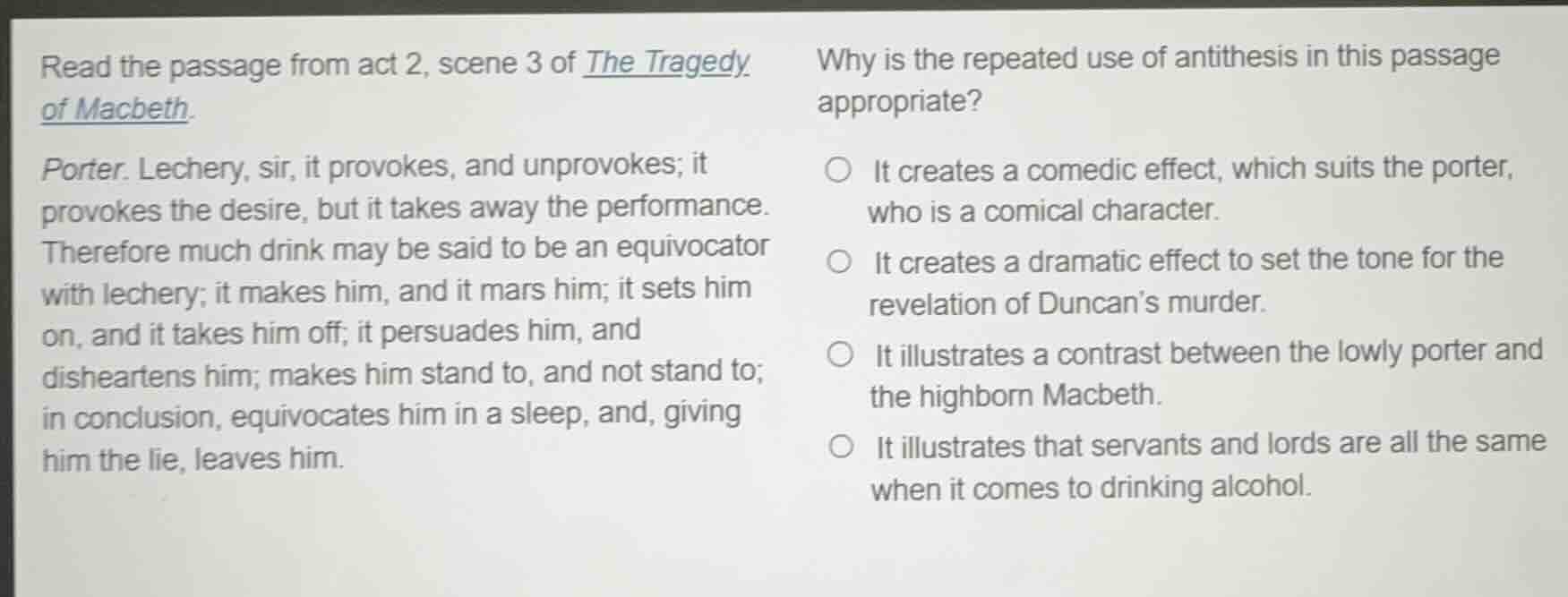
read the passage from act 2, scene 3 of the tragedy of macbeth.
porter. lechery, sir, it provokes, and unprovokes; it provokes the desire, but it takes away the performance. therefore much drink may be said to be an equivocator with lechery; it makes him, and it mars him; it sets him on, and it takes him off; it persuades him, and disheartens him; makes him stand to, and not stand to; in conclusion, equivocates him in a sleep, and, giving him the lie, leaves him.
why is the repeated use of antithesis in this passage appropriate?
○ it creates a comedic effect, which suits the porter, who is a comical character.
○ it creates a dramatic effect to set the tone for the revelation of duncans murder.
○ it illustrates a contrast between the lowly porter and the highborn macbeth.
○ it illustrates that servants and lords are all the same when it comes to drinking alcohol.
The porter's speech uses antithesis (contrasting pairs like "provokes, and unprovokes") to create dark comedy, which fits his role as a comedic, earthy character who provides brief, light relief amid the play's intense tragedy. The other options are incorrect: the passage precedes Duncan's murder reveal but its tone is comedic, not dramatic setup; it does not contrast the porter and Macbeth directly; nor does it equate servants and lords.

Snap & solve any problem in the app
Get step-by-step solutions on Sovi AI
Photo-based solutions with guided steps
Explore more problems and detailed explanations
A. It creates a comedic effect, which suits the porter, who is a comical character.