QUESTION IMAGE
Question
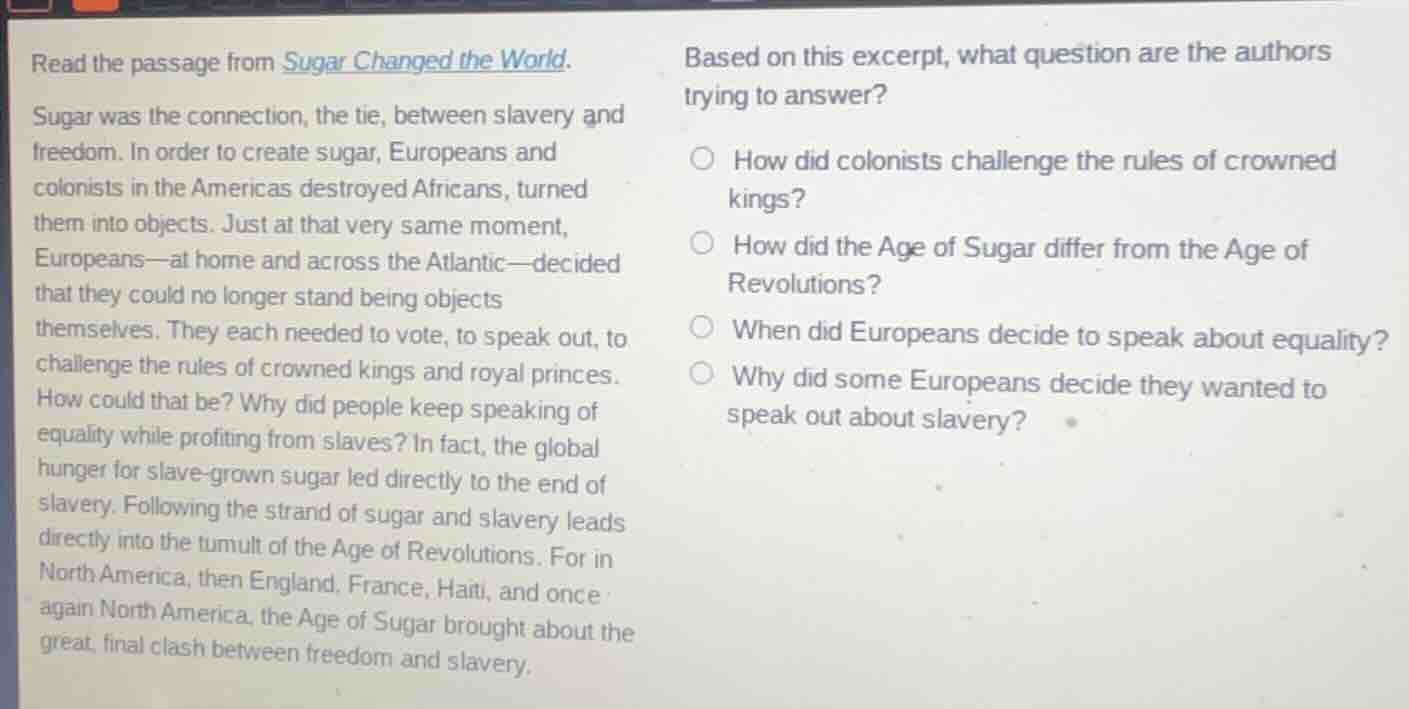
read the passage from sugar changed the world. sugar was the connection, the tie, between slavery and freedom. in order to create sugar, europeans and colonists in the americas destroyed africans, turned them into objects. just at that very same moment, europeans—at home and across the atlantic—decided that they could no longer stand being objects themselves. they each needed to vote, to speak out, to challenge the rules of crowned kings and royal princes. how could that be? why did people keep speaking of equality while profiting from slaves? in fact, the global hunger for slave - grown sugar led directly to the end of slavery. following the strand of sugar and slavery leads directly into the tumult of the age of revolutions. for in north america, then england, france, haiti, and once again north america, the age of sugar brought about the great, final clash between freedom and slavery. based on this excerpt, what question are the authors trying to answer? ○ how did colonists challenge the rules of crowned kings? ○ how did the age of sugar differ from the age of revolutions? ○ when did europeans decide to speak about equality? ○ why did some europeans decide they wanted to speak out about slavery?
- Analyze Option A: The passage focuses on sugar, slavery, and freedom, not colonists challenging kings' rules directly. Eliminate A.
- Analyze Option B: The passage doesn't compare the Age of Sugar and Age of Revolutions in terms of differences. Eliminate B.
- Analyze Option C: The passage is about why people spoke of equality while profiting from slaves, not when Europeans decided to speak about equality. Eliminate C.
- Analyze Option D: The passage discusses the contradiction of Europeans wanting freedom while profiting from slavery (due to sugar), and why they might speak out about slavery. This matches the question in the option.

Snap & solve any problem in the app
Get step-by-step solutions on Sovi AI
Photo-based solutions with guided steps
Explore more problems and detailed explanations
D. Why did some Europeans decide they wanted to speak out about slavery?