QUESTION IMAGE
Question
- read the passage.
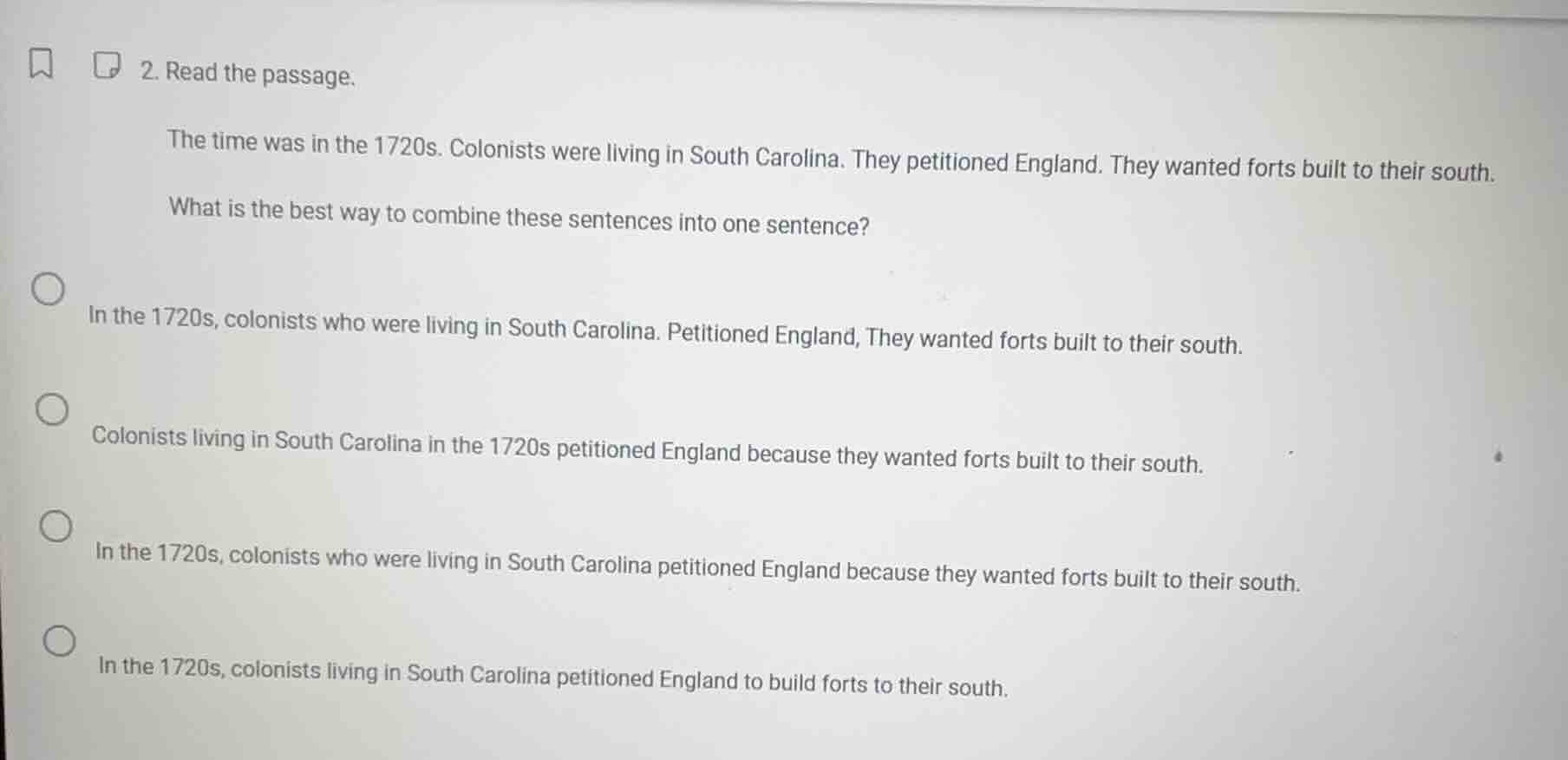
the time was in the 1720s. colonists were living in south carolina. they petitioned england. they wanted forts built to their south.
what is the best way to combine these sentences into one sentence?
in the 1720s, colonists who were living in south carolina. petitioned england, they wanted forts built to their south.
colonists living in south carolina in the 1720s petitioned england because they wanted forts built to their south.
in the 1720s, colonists who were living in south carolina petitioned england because they wanted forts built to their south.
in the 1720s, colonists living in south carolina petitioned england to build forts to their south.
To combine the sentences, we need a grammatically correct, concise sentence that conveys all the information: time (1720s), who (colonists in South Carolina), action (petitioned England), and purpose (forts built to their south). Let's analyze each option:
- First option: Has sentence fragments ("colonists who were living in South Carolina." is a fragment, and "Petitioned England, They wanted..." is incorrect structure).
- Second option: Conveys the info but uses "because" which is slightly less concise than a structure showing the purpose directly as a request.
- Third option: Correct but a bit wordy with "who were living".
- Fourth option: Is concise, grammatically correct, and clearly conveys all the details: In the 1720s, colonists living in South Carolina petitioned England to build forts to their south. It uses a participial phrase "living in South Carolina" for conciseness and "to build forts..." to show the purpose directly, which is the most efficient way to combine the sentences.

Snap & solve any problem in the app
Get step-by-step solutions on Sovi AI
Photo-based solutions with guided steps
Explore more problems and detailed explanations
D. In the 1720s, colonists living in South Carolina petitioned England to build forts to their south.