QUESTION IMAGE
Question
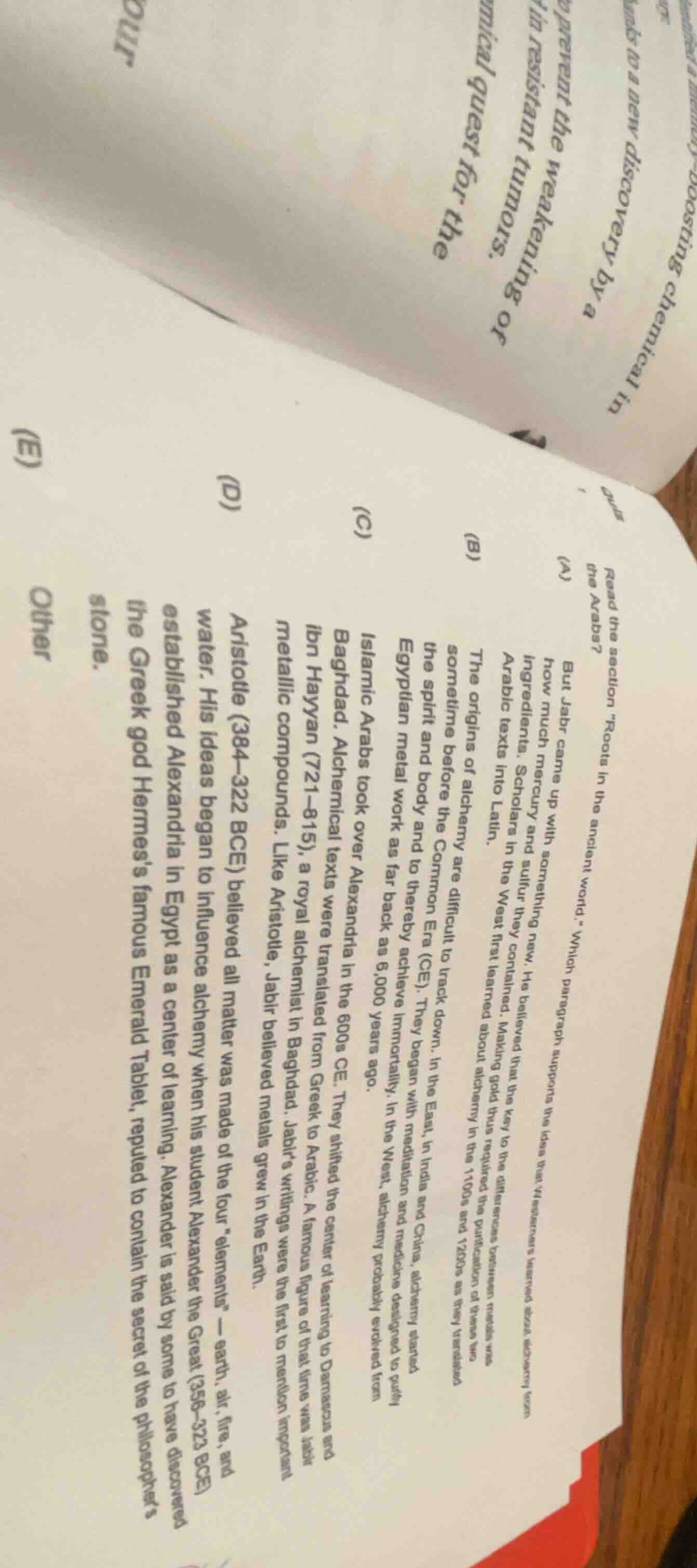
read the section “roots in the ancient world.” which paragraph supports the idea that alchemists learned about alchemy from the arabs? (a) but jabir came up with something new. he believed that the key to the differences between metals was ingredients. scholars in the west first learned about alchemy in the 1100s and 1200s as they translated arabic texts into latin. the origins of alchemy are difficult to track down. sometime before the common era (ce), in the east, in india and china, alchemy started the spirit and body and to thereby achieve immortality. in the west, alchemy probably evolved from egyptian metal work as far back as 8,000 years ago. (b) islamic arabs took over alexandria in the 600s ce. they shifted the center of learning to damascus and baghdad. alchemical texts were translated from greek to arabic. a famous figure of that time was jabir ibn hayyan (721–815), a royal alchemist in baghdad. jabir’s writings were the first to mention important metallic compounds. like aristotle, jabir believed metals grew in the earth. (c) aristotle (384–322 bce) believed all matter was made of the four “elements” — earth, air, fire, and water. his ideas began to influence alchemy when his student alexander the great (356–323 bce) established alexandria in egypt as a center of learning. alexander is said by some to have discovered the greek god hermes’s famous emerald tablet, reputed to contain the secret of the philosopher’s stone. (d) other
The question asks which paragraph supports that Westerners learned alchemy from Arabs. Paragraph (A) states Western scholars learned about alchemy in the 1100s-1200s by translating Arabic texts into Latin, which directly links Western alchemy learning to Arab sources.

Snap & solve any problem in the app
Get step-by-step solutions on Sovi AI
Photo-based solutions with guided steps
Explore more problems and detailed explanations
(A) But Jabir came up with something new. He believed that the key to the differences between metals was how much mercury and sulfur they contained. Making gold thus required the purification of these two ingredients. Scholars in the West first learned about alchemy in the 1100s and 1200s as they translated Arabic texts into Latin.